
00:08
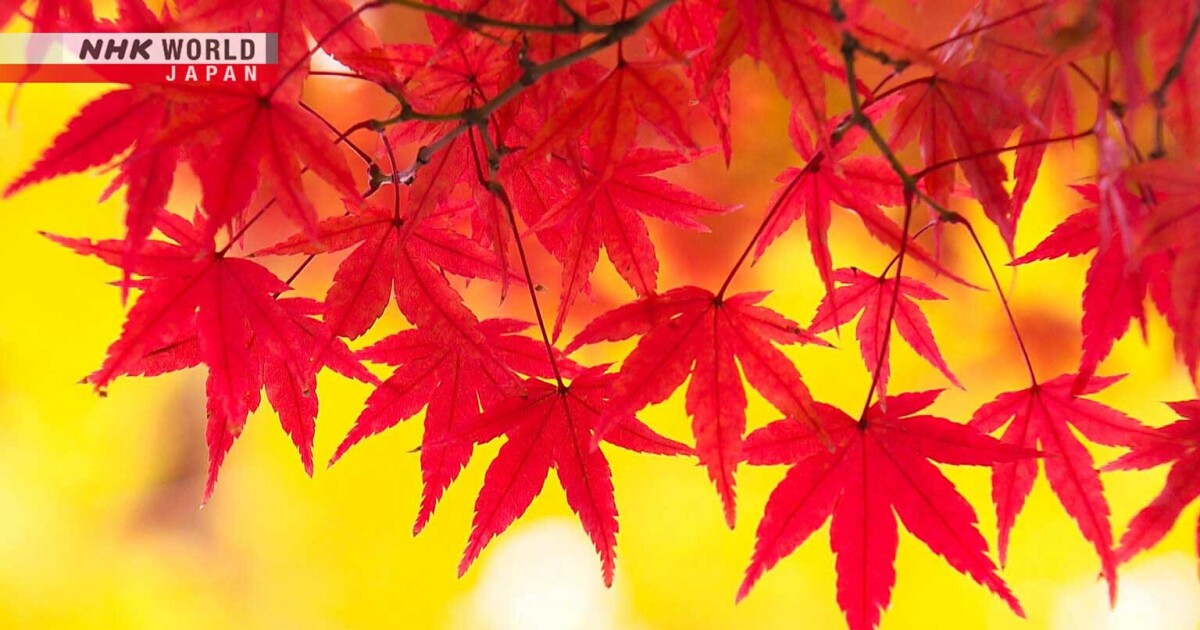
Summer turns to fall, the days become chillier, and the mountains are ablaze with color.
00:23
Kyotoites have always placed value on the change of the seasons,
00:26
and come late November, all attention turns to the fall foliage.
00:40
Saga-Arashiyama is one of Kyoto’s premier sightseeing locations.
00:46
It has been a favored spot to view the foliage since Kyoto became the capital a millennium ago.
00:56
Deciduous trees turn reds and yellows, and their leaves wither as winter approaches.
01:04
Leaves of the Japanese maple, resembling small hands, turn a fiery red.
01:13
From reds to oranges to yellows, it’s a gradation of colors.
01:18
I don’t think you can see something this stunning anywhere else.
01:26
Autumn greatly influences tea gatherings and other cultural pastimes.
01:34
Autumn equals maples.
01:38
I use utensils with maple motifs so we can delight in the beauty of the season at tea gatherings.
01:49
Core Kyoto explores the sensibilities of Kyotoites through their adoration of the fall colors at Saga-Arashiyama.
02:12
Saga-Arashiyama in the west of the city was once the playground of emperors and aristocrats.
02:24
Arashiyama, a peak with an altitude of around 380 meters, stands to the south of the river that flows through the area.
02:35
Come autumn, it becomes a patchwork of reds, yellows, and greens.
02:49
Horin-ji, founded in 713, is nestled at the foot of the mountain.
03:00
This Buddhist temple, dedicated to the bodhisattva who bestows wisdom,
03:04
draws many devotees, but it attracts even more attention in fall.
03:16
The stairs leading up to the main hall become a tunnel of color.
03:27
The Saga-Arashiyama area is easily accessible from downtown Kyoto.
03:34
Arashiyama is 2 degrees Celsius or 3 degrees Celsius cooler than downtown, so the leaves turn earlier.
03:42
Many of the trees are deciduous, and the area has always attracted a flock of visitors.
03:49
Fall is the time of harvest, a chance to enjoy nature’s bounty –
03:55
that we have worked hard to produce throughout the year.
03:59
It’s a time to relax as we prepare for the harsh winter ahead –
04:06
and the red of the leaves lifts our spirits. That makes fall a special time of year.
04:20
Across the river from Arashiyama is a rounded hill, called Mt. Ogura.
04:34
Jojakko-ji, which stands at its base was established around four centuries ago.
04:48
Deciduous trees line the path to the main hall.
04:59
About 200 Japanese maples grow on the Buddhist temple grounds,
05:03
enveloping visitors in a world of reds and yellows.
05:22
The maples also grow on the slopes of Mt. Ogura, creating a sculptural, fall scene.
05:33
We have many kinds of Japanese maples, but there are two main types.
05:39
There’s the “irohamomiji” that turns a bright red, and its leaves are small.
05:46
The other is the “omomiji,” so named for its large leaves.
05:54
But these basically turn bright yellow.
05:58
Our temple’s drawing card is how the reds of the “irohamomiji” –
06:03
and the yellows of the “omomiji” overlap, creating a gradation.
06:09
It’s like a maple brocade, and it’s captivating.
06:21
From a Buddhist perspective, Nagao believes that the maples, beautiful in fall, resonate in the hearts of Japanese.
06:32
In spring, Japanese maples sprout yellowish-green buds.
06:39
In summer, the verdant cover is the perfect shade from the sun.
06:45
In autumn, the leaves turn yellow and red, day by day.
06:51
This transition is similar to the Buddhist teaching of all things being impermanent.
07:00
In today’s language, it’s like atoms transforming.
07:06
Right now, I’m not the person I was moments ago. It’s the concept of constant change.
07:13
I feel this most in the turning of the maple leaves.
07:26
Kyotoites are reminded of the transience of their lives and their changing selves
07:30
when they see the autumnal cloak of the maples before their leaves drop.
07:50
The aristocrats took much pleasure in the fall foliage at the height of court life 1,000 years ago.
08:01
“The Tale of Genji” written in the early 11th century depicts court life.
08:07
In one scene, the characters are enjoying entertainment while viewing the turning colors.
08:18
Poetry was a refined pastime, and the courtiers would wallow in the sorrow of the fleetingness of the fall.
08:27
“Oh, maples of Mt. Ogura,
08:31
If you understand human emotion,
08:35
Wait until the emperor comes again,
08:39
Before you drop your leaves.”
08:50
Upon seeing the beauty of the Saga-Arashiyama area in autumn,
08:54
it is not hard to imagine how the stunning scenery touched the hearts of Kyotoites back then.
09:08
One of the secrets of Arashiyama’s fall scenery is the topography.
09:17
Umebayashi Hideyuki teaches a university course in archeology and urban history through fieldwork.
09:29
A feature of Saga-Arashiyama is the river flowing between the mountains.
09:38
Movement of the Earth’s crust from the east and west pushed up the ground around 200 million years ago,
09:45
and the many fault lines are evident in the resulting landscape.
10:00
Umebayashi believes this rugged terrain is key.
10:07
First, Arashiyama has a river flowing downstream that brings with it cold air.
10:16
That air creates a difference in temperature that triggers the leaves to change color.
10:23
Further, tectonic movement created sheer cliffs, upon which maples tend to take root.
10:32
So, the temperature difference and the sheer cliffs create an ideal environment conducive to maples.
10:47
Furthermore, Umebayashi believes the reason Saga-Arashiyama became famous for its foliage
10:52
stems from its proximity as a retreat as people sojourned from the ancient capital.
11:02
Arashiyama provides the ultimate viewing spot to enjoy the fully grown, turning maples.
11:13
Togetsukyo Bridge welcomes visitors worldwide for the perfect autumn stroll.
11:21
This bridge made the maples of Arashiyama famous and afforded enjoyment for all.
11:29
Over the last 1,000 years, people have created a culture and ways to appreciate the colors.
11:36
I think this is the secret of the beauty of Arashiyama’s maples.
11:43
This folding screen created some 450 years ago depicts the landmarks of Kyoto.
11:52
Togetsukyo Bridge is featured with people enjoying the autumnal scenery.
12:01
Traveling to view the foliage is a universal pleasure, and Arashiyama provides a next level experience.
12:18
People are also coming up with new ways to enjoy the autumn colors.
12:29
One is nightly illumination events.
12:42
The branches of 300 or so maples seem to be hovering in the darkness.
13:01
Hogon-in, a sub-temple of Tenryu-ji, was founded in 1461.
13:11
Every fall, it hosts a maple illumination event.
13:20
The 12-thousand-square-meter garden was created incorporating the natural topography of what was once a dry riverbed.
13:34
This annual event was conceived around the theme of “finding time to reflect on one’s life in the darkness.”
13:46
We want people to walk through the entire garden, noticing things as they go.
13:54
Once they find a spot they like, we want them to take a moment and return to themselves.
14:04
So, with the sounds of the breeze in the trees, the insects, the flowing water –
14:11
we want them to sense everything and appreciate it slowly.
14:17
We want people to become one with the garden and find peace.
14:24
One man has come up with a unique way to enjoy the colors.
14:34
Okuda Yusai runs a gallery in the same location as his dye workshop.
14:44
When an incandescent lightbulb shines on this kimono, the maples turn from purple to red.
15:01
Okuda researches ancient dyeing techniques and is reviving them.
15:10
Here, visitors can enjoy the distinct autumn hues as only an artist who works with colors could convey.
15:24
The windows in this room allow a splendid view of the foliage.
15:28
In front of them are lacquered tables.
15:34
They are positioned so the turning leaves are reflected on their surfaces;
15:38
thus, creating a magical effect throughout the room.
15:50
Over the course of about 10 days, the green maple leaves turn a deep red, then drop.
16:04
It’s a dramatic 10 days.
16:09
Japanese are very moved by this scene and treasure it.
16:14
I want people to throw away logic and blend into the setting, and feel it with all their senses.
16:28
Okuda has another, interactive illusion outside for visitors to enjoy.
16:43
The trees shimmer on the surface of this large, brimming receptacle, which acts like a “water mirror.”
16:54
Visitors use a brush to drip water into the receptacle.
17:03
The brief moment the waves ripple across the surface enhances the concept of the transience of time.
17:14
The Japanese sense of beauty is not about perceiving a single point.
17:20
It is more about enjoying the various effects of time and space –
17:25
such as the breeze or light.
17:31
It’s interesting that we’re always looking for a harmonious connection with nature.
17:54
The turn of colors in autumn has inspired culture in various ways.
18:01
The maples are marvelous, so I want to express this brocade-like view and the waterfront.
18:14
Uemura Kenji makes time to enjoy the Saga-Arashiyama scenery when he needs inspiration.
18:32
This heritage business, where he is the chief confectioner, has a history of over a century.
18:41
Come autumn, the store offers a variety of traditional confections to mimic the season.
18:52
Uemura is working on a confection that will bring the autumnal Saga-Arashiyama setting to life.
19:01
My greatest joy is symbolically representing various elements in one 50-gram traditional sweet.
19:13
I want people to enjoy the shape, color, and every part as a condensed version of fall.
19:25
As a trial run, Uemura prepares a dough of bean paste, flour, sugar and other ingredients,
19:31
then divides it into four balls of differing colors.
19:40
I’ll attempt to reimagine the mountains I saw as a brocade, like this.
19:50
He breaks the four balls into chunks and randomly bunches them together.
19:59
He then rolls this out to resemble patchwork.
20:09
Next, he makes a blue agar and pours it over the triangles of dough, allowing it to set.
20:22
Now, he blends white and black sesame into bean paste to depict the riverbed.
20:32
To finish the sweet, he wraps the log in the dough slabs.
20:42
The mountain and river in fall.
20:45
Each season, Uemura eagerly takes up the challenge to conceive an original sweet to please his customers.
20:56
I’ve succeeded in creating a sleek, eye-pleasing sweet.
21:01
I hope customers imagine that Arashiyama scene as they gaze at this confection.
21:22
Fall foliage has also had an impact on the way of tea.
21:29
Chiba Keiko and her daughter, Yoshimi run a school in Saga-Arashiyama where they teach the way of tea in the “Omotesenke” tradition.
21:46
The seasons play a vital role in the way of tea from the utensils used to the room decorations.
21:51
The natural scenery spills into the room.
22:03
The tea bowls they are using on this day bear a turning maple leaf motif.
22:15
Fall equals maples, so we use utensils with that motif –
22:20
for the guests to feel like they’re enjoying time outside.
22:25
So, I take care to choose utensils showing maples.
22:34
Chiba and her daughter have a wide range of utensils and items at their disposal to suit the season.
22:51
These utensils, however, are not used when the fall maples are at their peak,
22:55
but around a month before when the leaves are still green.
23:06
At the height of fall, the maples create a stunning world.
23:12
In tea circles, we stir up excitement in anticipation of the autumn colors –
23:22
as we serve guests and enjoy the moment together.
23:27
That is why we use utensils ahead of the season.
23:37
This anticipation of seasonal beauty can be found in other cultural pastimes as well,
23:43
and it heightens the participants’ sensitivity to the change of seasons.
24:02
These people are climbing Mt. Ogura in Saga-Arashiyama, which is well-known for its fall colors.
24:13
They belong to the Society for the Protection of Scenic Mt. Ogura,
24:17
a local volunteer group that works to conserve the mountain and its autumnal beauty for future generations.
24:30
The chair is Nagao Kenyu, the chief priest of Jojakko-ji, which stands at the foot of the mountain.
24:40
Mt. Ogura was originally covered in pine trees.
24:43
The group wants to return the mountain to its original state,
24:46
so they do maintenance work once a month.
24:54
On this day, the members are clearing the undergrowth around pines that they planted.
25:06
We want the pines to grow, so the undergrowth needs to be cleared.
25:14
Pines are sun-loving, so the leaves are spaced out to allow in the sunlight they need to grow.
25:23
Therefore, come summer, the leaves act like a screen –
25:27
so only about 70% of the sunshine reaches the maples growing under the pines.
25:35
And that amount of sunlight is just right for the maples.
25:41
Once, when Mt. Ogura had many pines growing on its slopes,
25:45
it was the perfect environment for maples and other low trees to grow.
25:55
The pines were later overtaken by broadleaf evergreens, and less sunlight reached the maples, thus stunting their growth.
26:11
Back in the day, people would cut down trees in mountains for fuel and building purposes.
26:21
However, as lifestyles modernized, they stopped going into the mountains.
26:26
In the 1970s, the pines on Mt. Ogura became infested with pests and died, and shady, broad-leafed evergreens took over.
26:42
Nagao and the other volunteers hope that they can protect the mountain’s beautiful fall scenery by increasing the number of pines.
26:55
Mt. Ogura has been famous for its naturally growing maples for 1,000 years.
27:01
I think it’s our duty to do what we can to pass on this environment to future generations.
27:07
Therefore, everyone cooperates and works hard every month to clear the undergrowth.
27:21
The autumn foliage of Saga-Arashiyama has fascinated people since time immemorial.
27:30
Living in close proximity to nature in this area
27:34
has inspired them to incorporate seasonal themes and motifs into their lives and culture.
27:43
The beauty of the colors as the leaves turn will continue to attract visitors to the area for years to come.
AloJapan.com