

There weren’t many venues in Japan back then specifically designed for business discussions. Could you tell us about how Tokyo Kaikan was originally established in that context?
At the time, there really weren’t any places in Japan where people could come together specifically for business discussions. That’s why the business community itself—rather than a single founder or founding family—took the lead in establishing Tokyo Kaikan. The idea was to create a facility that private individuals and companies could use when needed. That included not only restaurants but also banquet rooms.
When we first started, Japan didn’t have spaces like chapels for ceremonial gatherings. Traditionally, such events were held in people’s homes. To address this, we built a ceremonial shrine modeled after the famous Izumo Taisha, one of Japan’s most sacred Shinto shrines. It was quite groundbreaking at the time—bringing people together in a formal venue rather than having them celebrate at home. You could say Tokyo Kaikan was one of the pioneers in shifting Japanese cultural practices toward modern ceremonial venues.
Initially, people came here to celebrate in what resembled a chapel setting. It’s important to understand that at that time, there simply weren’t such venues in Japan. Most celebrations took place at home, so what we were offering was truly new. In that sense, we were ahead of our time.
How did the war affect Tokyo Kaikan’s operations and positioning?
During the Pacific War, and particularly after Japan’s surrender, this building was requisitioned by the American military. Our next-door neighbor at the time was GHQ, and our building was turned into a sort of business and officers’ club for the U.S. Army. The Japanese government lost control of the premises entirely, and we couldn’t conduct any of our own business.
It was only after the occupation ended that Tokyo Kaikan could resume operations as a civilian facility. From then on, it reopened to the public as a place where anyone could host events, attend ceremonies, or enjoy fine dining. That long history has shaped what Tokyo Kaikan is today—a venue that values and preserves Japan’s rich traditions, especially in weddings, where we uphold formal customs with great care.
You mentioned Tokyo Kaikan’s strong focus on tradition in weddings. What are some of the unique characteristics that define your wedding services?
Yes, in Japan, omotenashi—our philosophy of heartfelt hospitality—is deeply rooted. For wedding couples, the most important thing is ensuring their guests are completely comfortable and well taken care of. There’s a very strong desire to offer 100% hospitality—leaving nothing to chance.
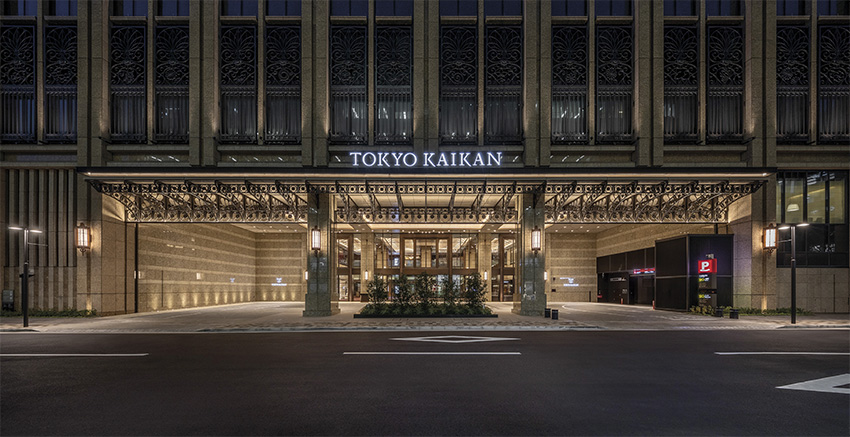
Tokyo Kaikan is well-regarded because we fulfill that expectation exceptionally well. In fact, we host around 1,100 weddings annually. Among them, about 20 are for international couples, and that number is gradually increasing.
How has the demand from international couples changed in recent years, especially post-COVID?
In the past, many Japanese couples preferred destination weddings—places like Hawaii were especially popular. But since the COVID-19 pandemic, that trend has significantly declined. Now, we’re seeing a reversal, with overseas couples—particularly from the U.S. and parts of Asia—choosing to travel to Japan for their wedding ceremonies, often combining it with a vacation.
We’ve already welcomed 370,000 international guests in total and are aiming for 600,000 in the near future. What draws them here? Broadly speaking, it’s Japan’s unique culture—its seasonal beauty, safety, and wide variety of wedding styles.
Why do you think Japan has become such an attractive destination for foreign couples wanting to get married here?
Japan is incredibly safe, which makes it ideal for family gatherings. Guests can travel here with peace of mind. Moreover, Japan offers a wide range of wedding styles: there are European-style chapels operated by companies like Tsukada Global Holdings, guesthouse weddings, luxury hotels, and specialized venues like ours that are not hotels but have decades of experience in weddings.
Importantly, all these venues are fully equipped—from dressing salons and catering to decorations and floral design. Everything is handled by trusted partners. So when a couple meets with our wedding planner, all elements of the event can be coordinated smoothly and efficiently. That convenience is a major reason people choose Japan.
Also, for expats who have lived in Japan and are returning to their home countries, Japan becomes a natural choice for the wedding—because it’s where their memories were made and where their friends still are.
Could you share a specific story that illustrates Tokyo Kaikan’s approach to hospitality, especially for international guests?
Yes, one particular example stands out. We hosted a wedding where the groom was an expat living in Japan, and the bride was from Hong Kong. Her family was still in Hong Kong, and this was the first time the two families would meet. The bride asked for something dramatic and memorable for that moment.
So we created a private path through the building to ensure no one else would pass by. The two families had their first meeting in front of the chapel, with the symbolic setting as a backdrop. Afterwards, they took commemorative photos together. They were deeply moved, and it became a beautiful memory for everyone.
What role do family dynamics play in Japanese wedding culture, particularly at a venue like Tokyo Kaikan?
That’s a very important point. In Japan, a wedding isn’t just about the couple—it’s about uniting two families. Often, there’s an unspoken understanding between families, and as a venue, we play a critical role in managing that dynamic. When we can facilitate that harmony early on, everything else tends to go smoothly.
More couples today are valuing the idea of two families becoming one. That mindset is gaining traction, and Tokyo Kaikan is seeing more interest from couples who are drawn to that kind of meaningful ceremony.
Japan is facing a declining birthrate. How does that demographic shift affect your business, and how are you responding to it?
It’s a serious issue. In Japan, unless each couple has at least two children, population decline will continue. The national birth rate is currently well below the replacement level. In that context, wedding venues play a more important role than people realize—they mark the beginning of family life.
As the domestic market shrinks, some venues will naturally disappear. That’s why we’re actively looking to attract more international weddings to balance out the decline in local demand.
What measures have you taken to address language barriers for international couples and their families?
Language can be a real challenge, so we ensure that professional interpreters are present throughout the process—from the initial consultations, dress fittings, and rehearsals to the wedding day itself. We assign interpreters not only to the couple but also to both families. This helps eliminate communication issues and creates peace of mind for everyone involved.
What concrete strategies are you currently using to grow your international wedding segment?
Right now, our international weddings are still limited—just a few dozen per year. We’ve identified two main strategies.
First is to enhance convenience. We offer a full-service, all-inclusive wedding package so couples don’t have to worry about bringing anything.
Second, we’ve made multilingual support a top priority. We’ve learned that limited language access can be frustrating for international couples, so we’ve put interpreters in place at every stage of the process. This has been very well received, and word is spreading via platforms like Instagram.
Tokyo Kaikan seems to rely more on word-of-mouth than aggressive marketing. Can you explain that approach?
Yes, that’s true. We don’t do much in terms of advertising or promotional campaigns. It’s not in our nature to push people with slogans like, “Please get married here!” Instead, when someone chooses us, we commit fully to making it exceptional.
Interestingly, one of our most appealing features has been the amount of time couples have for photography. We give them two to three times the photo time of typical venues in Japan. We didn’t plan it as a strategy—it just came from wanting to offer more. But couples post their photos online, and that’s caught the attention of international audiences.
Are you currently working with overseas travel agencies or partners to attract more foreign guests?
Not actively at the moment. We’ve distributed brochures to embassies and asked travel agencies to introduce us, but we haven’t yet built formal partnerships.
That’s largely because we’re nearly fully booked through next year. If we contacted agents now, they might find there’s no availability, which could hurt our credibility. Once capacity opens up, we do intend to pursue these relationships more seriously.

Do you have any plans to collaborate with international chefs or expand Tokyo Kaikan’s culinary brand overseas?
Yes. Every year, we used to invite one chef from France for a gourmet event, though that was paused during the pandemic. Our ties to Paris are particularly strong, and we already have connections with negotiators and culinary partners there.
What are your future aspirations before passing the baton to the next generation of leadership?
One goal I’d really like to achieve is opening a Tokyo Kaikan restaurant in Paris. We’re already well-established in Tokyo, and expanding domestically doesn’t make as much sense. Paris would be the ideal place.
What kind of cuisine would you like to showcase in Paris?
It would be French cuisine—but interpreted in our own way. It’s hard to describe, but it draws inspiration from early 20th-century styles, using techniques passed down to us from renowned chefs like Raymond Oliver, who worked with us during the 1964 Tokyo Olympics. It’s a refined, nostalgic experience that’s quite different from contemporary French cuisine.
For more information, please visit their website at: https://www.kaikan.co.jp/en/
AloJapan.com