
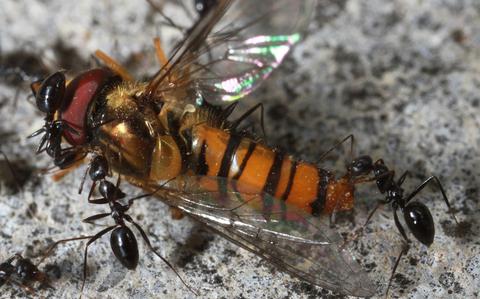
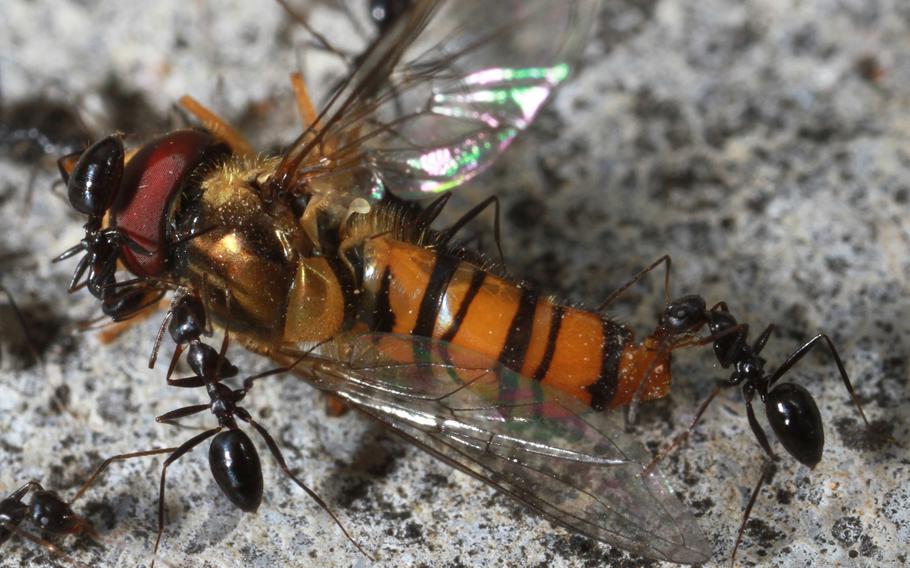
Browsing ants, seen here in this undated photo, were successfully eradicated from Naha Military Port, Okinawa, in October 2025, according to the U.S. Army. (Okinawa Institute of Science and Technology)
After a five-year effort, the U.S. Army on Okinawa said it has eradicated an invasive ant species at its port in the island prefecture’s capital city.
The browsing ant — Lepisiota frauenfeldi — is native to southern Europe and reproduces rapidly, forms super colonies and will attack and prey on other ant species and insects, according to a control plan released by the prefecture in March 2022.
The Environmental Division of the Directorate of Public Works at Torii Station declared the browsing ant finally eradicated from Naha Military Port in October 2025, according to a Jan. 23 news release from U.S. Army Garrison Okinawa.
It was first spotted in 2017 at Nagoya Port on Honshu, Japan’s largest island. The country’s Ministry of the Environment first recorded the ant in Naha along Routes 331 and 332 in February 2020, according to the control plan.
Nests were discovered at the Naha port in May 2020, and a control monitoring project began for the species in April 2021, according to the Army. A maximum of 62 nests were detected in May 2021.
The ants were found in grassy areas around the port’s utilities buildings and in concrete cracks, Naho Ishiki, Directorate of Public Works natural resources program manager and environmental engineer, said by phone Friday.
The Army set up sugar and mealworm bait traps containing a growth regulator that causes infertility, she said. The bait was developed by the Okinawa Institute of Science and Technology Graduate University and the University of the Ryukyus.
Four months later, nest numbers had dropped to two. No ants have been detected since December 2023, according to the Army’s release.
“After 24 months, you can say it’s pretty much eradicated,” Ishiki said. “We double-checked with the Ministry of the Environment, and we are good.”
The ants were eliminated before they could inflict any major damage, she said.
“It’s not very risky to human health compared to fire ants, but it could damage utilities and structures,” Ishiki said. “And biosecurity-wise, it’s going to cost more to eradicate it after they completely establish within the installation.”
The Army port wiped out its ant infestation more than a year after greater Naha had eradicated its infestation. As of May 17, 2024, the city was free of browsing ants for two consecutive years, the Okinawa General Bureau announced in a news release.
“This was a very rare case of successful eradication,” Yoshua Andersson, spokesman for U.S. Army Garrison Okinawa, said by phone Friday. “They’re still working to eradicate this ant [in Nagoya]. In Australia, it’s already invasive — islandwide in Australia and causing damage to native species.”
AloJapan.com