
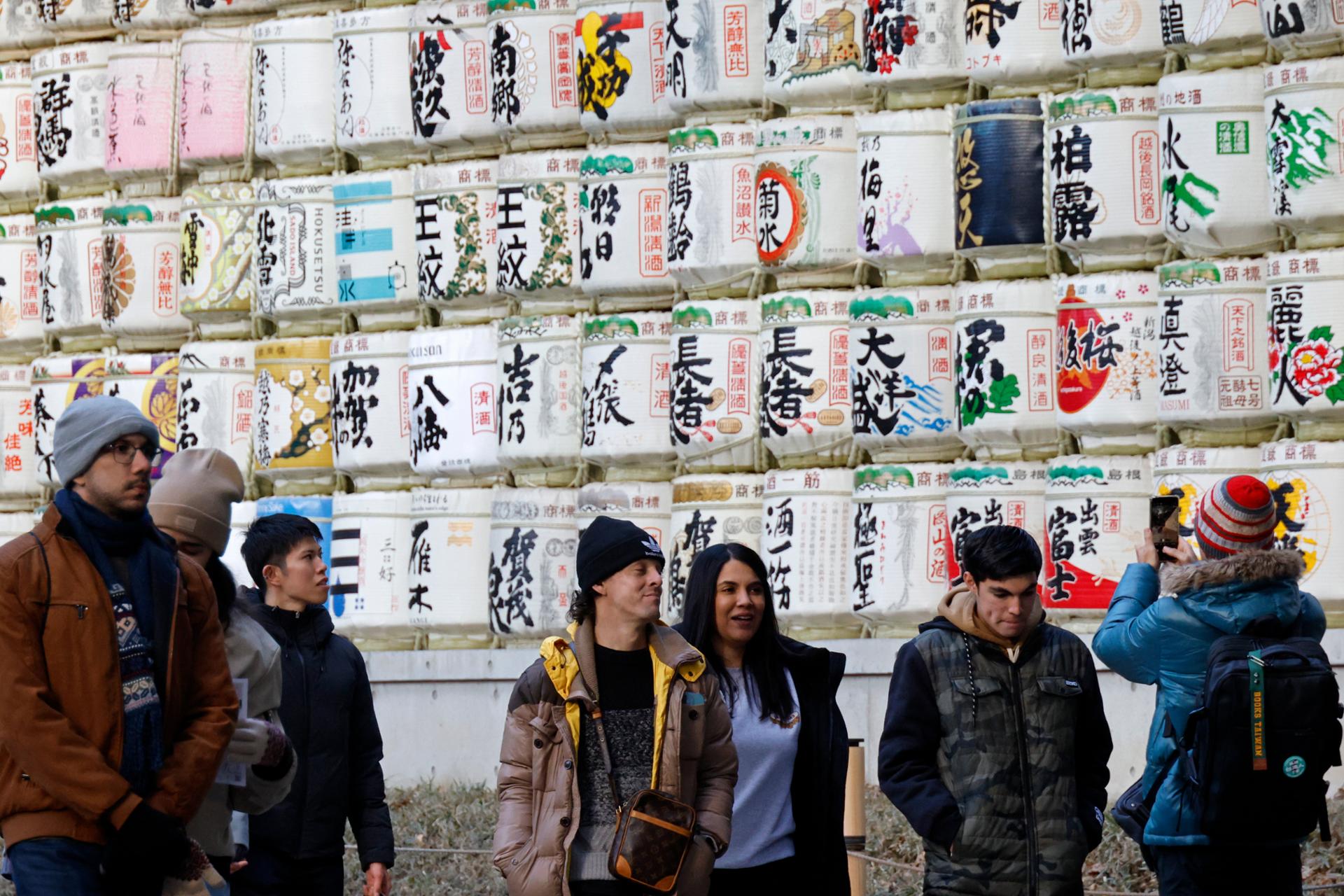
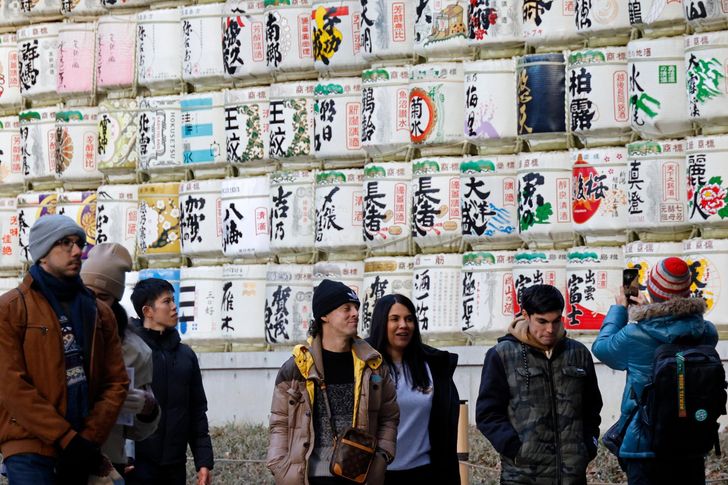
Tourists stroll past sake barrels displayed at the Meiji Jingu shrine in Tokyo, Japan, Jan, 21. EPA-Yonhap
For many Korean families, traditional holiday gatherings may be getting smaller this Lunar New Year, but suitcases are getting bigger. More than half of flight searches this holiday are for Japan, signaling a sharp shift away from the domestic travel boom that defined the holiday last year.
Flight search data from Skyscanner shows Japan accounts for 51.6 percent of all Lunar New Year holiday queries by Korean travelers, with Fukuoka leading at 23.3 percent, followed closely by Osaka at 23.2 percent and Tokyo at 13.7 percent. The only domestic destination to crack the top 10 is Jeju, at 11.6 percent — a steep drop from last year, when domestic destinations including Busan, Seoul and Jeju held the top three spots and made up 57 percent of all searches.
The reversal is driven in part by the calendar.
In 2025, an extra government-designated holiday created a nine-day break without requiring any annual leave, encouraging families to complete traditional ancestral rites before adding a domestic trip.
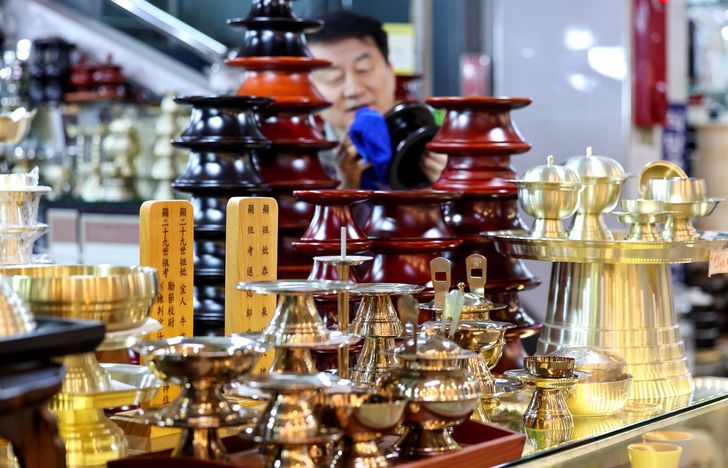
A merchant arranges a set of utensils for ancestral rites ahead of the Lunar New Year holiday at Seomun Market in Daegu, Feb. 3. Newsis
This year’s official holiday spans just three days, from Feb. 16 to 18, pushing travelers to choose between going home for family rites or going abroad — and many are choosing the airport over the ancestral altar.
“Flight search volume for the early part of the year rose 4.12 percent compared to an already high baseline last year,” said Jessica Min, a travel expert at Skyscanner. “With 44 percent of respondents saying they would travel during the holiday if it’s with family, short-haul destinations that are easy to navigate with multiple generations are drawing the strongest demand.”
The trend, widely described in Korean media as “airplane instead of the ancestral table,” reflects a cultural shift. Industry data shows the concept of “multi-generational travel,” where grandparents, parents and children vacation together in place of traditional rituals, has become the defining narrative of this year’s holiday season.
Japan’s appeal is anchored in the weak yen. With the currency hovering near historic lows against the dollar, dining, shopping and accommodation costs in cities like Osaka and Fukuoka remain significantly cheaper than in previous years.
Booking.com data confirms that Tokyo, Osaka and Fukuoka held the top three spots in accommodation searches for the second consecutive year, with Fukuoka seeing a 22 percent jump in search interest.
Beyond Japan, Vietnam and China are emerging as strong contenders. Skyscanner data puts both countries at 12.7 percent of overall searches. Vietnam’s Phu Quoc island recorded the most dramatic surge — a 71 percent increase in Booking.com search volume compared to the holiday season last year, leaping from 15th to fifth place in accommodation rankings. The resort island’s rise signals growing appetite for quieter, resort-centered getaways over traditional city-hopping itineraries.
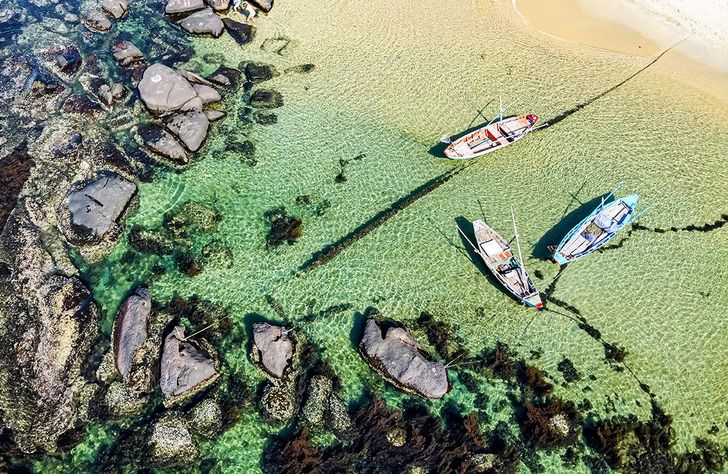
An aerial view of a beach in Phu Quoc, Vietnam / Courtesy of Jeju Air
China is benefiting from relaxed visa policies and a roughly 25 percent expansion in air routes between the two countries. Shanghai bookings jumped 270 percent year-on-year, according to travel agency Mode Tour.
Japan’s Sapporo also broke into the top 10 for the first time, with accommodation searches climbing 31 percent, driven by the Sapporo Snow Festival and the appeal of hot springs and winter landscapes. The city’s rise reflects a broader shift toward seasonal and experiential travel over conventional sightseeing.
Trip durations are also stretching. Trip.com data shows 65 percent of Korean travelers are booking trips of four days or longer, with 43 percent choosing four- to seven-day itineraries and 22 percent opting for eight to 14 days. Long-haul flight bookings surged 50 percent, and first-class ticket purchases jumped 83 percent compared to last year, pointing to a growing premium segment.
Last year, a total of 1.34 million Koreans traveled abroad during the 10-day holiday window from Jan. 24 to Feb. 2, with 1.05 million departing through Incheon International Airport alone. Daily outbound passengers averaged 134,000, a 13.8 percent increase from the prior year’s Lunar New Year, making it the busiest such travel period since the airport opened in 2001.
The Ministry of Land, Infrastructure and Transport added 7 percent more flights and expanded available seats by 5.8 percent to 4.22 million to absorb the demand. Total inbound and outbound Incheon Airport passenger traffic reached a daily average of 214,000, surpassing the pre-pandemic 2019 peak of 202,000 by 6 percent.
For 2026, the trajectory shows no signs of slowing: Korea’s total outbound departures are projected to reach 30.23 million for the full year, up 2.6 percent from an estimated 29.47 million in 2025, setting a new all-time high.
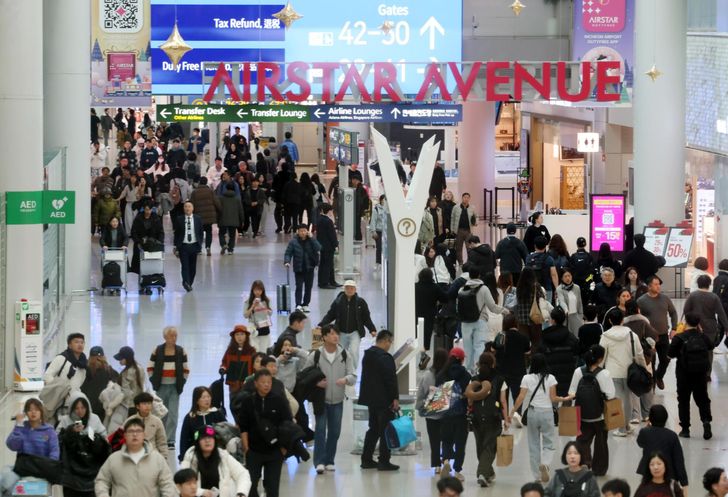
Travelers move through Terminal 1 at Incheon International Airport, Feb. 2. Newsis
Sydney and Paris both appeared in the top 10 accommodation searches, suggesting a widening travel radius among a segment of Korean travelers willing to use the extended break for more ambitious trips.
Five-star hotel bookings rose 59 percent globally during the Lunar New Year period, with upper-tier properties accounting for roughly 75 percent of all reservations across key Asian destinations, according to Trip.com.
The inbound picture is equally striking. Korea-bound flight bookings from overseas rose 88 percent year-on-year, with demand spreading beyond traditional source markets in China and Japan to include Poland, Canada and Uzbekistan.
“Travelers’ goals have expanded well beyond visiting tourist attractions — they’re seeking more diverse and personalized experiences,” said Hong Jong-min, Trip.com’s Korea country manager.
Laura Houldsworth, managing director for Asia-Pacific at Booking.com, echoed that view. “Korean travelers are maintaining a stable preference for familiar short-haul destinations while showing an increasingly open attitude toward new travel styles that prioritize relaxation and seasonal experiences,” she said.
AloJapan.com