
There’s a small city in Japan, near Mount Fuji, that has cancelled this year’s cherry blossom festival. Authorities in the Japanese city of Fujiyoshida took this decision ahead of the annual cherry blossom season.
With this, the curtains have drawn on a decade-long spring event. In the past, visitors were drawn to Fujiyoshida owing to the rare combination of cherry trees in full bloom against the backdrop of Mount Fuji’s snow-capped mountains.
STORY CONTINUES BELOW THIS AD
Let us take a look at the festival and the reason for its cancellation.
What is the cherry blossom festival?
Each year, the
cherry blossom festival is observed in Japan during the spring season when pink cherry blossom trees are in full bloom. Every year, the annual Arakurayama Sengen Park Cherry Blossom Festival gives tourists a chance to witness the mesmerising scenes.
It was in April 2016 that the authorities opened the gates of Arakurayama Sengen Park for tourists to witness the Sakura season. According to the BBC, the park offers a panoramic view of the city from its pagoda, with several picture-worthy and “Instagrammable” spots.
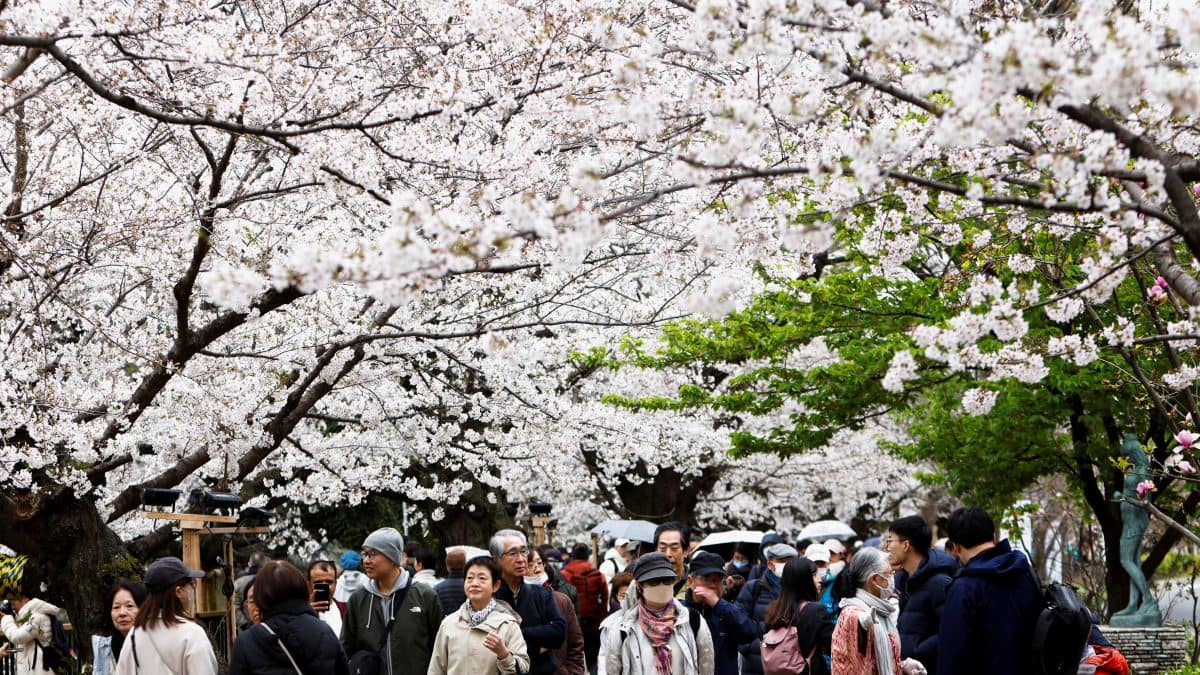
Visitors take pictures with cherry blossoms at Chidorigafuchi park in Tokyo, Japan. File image/Reuters
Fujiyoshida officials started hosting the annual event at Arakurayama Sengen Park to make the area more attractive and bring in more visitors, hoping to create “a lively atmosphere.”
Now, as many as 10,000 visitors flock to the city during peak blossom season, authorities said in a statement.
Why has the event been cancelled?
This year, the city government in Yamanashi prefecture announced that they will not be holding the annual festival, sending shockwaves among tourists.
According to the authorities, they have been facing a strong sense of crisis due to overcrowding of the city during the peak season. The city’s mayor, Shigeru Horiuchi, said that Fujiyoshida’s picturesque scenery threatens “the quiet lives of citizens.” He further said, “We have a strong sense of crisis.”
Announcing the decision on Tuesday (February 3), he said, “To protect the dignity and living environment of our citizens, we have decided to bring the curtain down on the 10-year-old festival.”
He also noted that the increase in visitors over the years is due to factors like the weak yen and explosive popularity due to social media.
A visitor touches the early-flowering Ookanzakura cherry blossoms almost in full bloom at Ueno Park in Tokyo, Japan. Reuters
Overtourism is such an issue that authorities say that some visitors have been opening private homes to use the bathroom, trespassing, littering, defecating in people’s yards, and even causing a scene when confronted about their behaviour.
STORY CONTINUES BELOW THIS AD
Families living nearby have also raised safety concerns. According to the city authorities, parents say children have been pushed aside on school routes as crowds spill onto narrow pavements near popular photo spots.
Despite the festival’s cancellation, the city is preparing for an increase in visitors during April and May, according to the BBC.
How are netizens reacting to the cancellation?
People took to social media to react to the cancellation of the popular festival.
One of the users wrote on X, “That’s a real shame, my suggestion would be to do what other places in Japan do and keep it to locals only.” Another said, “Sad to see a beautiful tradition spoiled. Hope tourists learn to respect local customs before ruining more experiences.”
Expressing concern over the situation, a user wrote, “That’s sad. Hopefully it’s a wake up call that being a visitor comes with responsibility, not just photo opportunities.”
“Really sad that a great tradition like the Cherry Blossom Festival was cancelled because idiots can’t behave themselves. I was there last year. It was beautiful, and I did my best to be respectful there. Japan is not your playground!”, said another user.
STORY CONTINUES BELOW THIS ADHow is the world reeling from overtourism?
This is not the first time that authorities have taken steps to control overtourism. In 2024, officials in
Fujikawaguchiko put up a giant black barrier to block views at one of the area’s most popular photo spots, after residents complained that tourists, especially those seeking viral shots, were littering, jaywalking, and parking illegally.
Japan is not the only country that has been taking steps to curb the influx of tourists.
This week, Italian authorities introduced a €2 (approx Rs 213) fee to enter the viewing area of
Rome’s Trevi Fountain, which was previously free. Officials say the charge will help control visitor numbers and fund maintenance of the monument.
Similarly, Venice has introduced a
variable fee for day visitors between April and July, with advance bookings costing €5 (aprox Rs 530) and last-minute entry costing €10 (approx. Rs 1070).
With inputs from agencies
HomeLifestyleWhy a Japanese town has cancelled the cherry blossom festivalEnd of Article
AloJapan.com