
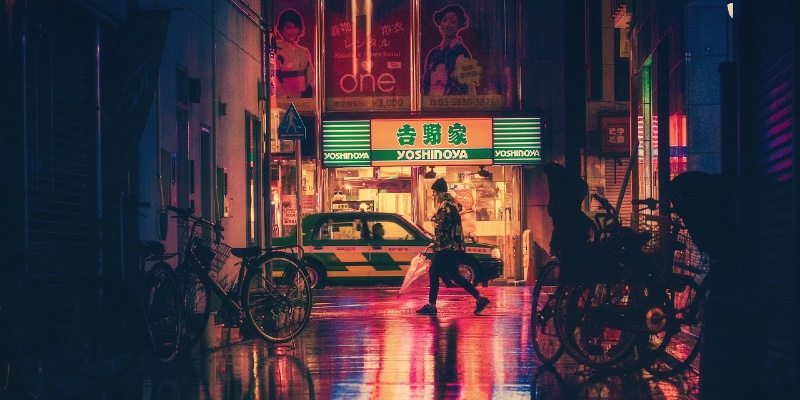
So far in Crime and the City we’ve been to Japan twice – the mega-city of Tokyo and the ancient city (and former capital) of Kyoto. The Tokyo crime world is contemporary and often noir (as well as the current batch of super popular “healing novels” which features nighttime cafés, cats and bookshops but rarely crime!) while Kyoto has had a crime writing resurgence with the publication of so much newly translated Japanese “Golden Age” mystery writing. And, as we’ll see, Osaka seems to specialise in the popular genre in Japan of horror/supernatural/crime crossovers. So off to the major port city we go….
Article continues after advertisement
The boss (or perhaps we should say ”oyabun”, the “father figure” of Yakuza life) is undoubtedly Keigo Higashino, an Osaka-born mystery writer who sells by the truck load in Japan and in translation. Higashino has won major Japanese awards for his books, almost twenty of which have been turned into films and TV series. Higashino became internationally known and broke out of the Osaka crime writing world with The Devotion of Suspect X (2005), the first in his Detective Galileo series. Yasuko’s abusive ex-husband, Togashi, shows up one day to extort money from her. He threatens both her and her daughter. They kill Togashi in self-defence, dispose of the body and cover-up of the murder. What evolves is a tightly written mystery but one which appreciates the criminal side and the police and shows that life and justice are often messy.
Salvation of a Saint (2008) is the second in the Detective Galileo series. A famous patchwork quilter Ayane Mita is found dead while she is away on a trip to visit her parents at Sapporo. Detective Kusanagi is faced with affairs, fake alibis and Kusanagi’s old friend, Manabu Yukawa (also known as Detective Galileo). The Galileo series continues with A Midsummer’s Equation (2016), Silent Parade (2021) and Invisible Helix (2024) all featuring Kusanagi and Yukawa.
But Higashino is also the author of equally if not more popular four book Police Detective Kaga series. Malice (2014) starts with bestselling novelist Kunihiko Hidaka discovered brutally murdered in his home on the night before he’s planning to leave Japan and relocate to Vancouver. His body is found in his office, in a locked room, within his locked house, by his wife and his best friend, both of whom have rock solid alibis. Or so it seems. Enter Police Detective Kyochiro Kaga of the Tokyo Police Department. In book two, Newcomer (2018) Kaga is promptly assigned to the team investigating the murder of a woman and then in A Death in Tokyo (2022) a man is found dead on the capital’s Nihonbashi Bridge. There’s a possible supernatural element and Kirin spirits (remember I said Osaka writers like to blend horror and crime with the supernatural). And lastly The Final Curtain (2023) investigates both a murder in Tokyo and his own family’s history.
But of course there are other writers in Osaka as well as Keigo Higashino.
Article continues after advertisement
SJ Cullen was an international schoolteacher in Asia when he got the idea for the Hunter and Higashi series, a crime-solving duo who attend a British school in Japan. It’s a three-book series… so far… that starts in Kyoto when Jessica Hunter, a seasoned globetrotter trying to adapt to life at British School Kyoto, teams up with Kenta Higashi, a local boy. The second book in the series, The Osaka Syndicate (2024), sees Hunter and Higashi travel to Osaka, where they discover a sinister organisation known as The Syndicate is behind a brutal murder in the port city. Why are they building a secret army? And what is The Syndicate’s connection to a major organisation in Osaka? By the way, the third Hunter and Higashi novel takes the young pair to London.
A few more Osaka-set standalone crime novels:
Joe Hefferon’s Countdown to Osaka (2018) features Koi, an enforcer for the Osaka yakuza syndicate. Yet she wants out, but can you walk away from the Yakuza. She must hunt and kill the assassin Le Sauvage.
A slightly different kind of book, and a YA novel, is Leading a Life of Crime: After School in Osaka (2025) was supposedly written by two bored 5th grade friends during online classes. It’s a fast-paced adventure of friendship, hacking, and chaos.
Shalin Soni’s Nightmare in Osaka: The Haunting of Osaka Castle (2025) is a horror/crime/supernatural mix. Beneath the ancient stones of Osaka Castle, something waits—something older than history, darker than night, and hungrier than death itself. There’s haunting and murder too.
And then there’s Richard D Todd’s Osaka Protocol (2024), the sixteenth book in The Phantom Directive Book, a series of 21 espionage novels of covert operations, international intrigue, and featuring Victor Sterling, a shadowy operative for an organization known as WARDEN. global stability is at risk, and the threat appears to be coming the Japanese port of Osaka.
And finally, a Japanese Golden Age classic. The last few years have seen publishers rushing to find classic Japanese mystery novels to translate from the country’s crime writing Golden Age – which stretches from the 1930s to the 1970s in Japan. Among these rediscovered and newly translated novels is one of Japanese crime and mystery master Seicho Matsumoto’s best-loved novels in Japan – Inspector Imanishi Investigates (1961).
Matsumoto is often considered the Japanese crime writer who really popularized detective fiction in Japan. His novels mixed elements of human psychology and ordinary life. Inspector Imanishi Investigates was Matsumoto’s ninth novel, but really his first big seller after being serialised in a major Japanese newspaper. The novel has since been made into film and TV dramas. The book starts with a murder in Tokyo and leads Inspector Imanishi and his junior partner, Detective Yoshimura, on an investigation across Japan, including Osaka. The investigation leads them to the Nouveau Group, a collective of young artists pushing modern ideas. Matsumoto takes his story from metropolitan Tokyo, to smaller towns and to the modern port city of Osaka to show a range of Japanese locations and lifestyles.
Osaka is often seen as a somewhat uninteresting city compared to Tokyo or older cities like Kyoto. Yet it has long been a centre of Japanese modernism as well as food, art and nightlife…. And crime writing.
Article continues after advertisement
AloJapan.com