
![Six Korean undergraduates pose for a photograph with their home-stay host family in front of their house in Mima City in Tokushima Prefecture, Japan, on Jan. 25. [LEE SOO-JUNG]](https://www.alojapan.com/wp-content/uploads/2026/02/5dca2bba-ab51-460b-8146-b1212479f72f.jpg)
Six Korean undergraduates pose for a photograph with their home-stay host family in front of their house in Mima City in Tokushima Prefecture, Japan, on Jan. 25. [LEE SOO-JUNG]
OSAKA — A single sip of matcha tea is no mere savory experience. It can unfold into lessons about courtesy and international friendships.
On Jan. 22, inside a small room at Osaka-based Tezukayama Gakuin University, 34 Korean undergraduates sat on their knees on the straw mat-covered floor and gently sipped matcha brewed by their Japanese peers.
Observing a traditional tea ceremony, they learned to maintain proper posture while savoring the tea.
As the ceremony began, the students exchanged bows in silence. What followed was a hands-on experience in which they whisked matcha themselves with bamboo chasen, or whisks, with Japanese peers serving as mentors.
On Jan. 20, a group of 67 Korean undergraduates — 34 from Seoul and 33 from Jeju Island and Busan — kicked off their nine-day journey to experience authentic Japanese culture firsthand through peer exchanges in Osaka, a dance class and homestay experiences in Tokushima. They also explored local environmental initiatives at the Kamikatsu Zero Waste Center in Tokushima Prefecture and earthquake-related safety initiatives at the Great Hanshin-Awaji Earthquake Memorial Museum in Kobe, Hyogo Prefecture.
The Korean students were part of a Japanese Foreign Ministry exchange program, the Japan-East Asia Network of Exchange for Students and Youths (Jenesys), which aims to boost understanding of Japanese society and to strengthen people-to-people ties among the emerging generations of East Asia. It has invited more than 4,000 Korean university students since 2007 through coordination with the state-managed Japan-Korea Cultural Foundation. Each delegation was sent to different destinations across Japan, a move to showcase the diverse aspects of localities.
The nine-day program was not just a one-sided cultural exchange. The Korean students, in turn, presented their culture and cuisine to Japanese students and their host families.
“By sharing meals, having everyday conversations and experiencing each other’s thoughtfulness, I have realized the true meaning of cultural exchange,” said Kim Bum-jun, 20, vice leader of the 34-student cohort from Seoul.
The latest program comes amid vibrant “shuttle diplomacy” between the two countries’ leaders, who have stressed that candid youth exchanges and building people-to-people ties are the true foundation of future-oriented bilateral relations.
Building youth friendship ![Korean and Japanese undergraduates chat during a cultural exchange session held at Tezukayama Gakuin University in Osaka, Japan, on Jan. 22. [LEE SOO-JUNG]](https://www.alojapan.com/wp-content/uploads/2026/02/7640b6b4-97c0-4890-8c3c-199015b7b940.jpg)
Korean and Japanese undergraduates chat during a cultural exchange session held at Tezukayama Gakuin University in Osaka, Japan, on Jan. 22. [LEE SOO-JUNG]
On Jan. 22, a group of 34 Korean college students from the greater Seoul area mingled with about a dozen Japanese students from the Korean language and culture department at Tezukayama Gakuin University.
The liberal arts university, roughly 25 kilometers south of downtown Osaka, runs one of the Kansai region’s largest Korean culture and language departments. The department currently has around 200 students.
The half-day exchange focused on improving mutual understanding between the two nations and their languages as learners.
The students shared the difficulties of studying each other’s languages and discovered that their struggles mostly overlapped. They soon became mentors to each other, offering tips and encouragement on how to learn their native languages effectively.
![Korean students sitting on their knees learn how to drink matcha tea properly during a tea ceremony lesson at Tezukayama Gakuin University in Osaka, Japan, on Jan. 22. [LEE SOO-JUNG]](https://www.alojapan.com/wp-content/uploads/2026/02/7450a3de-f36c-4a35-bfe4-e32e82ae5025.jpg)
Korean students sitting on their knees learn how to drink matcha tea properly during a tea ceremony lesson at Tezukayama Gakuin University in Osaka, Japan, on Jan. 22. [LEE SOO-JUNG]
“The students of both nations found that we have something in common with relatable topics and ideas,” said Do In-seo, a 22-year-old Korean student. She added that she experienced no difficulty in chatting with Japanese students.
“Discussions began with sharing ideas on language-learning experiences and later evolved into deeper topics,” said Jung Shin-mi, a 23-year-old Korean student.
Whenever Korean students failed to produce foam on their matcha, their Japanese peers readily stepped in to help.
“The program of learning the tea ceremony and its manners together made the students feel closer,” Jung added.
Yuki Kawashima, a Japanese student in her senior year whose interest in Korea began five years ago, was “thrilled” to closely engage with Korean students.
“Living in Osaka, I used to chat briefly with Korean tourists who barely spoke Japanese,” Kawashima said. “However, today’s session surprised me because Korean students knew hiragana [the Japanese alphabet] and understood Japanese. It motivated me to study Korean more passionately.”
![A Japanese student, left, helps a Korean student whisk matcha powder in a bowl during a cultural exchange session at Tezukayama Gakuin University in Osaka, Japan, on Jan. 22. [LEE SOO-JUNG]](https://www.alojapan.com/wp-content/uploads/2026/02/0d033017-90ca-4033-a571-973efc5103d0.jpg)
A Japanese student, left, helps a Korean student whisk matcha powder in a bowl during a cultural exchange session at Tezukayama Gakuin University in Osaka, Japan, on Jan. 22. [LEE SOO-JUNG]
The university now explores opportunities to offer joint virtual courses with its partner institutions in Korea.
Ryuzo Nishikawa, president of the Graduate School of Human Science at Tezukayama Gakuin University, noted that the Korean department has seen rising popularity, attributing this to the popularity of K-pop and K-culture.
“The weak yen made studying in Korea less affordable to Japanese students,” said Nishikawa. “Virtual classes with Korean colleges are highly feasible as the two nations are in the same time zone. The class can also allow Japanese students to experience Korean culture directly despite physical distance.”
Dance transcending borders ![A group of 67 Korean undergraduate students perform Awa Odori, a traditional Japanese dance, with local performers at Mima City Hall in Tokushima Prefecture, Japan, on Jan. 24. [LEE SOO-JUNG]](https://www.alojapan.com/wp-content/uploads/2026/02/444be5a7-fe54-40be-a3c2-361fa4758626.jpg)
A group of 67 Korean undergraduate students perform Awa Odori, a traditional Japanese dance, with local performers at Mima City Hall in Tokushima Prefecture, Japan, on Jan. 24. [LEE SOO-JUNG]
On the afternoon of Jan. 24, a group of 67 Korean students danced in a large circle, flinging their arms into the air as they learned traditional Japanese dance from professional Japanese dancers at Mima City Hall in the central Tokushima region.
The professional dancers were from Akatuskiren, a self-organized troupe specializing in Awa Odori, a traditional festival dance originating in Tokushima about 400 years ago. Among them were dancers of all ages, including children and older adults.
Once the dancers’ performance ended, the stage was given to the students. The atmosphere was awkward as some students hesitated to dance at first. However, the hesitation melted away once the dancers demonstrated every element and coached the students. Live music by a percussion-and-wind instrument band also lightened up the mood.
After rounds of repeated practice, they soon mastered the dance moves. A half-hour-long dance session followed, during which Korean students and Japanese performers danced together in a massive circle in the same rhythm. When the session ended, they were sweating.
![Korean undergraduates and Awa Odori performers dance together in a large circle at Mima City Hall in Tokushima Prefecture, Japan, on Jan. 24. [LEE SOO-JUNG]](https://www.alojapan.com/wp-content/uploads/2026/02/5fbb6b71-3bb8-4833-b976-4724090e1b53.jpg)
Korean undergraduates and Awa Odori performers dance together in a large circle at Mima City Hall in Tokushima Prefecture, Japan, on Jan. 24. [LEE SOO-JUNG]
Awa Odori is characterized by a forward-moving march in a slightly hunched posture, with arms stretched and simple footwork. The dance also distinguishes between movements by gender. While choreography for females stresses elegance and fluid transitions, that of their male counterparts emphasizes energy and vigor.
“I carefully observed the Japanese dancers and tried my best to follow,” said Lee Seul-chan, 23. “Still, the chant lingers in my brain. Today’s experience will become a precious memory.”
![A Korean student delegation and Japanese Awa Odori performers pose for a commemorative photo at Mima City Hall in Tokushima Prefecture in Japan on Jan. 24. [LEE SOO-JUNG]](https://www.alojapan.com/wp-content/uploads/2026/02/5ad8a964-4795-4c86-8e8c-d3618cbb12b8.jpg)
A Korean student delegation and Japanese Awa Odori performers pose for a commemorative photo at Mima City Hall in Tokushima Prefecture in Japan on Jan. 24. [LEE SOO-JUNG]
Young Japanese dancers also found the exchange fulfilling.
“Despite language barriers, I was grateful that everyone learned Awa Odori so earnestly,” said Haruna Shimokawa, a 28-year-old dancer. “It was impressive to see Korean students dancing in joy.”
“Korean students were friendly and considerate enough to communicate in Japanese, and I am highly grateful for it,” another 26-year-old Awa Odori performer, Ayu Miyawuchi, said. “Dancing with them was fun.”
Familial welcome
![Five Korean undergraduates sit around a kotatsu, a Japanese heated table, with their home-stay host, center, at a house in Tokushima Prefecture in Japan on Jan. 25. [LEE SOO-JUNG]](https://www.alojapan.com/wp-content/uploads/2026/02/bda28750-4d35-4a3e-9361-159e01540a3d.jpg)
Five Korean undergraduates sit around a kotatsu, a Japanese heated table, with their home-stay host, center, at a house in Tokushima Prefecture in Japan on Jan. 25. [LEE SOO-JUNG]
Twelve families across Mima city and Tsurugi town in Tokushima Prefecture welcomed three to six Korean students at their homes on Saturday.
Of 119 families offering homestay services through a local network called Sora no Sato, twelve volunteered.
The Korean undergraduates blended naturally into the family life of Japanese people as if they were children or grandchildren of their hosts. They partook in household chores and meal preparations.
On the morning of Jan. 25, in the front yard of a family house on a mountain slope at about 100 meters above sea level, four Korean male undergraduates washed and boiled Konjac, a root vegetable used as an ingredient in Japanese gelatinous food. The host family grilled kirimochi (chewy Japanese rice cake) as a snack for the students.
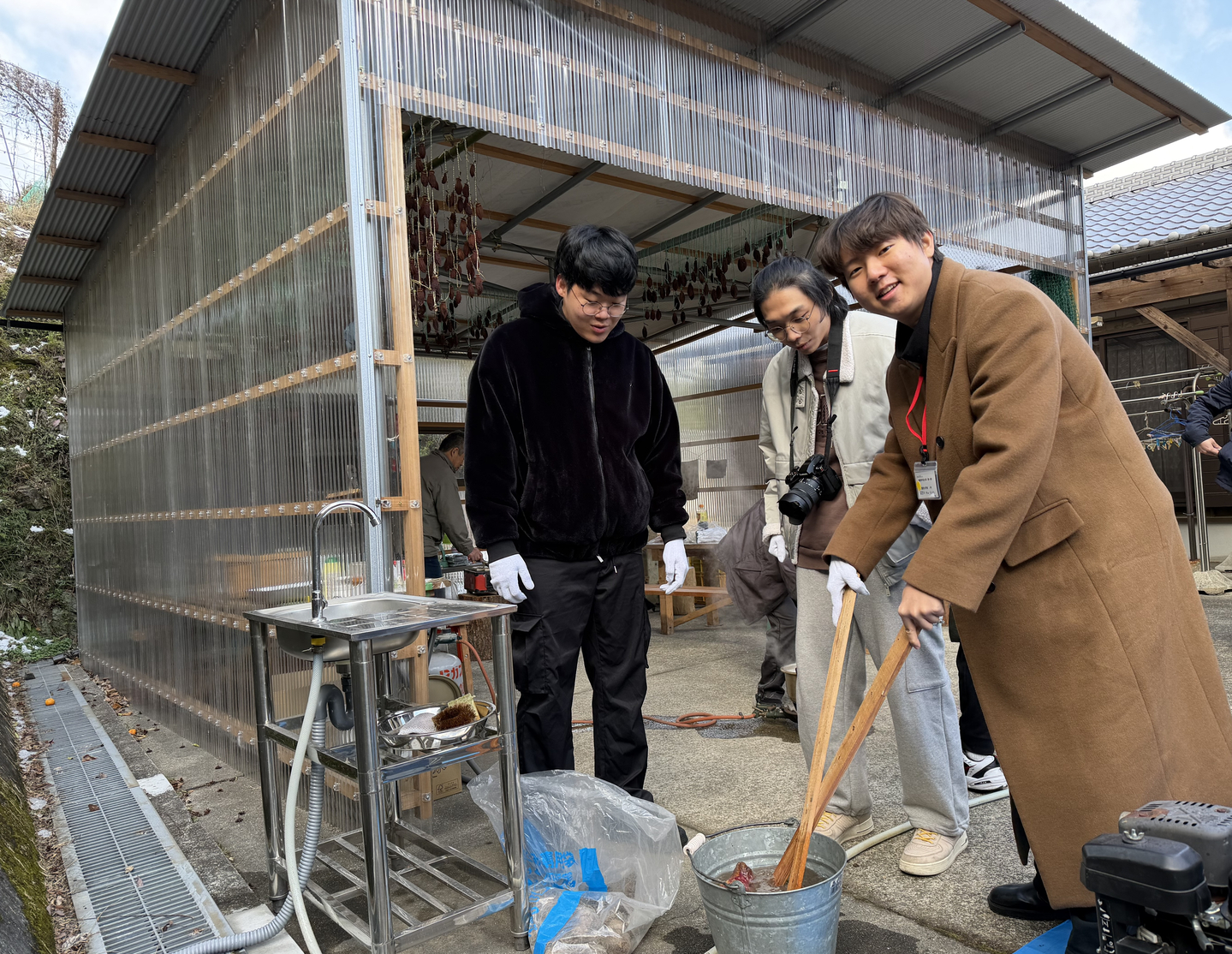
Three Korean undergraduates wash Konjac, a root vegetable used to make Japanese gelatinous food, at their home-stay residence in Mima City, Tokushima Prefecture, Japan, on Jan. 25.
“Korean students are polite and try to make every moment count during their stay,” Mitsuo Murakami, a host father of the four Korean male students, said. He had accepted Korean students as guests twice as of Sunday.
Reiko Gotsubo, another homestay service provider who hosted six Korean female participants, added that she found Korean students passionate and friendly.
Korean students reciprocated the warm hospitality by preparing and serving Korean dishes, including gimbap (rice roll with seaweed) and hotteok (fried pancake).
![Five Korean undergraduates and their host family members polish leaves at a kitchen during their home-stay experience in Tokushima Prefecture in Japan on Jan. 25. [LEE SOO-JUNG]](https://www.alojapan.com/wp-content/uploads/2026/02/a05b1150-b313-477b-8ad0-aa8ed5d7e3a7.jpg)
Five Korean undergraduates and their host family members polish leaves at a kitchen during their home-stay experience in Tokushima Prefecture in Japan on Jan. 25. [LEE SOO-JUNG]
The three-day homestay ended on Jan. 26 with tears of farewell and bittersweet smiles.
“As the phrase ‘ichigo ichie’ suggests, the meals that we [referring to the students and host families] shared, and every second we spent together, taught me valuable lessons and led to unforgettable memories,” 20-year-old student Boo Eun-bin said in tears. Her host family also shed tears.
Ichigo ichie, which means “one lifetime, one encounter,” is a Japanese saying emphasizing the value of every encounter in life.
Some other host families cherished the students’ visit in their own way and gave the students warm hugs for the last time. Sachiko Miyamoto, a female homestay host in her 70s, asked students to write their names in Korean on the back of her phone case.
“Through the homestay experience, we had priceless experiences of sharing culture and our hearts,” said Kim Bum-jun, the vice leader of the Korean students. “Thereby, we felt at ease and safe even in an unfamiliar environment.”
BY LEE SOO-JUNG [[email protected]]
AloJapan.com