
By
Quang Minh, Quang Nguyen
Sun, February 1, 2026 | 6:06 pm GMT+7
Japanese companies operating in Vietnam are the most willing in Southeast Asia to expand their business in the next one to two years, driven mainly by domestic market demand and services catering to fellow Japanese firms, a survey by Japan External Trade Organization (Jetro) showed.
Some 56.9% of Japanese companies in Vietnam plan to expand their operations in the next one to two years, up 0.8 percentage points from a year earlier, according to Jetro’s 2025 survey on the business conditions of Japanese companies investing overseas.
Although expansion intentions are broadly stable year-on-year, Vietnam ranks first in ASEAN for the second consecutive year, with the expansion rate exceeding the ASEAN average of 46.8% and the Asia-Oceania average of 45%, Jetro said.
The survey found that 38.2% of Japanese firms in Vietnam plan to maintain their current operations, while 4.2% intend to scale down and only 0.7% are considering relocating or withdrawing to a third country.
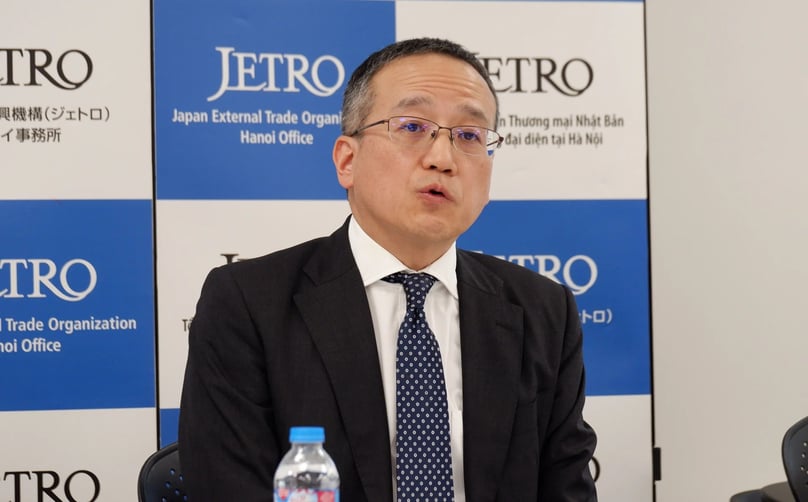 Haruhiko Ozasa, chief representative of Jetro Hanoi. Photo by The Investor/Minh Tuan.
Haruhiko Ozasa, chief representative of Jetro Hanoi, said Japanese companies in Vietnam are expanding along two main trends. “The first is a strong focus on Vietnam’s domestic market, particularly in sectors with high growth potential,” Ozasa said.
In non-manufacturing, restaurants, retail, trading and wholesale are among the most active sectors, while in manufacturing, food processing record the highest expansion rate, aimed at serving domestic consumption.
Many companies cite rising exports and expanding domestic demand as key reasons for expansion, alongside plans to strengthen sales functions, Ozasa said.
He cited instant noodle maker Acecook and confectionery producer Fujiya, which recently inaugurated a manufacturing plant in Tay Ninh province, as notable examples.
Chemical and pharmaceutical companies are also optimistic about Vietnam, with 69.2% planning to expand operations, he said, noting that several Japanese drugmakers have begun building factories to serve local demand.
The second trend is investment aimed at providing services to other Japanese companies operating in Vietnam, particularly in trading, wholesale, finance and insurance.
“Japanese companies investing in Vietnam benefit from services provided by fellow Japanese firms, which helps improve their business environment and enriches Vietnam’s supporting industries,” Ozasa said.
Profit at highest level in 15 years
The survey showed that 67.5% of Japanese companies in Vietnam expect to post a profit in 2025, up 3.4 percentage points from a year earlier and the highest level since 2009. Meanwhile, 17.6% forecast losses, down 1.7 points.
The profit-making ratio has risen for two consecutive years and, for the first time since 2020, exceeded the ASEAN average of 65.3%.
In manufacturing, 74.1% of firms expect to be profitable in 2025, up 3.9 points year-on-year, while the proportion forecasting losses fell 4.4 points to 13%.
Sectors including paper and wood products/printing, electrical and electronic components, and iron and non-ferrous metals record profit increases of 15 percentage points or more.
All surveyed companies in the restaurant sector, however, expect to incur losses in 2025.
Looking ahead, 42.3% of firms say operating profits in 2025 would improve from 2024, down 6.5 points, while 21.8% expect conditions to worsen, up 4.9 points.
For 2026, 47.6% of respondents forecast an improvement from 2025, 4.9 points higher than the ASEAN average of 42.7%. However, more than 30% of firms in the transport equipment and transport equipment parts sectors expect conditions to deteriorate, at 38.2% and 33.3%, respectively.
Jetro said improved conditions in manufacturing are mainly driven by stronger export demand, while the most cited reason for deterioration is weaker export demand.
In non-manufacturing, higher domestic demand is the most common factor supporting improvement, while intensifying competition and rising labour costs are the main negative factors.
The survey included Japanese businesses investing in 20 countries/territories, comprising five countries/territories in Northeast Asia, nine ASEAN countries, four Southwest Asian countries, and two Oceania countries.
The 2025 survey was conducted from August 19 to September 17, with questionnaires sent to 12,900 companies and valid responses received from 5,109 firms. Vietnam recorded the highest number of respondents in ASEAN, with 906 companies participating, representing a valid response rate of 45.1%.
AloJapan.com