
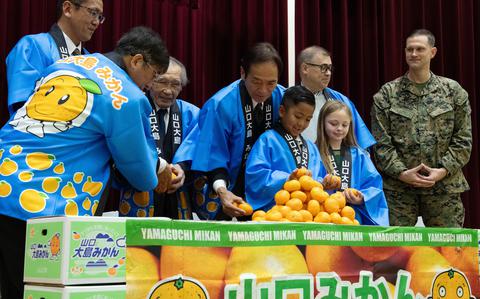
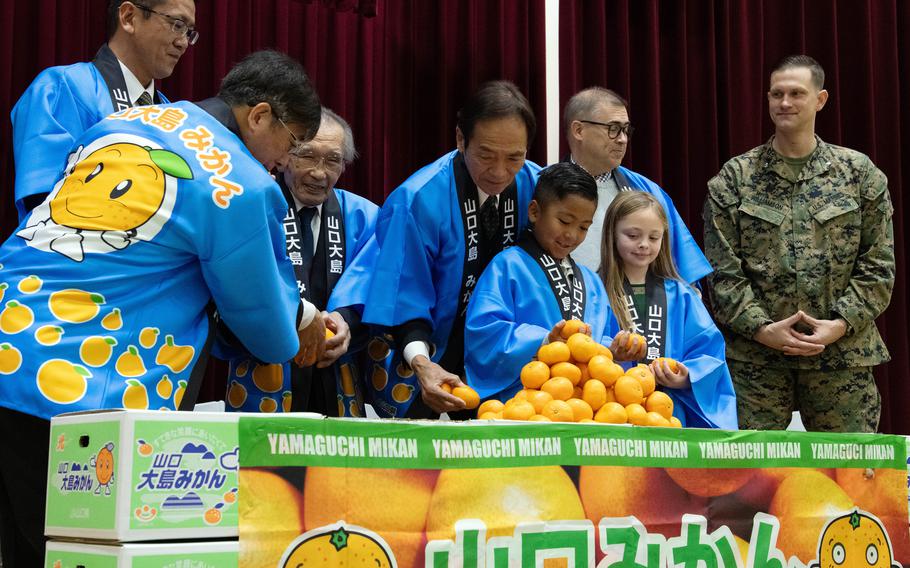
Members of the Yamaguchi Prefectural Agricultural Cooperative Associationat deliver boxes of mikans to Matthew C. Perry Primary School on Marine Corps Air Station Iwakuni on Jan. 30, 2026. (Janiqua Robinson/Stars and Stripes)
MARINE CORPS AIR STATION IWAKUNI, Japan — Tangerines, naval oranges and clementines are familiar citrus fruits for many American children, often eaten on soccer sidelines and in school cafeterias.
Students at this U.S. base south of Hiroshima are getting a taste of a local alternative, the Japanese mikan.
Nearly 550 students at Matthew C. Perry Primary School and Iwakuni Intermediate School received 20 boxes of mikans Friday, donated by the Yamaguchi Prefectural Agricultural Cooperative Association.
“To our guests, thank you again for bringing your warmth, your mikans and your generosity to our school,” Maria Bell, assistant principal of the primary school, said during a delivery ceremony. “We truly value you and look forward to bringing you back many more times in the future.”
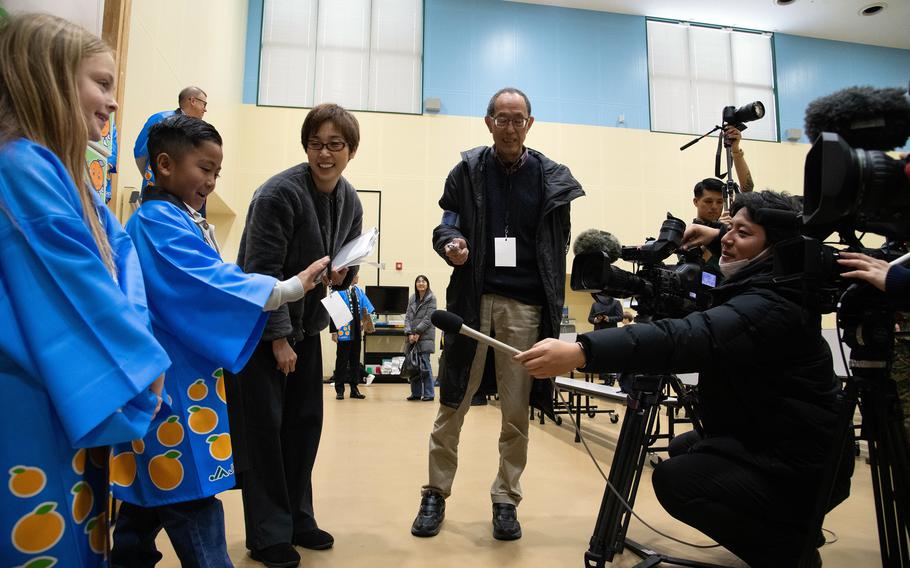
Students Sydney Lasky and Liam Buenaventura speaks to reporters about mikans at Matthew C. Perry Primary School on Marine Corps Air Station Iwakuni on Jan. 30, 2026. (Janiqua Robinson/Stars and Stripes)
The association dropped off nearly 1,600 mikans grown on Suo-Oshima, an island about an hour south of the air station known for producing the sweet, juicy fruit, according to Hiromi Kawamoto, an air station spokeswoman who gave additional information to the media.
“I would like more people to know how good [Suo-Oshima] Island’s mikans are, and the air station is one of the target places that we want to advertise to,” Hisanobu Sugihara, general manager of the association’s Suo-Oshima branch, told Stars and Stripes after the ceremony.
Suo-Oshima is often called Mikan Island because it produces about 80% of Yamaguchi Prefecture’s mikans, according to a 2023 report in the Japan Times. Last year, the price of mikans was higher by about 20% over the previous year due to the previous summer’s heat and an insect infestation, according to Japan Today in January 2025.
Students Sydney Lasky and Liam Buenaventura spoke with reporters after the ceremony. Asked whether she had tried mikans before, Lasky said she had and liked their sweetness. Buenaventura said he planned to share his with his baby sister.
Sugihara said the visit gave him the impression that American students were already familiar with the citrus fruit.
“I’m so glad that they know it’s very delicious, and I’d like for them to enjoy it more,” he said. “The mikan’s quality this year, amount wise, is very good. Flavor-wise, it’s similar to last year — very well balanced with acidity, sourness and sweetness.”
Each student received two mikans to take home and share with their families.
“We’re so grateful you took the time to visit our school,” Bell said at the ceremony, which closed out the school’s kindness week. “Today reminds us how important friendship is. When we come together, learn from one another and share traditions, our community grows stronger and bigger.”
AloJapan.com