
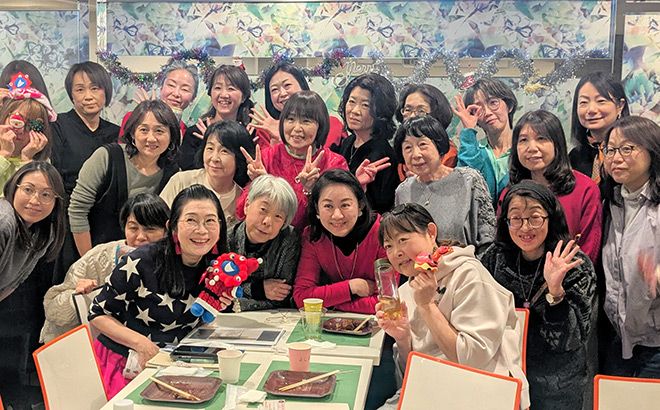
Their vision came together over tea, desserts and an array of colorful sticky notes.
“A place where people of various backgrounds can come together freely” and “exercise equipment, please!” were among the hopeful requests that filled a large sheet of paper as a circle of women imagined the kind of community apartment they want to call home.
The Osaka gathering was thanks to the “Adult Women’s Dormitory Project,” a group working to build just that for middle-aged women.
Along with trading ideas about what they would value most in a rental housing complex that promises a built-in community came reasons why they believe such a space is necessary.
The project was launched in 2022 by Chisato Makimoto, 56, a workstyle adviser based in Osaka, who also gives frequent lectures.
She has hosted more than 40 similar gatherings in western Japan’s business hub. Each typically draws around 10 women who are mostly in their 50s and older with varying motivations.
“I thought it might be lonely being single forever,” one participant said.
“I couldn’t rent an apartment on my own after my divorce,” another revealed.
Their vision is simple but, in today’s Japan, still radical: if the kind of home they need does not exist, they will create it themselves.
PERSONAL FEAR TURNED PLAN
Makimoto got divorced about a decade ago and left Tokyo to move back to the Kansai region, which is home to Osaka and Kyoto.
When searching for a place of her own, she struggled to find a guarantor and found it difficult to secure a lease.
“I became anxious about what would happen to me as I got older,” she said.
What then came to mind was her aunt’s vibrant lifestyle that involved running a cooking school out of her home and constantly interacting with students.
Makimoto began to picture a “women’s dormitory” model where social connection is woven into everyday life.
But she could not find rental housing designed for single women to live independently while remaining connected.
“If it doesn’t exist, I’ll build it myself,” she decided, and the small meetings kicked off after she reached out to acquaintances.
When her friend Harumi Tamura first heard the idea, she was skeptical.
“Can we really pull this off?” she wondered.
Yet as a single renter and a 62-year-old office worker from Amagasaki, Hyogo Prefecture, Tamura said she felt a growing uncertainty about the future despite being employed.
After attending several tea parties, she is now eagerly waiting to become the project’s first resident.
Through discussions among Makimoto and her peers, the concept has taken shape as a residence for single women 40 and above.
Rent would be set at about 1.3 to 1.5 times the market rate to fund shared features, such as a communal living room and a dedicated space for gatherings with the surrounding neighborhood.
HELP FROM ‘AKIYA’ RENOVATOR
To turn this into a reality, Makimoto brought her proposal to real estate companies and developers. Most immediately turned her away.
On the verge of giving up, she read a book by Kinya Wada.
Wada, 59, is known for tackling Japan’s growing “akiya” (abandoned house) predicament by focusing on reviving both the structure and its surroundings.
Based in the Gamo 4-chome district of Osaka’s Joto Ward that sits east of Osaka Castle, he renovates older buildings and converts them into what he hopes will be assets to the community and the local economy by helping restore foot traffic and commercial activity.
“Maybe this person will listen,” Makimoto thought.
When Wada heard her vision, he initially felt that Makimoto was “in a bit too much of a hurry.” He soon became interested, however.
Having mostly worked on shops aimed at younger people, he began to see housing for older residents as “a crucial field for the future.”
Wada agreed to cooperate and consulted a local real estate firm. They have since found several viable sites in the city and are refining the construction plans.
Rising material costs have pushed the estimated budget for a new building to around 1.5 billion yen ($9.7 million) and Wada has been visiting financial institutions to secure funding while exploring the possibility of public loans.
FIVE-YEAR PLAN
More than 200 people have attended the tea parties in the three years since the project began.
A 54-year-old company employee from Osaka started taking part last spring. Divorced and without children, she said she has almost no interaction with her neighbors.
“I resonated with the idea of having acquaintances while still valuing my time alone,” she said. She now helps organize tours of potential construction sites.
Some participants have begun exploring establishing similar women’s dormitories in other regions.
“We want to show, through our own actions, that this kind of option exists for the future,” Makimoto said. “I believe this will increase the number of people who can approach aging positively.”
The group’s current goal is to complete the women’s dormitory within five years.
THE BIGGER PICTURE
According to the national census, the portion of seniors (65 or older) living alone in 2020 comprised 15 percent of men and 22 percent of women.
These figures are projected to rise to 26 percent for men and 29 percent for women by 2050, spurred by the aging population and the rise in unmarried individuals.
Landlords are often hesitant to rent to this demographic over concerns about “lonely deaths”—dying undiscovered—or rent arrears. Isolation from local communities has also become a major social issue for those living alone.
The government has begun addressing this issue. Under the revised Housing Safety Net Law implemented in October, measures were introduced for landlords renting to seniors.
Measures include support for disposing of belongings after a tenant’s death and systems for providing resident monitoring services.
AloJapan.com