
 사진 확대
사진 확대
The U.S. and Japanese governments jointly defended the yen. They say they will take all necessary measures against speculative movements, directly mentioning the possibility of government intervention in the foreign exchange market.
The Nihon Keizai Shimbun (Nikkei) reported on the 25th that the US-Japan foreign exchange authorities have worked together to prevent excessive yen depreciation. Prior to market intervention, authorities conducted a “rate check” to ask major banks about transaction conditions.
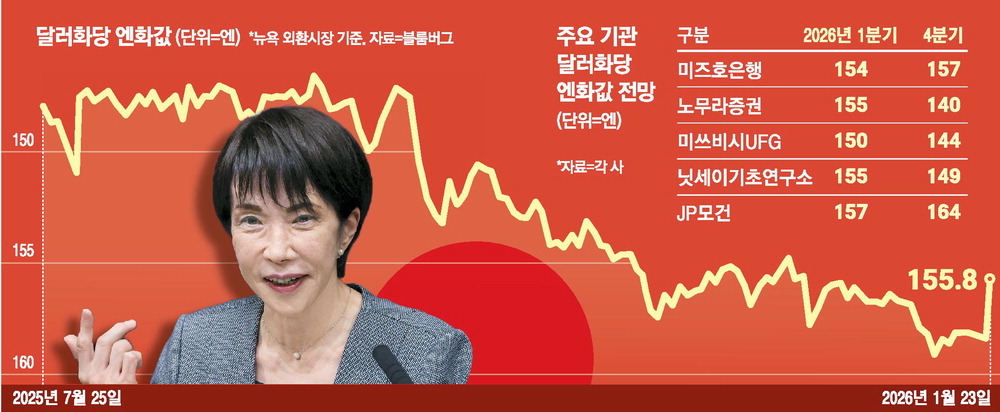
The yen per dollar weakened on the 23rd when the Bank of Japan decided to freeze its benchmark interest rate and Bank of Japan Governor Kazuo Ueda began a press conference at 3:30 p.m. There were many predictions in the market that the Bank of Japan would raise its key interest rate further in April, but the yen’s selling has intensified as the view that Ueda’s remarks did not respond to this.
As a result, the yen, which was around 158.6 yen per dollar just before the press conference, fell to around 159.1 yen during the conference. However, immediately after the conference, the yen showed a reversal. The yen moved about 2 yen for 10 minutes, and the yen rose to 157 yen.
In this regard, local media reported that there was a “rate check” that the Bank of Japan took before intervening in the foreign exchange market in earnest. Although the Japanese Finance Ministry has steadily intervened verbally since the beginning of the year, some observers say that it will now begin to exercise its capabilities in earnest.
Japanese Finance Minister Satsuki Katayama responded to reporters’ questions about whether to conduct a rate check on the day, saying, “I can’t comment on it in this situation.” At the same time, he did not respond to the theory of intervention, saying, “We are always watching with a sense of urgency.”
The last time Japan intervened in the foreign exchange market was in July 2024. At that time, the total amount of intervention over the two days amounted to 5.5348 trillion yen (about 51.4 trillion won). As a result, the yen per dollar, which had fallen to 161 yen in the New York foreign exchange market, surged by more than 4 yen and rose to 157 yen.
Currently, the market sees the Japanese government’s intervention in the foreign exchange market at 160 yen. This time, it was only a rate check, but there is an observation that the possibility of actual market intervention is also growing.
Japanese Prime Minister Takaichi Sanae also appeared on civil broadcast television on the same day and said, “We will take necessary measures against speculative or very abnormal market movements.” Although it did not provide specific measures, it showed a willingness not to look only at the excessive yen’s depreciation.
The Wall Street Journal (WSJ) reported on the 23rd (local time) that the Federal Reserve Bank of New York also requested major banks to “check rates” in line with Japan’s move. New York Fed conducts financial transactions on behalf of Treasury.
As the news spread, the yen per dollar rose further on the New York foreign exchange market to close at 155.8 yen. The dollar weakened 1.7 percent against the yen and more than 1 percent against other Asian currencies, including the Korean won and the Taiwanese dollar.
The won’s value, which has recently been undervalued due to the weak dollar, has also risen. The won per dollar closed at 1465.8 won during weekly trading on the 23rd. However, as of night trading, which closed at 2 a.m. on the 24th, the won rose 3.3 won from the weekly closing price to 1462.5 won. The won, which entered the New York foreign exchange market at around 1,467 won, expanded its gains in line with the strong yen.
[Tokyo correspondent Lee Seung Hoon / Seoul reporter Kim Seulgi / Lee Hee Soo]
AloJapan.com