

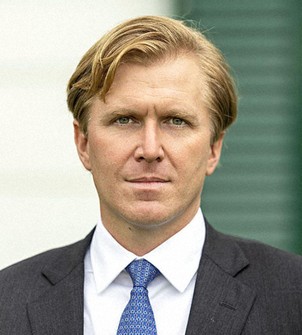
Elbridge Colby. (Photo courtesy of Elbridge Colby)(Kyodo)
WASHINGTON (Kyodo)– The U.S. Defense Department said Saturday its top policymaker will visit Japan and South Korea to advance President Donald Trump’s “peace through strength” agenda.
The trip by Elbridge Colby, undersecretary of defense for policy, starting this weekend was announced a day after the department released the National Defense Strategy, which calls on American allies to increase defense spending to 5 percent of their gross domestic product and do more for their own national security.
Colby, the third-highest ranking official at the Pentagon, is a key figure in U.S. efforts to get its allies and partners to raise defense spending.
Colby is likely to brief Japanese and South Korean officials on the new policy document, and he could directly ask them to work toward the spending target.
The Pentagon said his visit “underscores the critical importance of the Indo-Pacific region and our alliances” with the two Asian countries.
NATO members have already committed to meeting Trump’s demand to increase defense spending from 2 percent to 5 percent of GDP by 2035.
The first National Defense Strategy since Trump’s return to the White House a year ago said, “We will advocate that our allies and partners meet this standard around the world, not just in Europe.”
U.S. Defense Secretary Pete Hegseth and his Japanese counterpart Shinjiro Koizumi met in Washington last week and agreed to step up the decades-old alliance’s deterrence and response capabilities.
During the meeting, Hegseth did not urge Japan to raise its defense spending, according to Koizumi and Japanese officials.
In 2022, after Trump’s first term, Japan decided to double its annual defense budget to 2 percent of GDP by 2027, a dramatic move in postwar security policy under the country’s war-renouncing Constitution.
Japan achieved the target in 2025, two years ahead of its initial schedule, and plans to determine a new level of defense spending by the end of this year.
Last year, South Korea committed to raising its annual defense spending to 3.5 percent of GDP, with Colby and other U.S. officials praising its policy change.
The defense strategy, released Friday, said, “South Korea is capable of taking primary responsibility for deterring North Korea with critical but more limited U.S. support.”
The document, highlighting Trump’s “America First” doctrine, suggested South Korea could become less reliant on the United States in dealing with North Korea, citing reasons such as Seoul’s advanced military capabilities and mandatory conscription.
AloJapan.com