
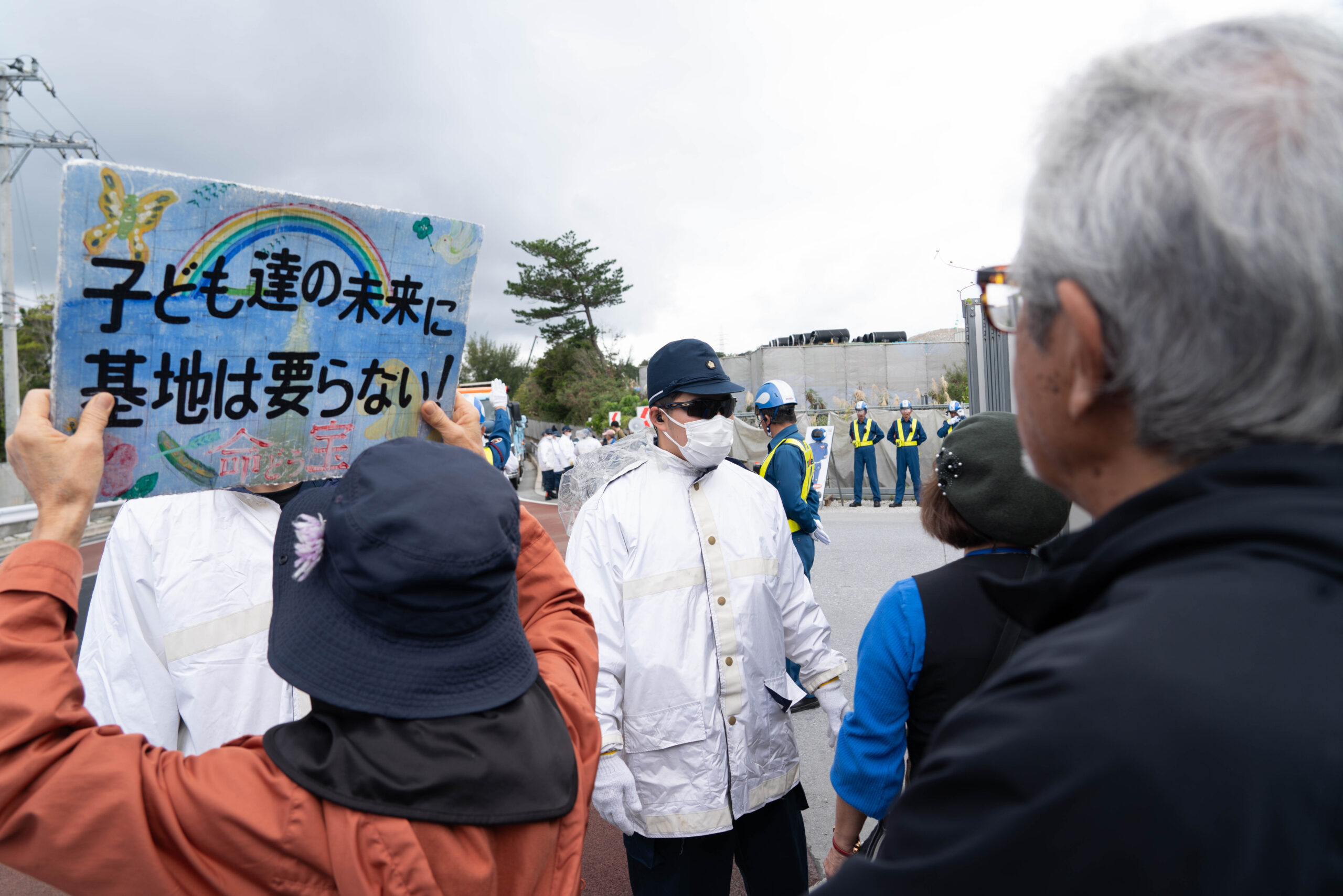
Okinawa in an archipelago in southern Japan that represents no more than 0.6% of the country’s total territory. However, these islands hold nearly 70% of the U.S. military facilities in Japanese land. The heavy military presence since the end of World War II affects the daily lives of locals, who for decades now have to live with sound pollution, land contamination, accidents and crimes involving U.S. military personnel.
BdF reporting team has recently visited the archipelago and spoke to members of local organizations. The entities, that oppose to the strong militarization of the region for decades, fear that Okinawa may become the target of military conflict once again. While the Japanese government argues that the facilities guarantee national security, local militants doubt this narrative, and have for years fought against the construction of new facilities, the deployment of missiles and military exercises carried out by the United States and Japan’s so-called Self-Defense Forces.
Keiko Yonaha, co-representative of the organizations No More Battle of Okinawa and Okinawa’s Voice, says that beyond the risk of war, the military bases bring a range of other problems to the islands. “In my view, the root of all problems in Okinawa still lies with the U.S. military bases. Recently, even the Self-Defense Forces’ bases have become part of the problem,” she said.
“There are issues such as sexual violence against women, as well as accidents caused by U.S. soldiers, for example, helicopters or fighter jets crashing in Okinawa. There are also problems like soil contamination,” Yonaha added.
Economic impacts
Takamatsu Gushiken, also a co-representative of No More Battle of Okinawa, challenges the claim that U.S. military bases boost Okinawa’s economy. According to Stanford University, around 52,000 U.S. military personnel and civilians are currently stationed in the archipelago.
Gushiken argues that the U.S. military presence does not benefit Okinawa economically. “In the past, some claimed that U.S. military bases supported Okinawa’s economy. But research has shown this to be false,” he said. “Studies indicate that the U.S. bases are actually one of the biggest obstacles to Okinawa’s economic development. It can no longer be said that ‘Okinawa’s economy prospers because of U.S. bases’. The people of Okinawa are very clear about this.”
According to data from The Borgen Project, poverty affects 35% of Okinawa’s population, double the national average. Child poverty stands at 29.9%, the highest among all Japanese prefectures and more than twice the national average of 13.5%, according to Okinawa’s prefectural government.
Okinawa also has the lowest per capita income in Japan, at 2.249 million yen, which is just 37% of Tokyo’s 6.037 million yen, the highest in the country.
Unemployment is also higher than the national average. In November 2025, Okinawa’s unemployment rate stood at 3.4%, compared to 2.6% nationwide.
Questioning Japan’s subordination to the United States
Kadena Air Base is the largest U.S. military base in Okinawa. For decades, residents have complained about noise and other problems caused by its operations. The city, home to nearly 13,000 people, has more than 80% of its territory occupied by U.S. military installations.
Yoshihiro Fukuchi, vice-leader of a group pursuing legal action against noise pollution, said the organization seeks at least to ban nighttime military activities and obtain compensation for damages.
“Our main demands include banning nighttime flights, meaning no aircraft takeoffs or landings during the night, as well as halting nighttime engine tests and related activities,” he explained.
However, Fukuchi noted that such demands have been systematically rejected by Japanese courts.
“These demands have been difficult to have recognized by the courts. As a result, in our ongoing struggle to secure our rights, we have already filed four successive lawsuits,” he said. “Because the courts have consistently refused to grant injunctions against nighttime flights, this problematic situation persists, requiring repeated legal action.”
Fukuchi questioned Japan’s sovereignty. Although courts acknowledge that residents suffer harm from noise generated within Japan’s own territory, they simultaneously claim there are no legal remedies available.
“This forces us to ask: is Japan truly a sovereign state? Does Japan possess the inherent rights of any sovereign nation?” he asked. According to Fukuchi, Japan is considered legally incapable of halting U.S. military operations.
The historical trauma of the Battle of Okinawa
The militarization of Okinawa followed the Battle of Okinawa in 1945, at the end of World War II. According to the Okinawa prefectural government, more than 100,000 civilians were killed by U.S. or Japanese forces, in addition to deaths caused by forced suicides, starvation, and disease.
After Japan’s defeat, Okinawa remained under direct U.S. military administration for 27 years, until 1972.
Gushiken also volunteers in the recovery of remains of war victims and has dedicated decades to this work.
“The reason I oppose military bases in Okinawa is to prevent Okinawa from becoming a battlefield again,” he said. “From the age of 28 until now, at 71, I have been collecting the remains of those who died in the Battle of Okinawa, returning them to their families.”
He noted that victims were not only soldiers. “There were ordinary residents, elderly people, children, and women,” he said.
Gushiken recalled repeatedly asking survivors whether Okinawa could have avoided becoming a battlefield.
“Their answers were almost unanimous: when the Japanese army came to Okinawa, it claimed it was ‘protecting Okinawa’, and people believed it. But once the war began, reality was completely different. They said the Japanese army was even more brutal than U.S. forces.”
Okinawa as a launchpad for U.S. military operations
Gushiken’s experience illustrates Okinawa’s historical role in U.S. military campaigns.
“When I was in elementary school, I saw formations of B-52 bombers taking off from Okinawa every day, heading toward Vietnam,” he recalled. “The noise was overwhelming. As soon as I heard that roar, I knew: ‘They’re flying to Vietnam again.’ It happened almost daily.”
“From scattered news reports, I knew they were killing a large number of Vietnamese people,” he said. “I strongly felt that U.S. forces stationed in Okinawa were killing people in Vietnam, and that the suffering Okinawa endured was being repeated, unchanged, in Vietnam, Afghanistan, and elsewhere. That realization filled me with deep sorrow.”
Fear of a new war
Concern among Okinawan organizations fighting militarization has intensified in recent years. Yonaha noted that since 2021, official statements have suggested Okinawa could become a battlefield, as bases are continuously reinforced and militarized.
“Under these circumstances, we are acting to protect the lives of our children and grandchildren,” she said. “Especially elderly people who experienced the war and U.S. occupation have become the core of the peace movement. We do not want our children and grandchildren to suffer such hardships again.”
She cited an Okinawan saying: 命どぅ宝 (Inochi du takara), meaning “Life is the most precious thing.”
“Above all, our goal is to prevent the loss of life in another war, and we are fully committed to preserving peace in Okinawa,” Yonaha said. “Since 2021, when people began saying Okinawa could become a battlefield again, we have raised the slogan ‘No more war, no more bases’ and continued our activities.”
She also described the psychological toll of the current situation.
“We are exposed every day to the danger that our lives could be taken in an instant. That is why elderly people who lived through the Battle of Okinawa say they can no longer sleep at night,” she said. “The trauma of that war still exists, and now it is being reawakened. War must never happen again, not only in Okinawa, but anywhere in Japan.”
Regional tensions and rising military spending
Gushiken emphasized that opposition to militarization in Okinawa is not directed solely at U.S. forces.
“Currently, Japan’s Self-Defense Forces are stationed in Okinawa with missiles, supposedly to attack China in the event of a ‘Taiwan contingency’,” he said. “As long as they remain here, Okinawa will inevitably be dragged into war. That is why we demand the withdrawal of the Self-Defense Forces as well. This is a position directed at Japan’s own military.”
Concerns have grown with the arrival of Japan’s Prime Minister Sanae Takaichi. Her government approved a military budget exceeding 9 trillion yen, while escalating tensions with China early in her term.
To justify the spending and legal changes, China is portrayed as a security threat. Hiroshi Taniyama, adviser to the Japan International Volunteer Center, disagrees.
“China has consistently advocated regional and global peace and adheres to the path of peaceful development,” he said. “As important neighbors, friendly cooperation is the mainstream of China-Japan relations.”
According to Taniyama, China promotes dialogue and exchanges to enhance mutual understanding and supports building a bilateral relationship suited to a new era.
“China respects each nation’s independent choices and firmly opposes any ‘China threat theory’ based on false information,” he said.
“China is willing to work with Japan and other countries to strengthen communication, deepen cooperation, and jointly promote regional and global peace, stability, development, and prosperity,” Taniyama concluded.
AloJapan.com