
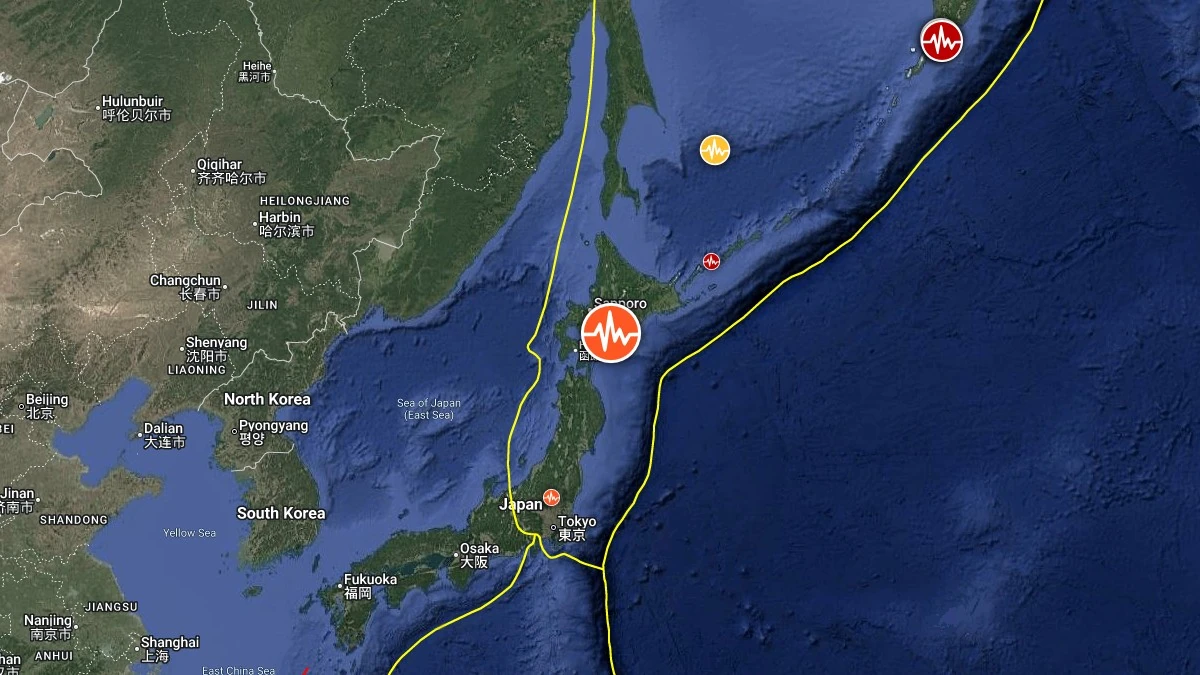
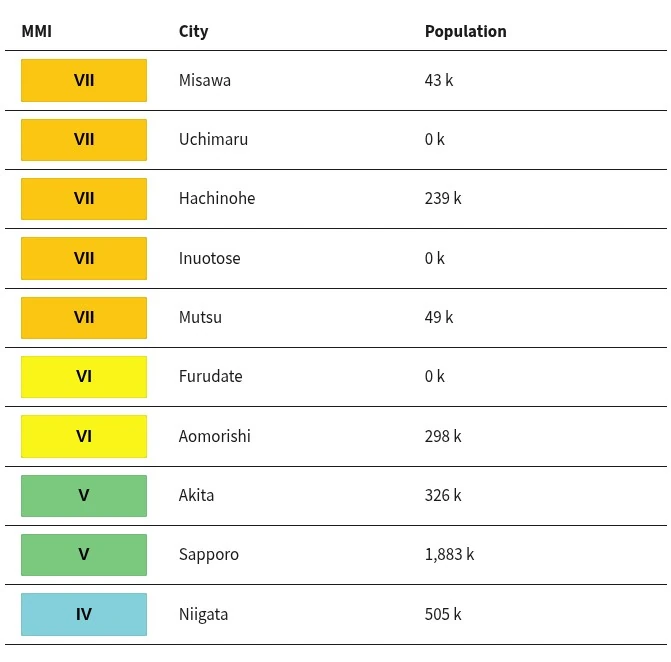
The epicenter was located 84 km (52 miles) ENE of Misawa (population 42 800), 77 km (48 miles) NE of Hachinohe (population 239 050), 89 km (55 miles) ESE of Mutsu (population 52 250), and 123 km (77 miles) E of Aomori (population 298 400), Aomori, Japan.
According to the Pacific Tsunami Warning Center (PTWC), hazardous tsunami waves are possible within 1 000 km (620 miles) of the epicenter. The threat includes the coastal areas of Japan and Russia.
The initial tsunami waves were expected to reach coastal areas within minutes of the earthquake. Estimated times of arrival (UTC) included 14:44 for Hachinohe, 14:58 for Kushiro, and 15:32 for Katsuura, Japan. Urup Island in Russia was expected around 15:43 UTC, followed by Hachijo-jima at 15:50 and Sapporo at 16:28 UTC.
Subsequent waves were forecast to reach Niigata at 16:48, Vladivostok at 17:04, and Shimane at 17:47 UTC. The Russian ports of Gastello and Vanino were forecast to see initial tsunami activity around 18:04 and 18:06 UTC, respectively.
PTWC reminded that actual arrival times may differ and that the first wave may not be the largest. Tsunami waves can occur in a series, with intervals ranging from five minutes to one hour.
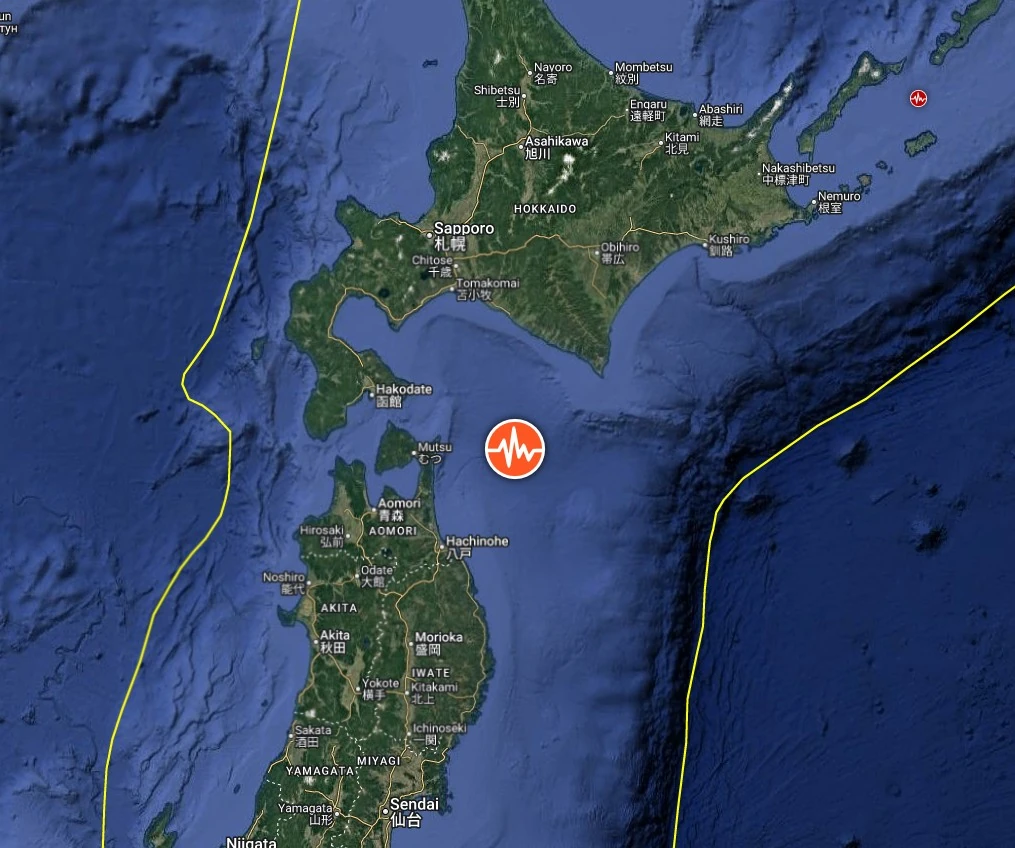 Epicenter of M7.6 earthquake off the east coast of Aomori Prefecture, Japan on December 8, 2025. Credit: TW/SAM, Google
According to USGS estimates, about 303 000 people experienced very strong shaking, 1 289 000 strong, 6 257 000 moderate, and 4 795 000 light shaking.
The USGS issued a Green alert for shaking-related fatalities and a Yellow alert for economic losses. There is a low likelihood of casualties. Some damage is possible and the impact should be relatively localized. Estimated economic losses are less than 1% of Japan’s GDP. Past events with this alert level have required a local or regional level response.
Overall, the population in this region resides in structures that are resistant to earthquake shaking, though vulnerable structures exist. The predominant vulnerable building types are adobe block and unreinforced brick with mud construction.
Recent earthquakes in this area have caused secondary hazards such as tsunamis, landslides, and fires that might have contributed to losses.
Liquefaction triggered by this earthquake is estimated to be significant in severity and/or spatial extent. The number of people living near areas that could have produced liquefaction in this earthquake is significant. Landslides triggered by this earthquake are estimated to be limited in number and/or spatial extent.
Update
07:45 UTC, December 9
The quake prompted immediate tsunami warnings for Aomori, Iwate, and Hokkaido prefectures, with predicted wave heights up to 3 m (10 feet). Observed tsunami amplitudes, however, were much smaller: about 70 cm (2.3 feet) in Kuji (Iwate) and 50 cm (1.6 feet) at other coastal stations.
Warnings were downgraded to advisories and lifted early on December 9 after no large destructive waves occurred.
By the morning of December 9, official updates indicated at least 30–35 injured nationwide, mostly from falling objects or accidents during evacuation. Roughly 90 000 residents were ordered to evacuate as a precaution against a potential tsunami. All warnings were lifted by early morning, and most residents returned home after inspection of the infrastructure.

The strongest shaking was felt in the eastern and southern parts of Aomori, with intensity 6- on the Japanese Shindo scale. Local authorities reported minor structural damage, including cracked walls and fallen roof tiles.
Approximately 2 700 households in the prefecture temporarily lost electricity, and two fires were reported in Hachinohe City. Several injuries occurred in a hotel where furniture fell during the shaking. At the Rokkasho nuclear reprocessing facility, a minor water spill was detected in a cooling system but no radiation leak or safety risk was found, according to the operator.
Along the Sanriku coast, the cities of Kuji and Miyako recorded the highest tsunami readings in Iwate Prefecture. Some harbor equipment and fishing vessels were slightly damaged by wave action. Several people suffered minor injuries from falling objects, and evacuations were carried out for tens of thousands in low-lying coastal zones. No fatalities were confirmed.
Southern Hokkaido recorded moderate shaking (intensity 4 on the Shindo scale). The quake triggered automatic stoppage of train services and temporary shutdowns of port facilities in Hakodate and Muroran. Local governments reported no major damage and no casualties.
Farther south, weaker but noticeable tremors were felt across Miyagi and Fukushima. No damage or injuries were recorded, but officials issued standard aftershock warnings.
High-speed Shinkansen services between Morioka and Hachinohe were suspended overnight for track inspections. Several local rail lines and expressways were temporarily closed but reopened after no major damage was found.
Power restoration was completed by early morning in the most affected areas.
At 02:00 JST on December 9, the Japan Meteorological Agency issued a statement assessing the likelihood of a new large-scale earthquake in northern Japan as relatively higher than normal.
According to the agency, the December 8 earthquake occurred within a seismically active zone influencing the hypothetical source area of a megathrust earthquake along the Japan Trench and Kuril Trench system, which extends from offshore Nemuro in Hokkaido to offshore Sanriku in Tohoku.
Estimated population exposure to earthquake shaking
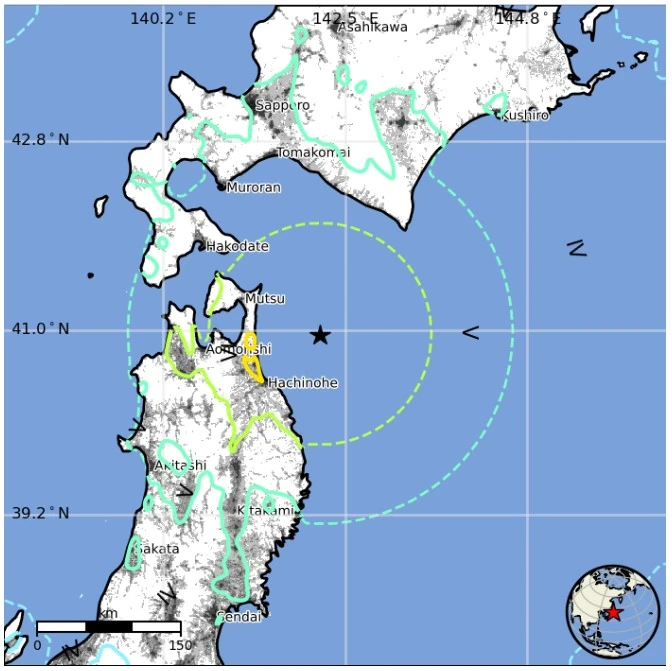 Image credit: USGS
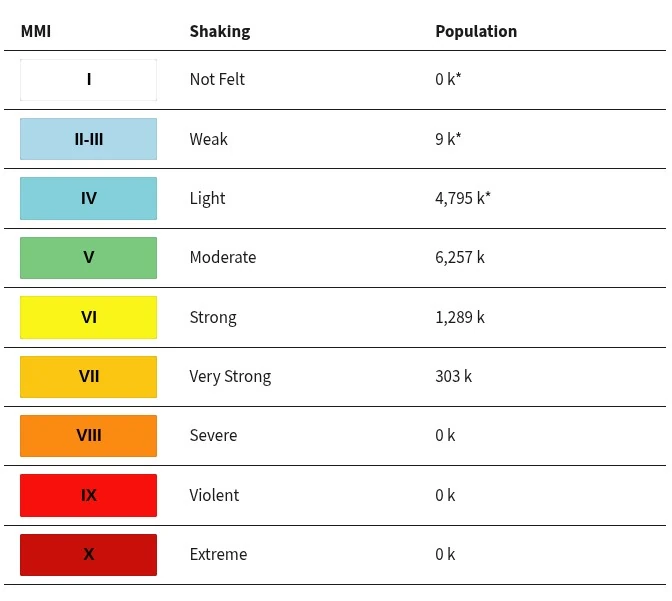
Selected cities exposed
Regional seismicity
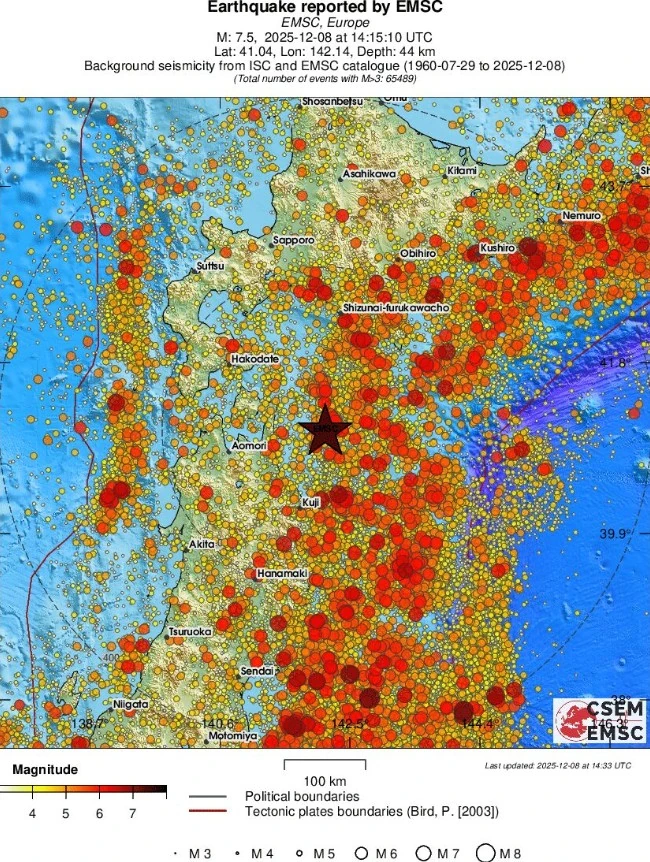 Image credit: EMSC
References:
1 M7.6 earthquake off the east coast of Aomori Prefecture, Japan — USGS — December 8, 2025
2 M7.5 earthquake Hokkaido, Japan region — EMSC — December 8, 2025
3 M7.6 earthquake off the east coast of Aomori Prefecture, Japan – NWS/PTWC – December 8, 2025
AloJapan.com