
REUTERS/JASON LEE/FILE PHOTO/FILE PHOTO/FILE PHOTO
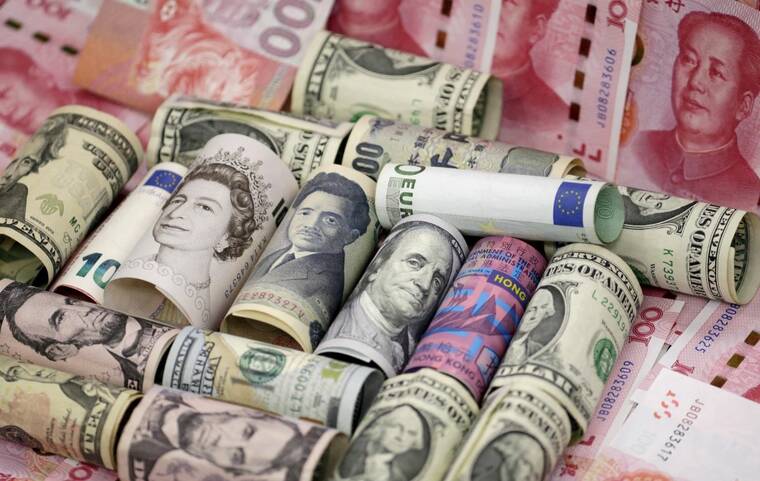
Euro, Hong Kong dollar, U.S. dollar, yen, pound and 100-yuan banknotes are seen in this picture illustration, in Beijing, China, in January 2016.
NEW YORK/LONDON >> The yen firmed against the U.S. dollar today after Japanese officials warned against “one-sided and sharp” currency moves, signaling readiness to take appropriate action in what analysts viewed as a clear hint of intervention.
The Japanese currency also gained support from a broadly weaker dollar, which has been under pressure since the Federal Reserve’s 25 basis-point rate cut at its December 10 policy meeting, analysts said.
“There was verbal intervention…by finance ministry officials, threatening actual intervention, which makes sense after the (Japan) rate hike. I didn’t think that intervention was likely until the BOJ (Bank of Japan) raised rates,” said Marc Chandler, chief market strategist at Bannockburn Global Forex in New York.
“Now that the BOJ raised rates, they can say that they’ve tightened monetary policy and that the yen is deviating from fundamentals. And so you’ve got a bit of short covering on the yen as a result.”
Atsushi Mimura, Japan’s top currency diplomat, told reporters today that recent FX moves were one-sided and sharp, adding that the government will take appropriate action against excessive moves.
Chief Cabinet Secretary Minoru Kihara also warned about the yen’s continued weakness and said it was important that “the currencies should move in a stable manner, reflecting fundamentals.”
Don’t miss out on what’s happening!
Stay in touch with breaking news, as it happens, conveniently in your email inbox. It’s FREE!
In midmorning trading, the dollar fell 0.5% against the yen to 156.96 yen, falling as low as 156.88.
Elsewhere, the dollar index slid 0.4% to 98.267, led by losses against the euro and yen. The index was on course to post its biggest yearly fall in eight years.
The euro rose 0.4% against the dollar to $1.1761, breaking a four-day decline last week. The European Central Bank left euro zone rates unchanged and effectively closed the door on rate cuts any time soon. The decision had been widely expected and ECB President Christine Lagarde has said numerous times the central bank is “in a good place” on monetary policy.
Sterling was also higher today against the dollar at $1.3448, up 0.6%, having ended the previous week fairly flat after the Bank of England cut rates. The BoE, however, suggested that there may not be many more in the pipeline, given inflation remains well above the central bank’s target.
The pound has risen 1.1% so far this month, bringing the gain for the year to around 7%.
The euro earlier hit a record high versus the yen of 184.92 , while the Swiss franc also rose to an all-time peak of 198.4 yen.
However, both pulled back a little bit, with the euro last flat on the day at 184.74 yen, while the Swiss currency last changed hands at 198.32 yen, still up 0.6%.
One of the drivers of yen weakness in recent weeks has been new Prime Minister Sanae Takaichi’s spending plan to boost growth and the impact that might have on Japan’s already strained finances. BOJ Governor Kazuo Ueda is due to speak at Japan’s Keidanren business lobby on December 25, which may offer markets another opportunity to parse any policy clues. Total spending in Japan’s draft budget for fiscal 2026 will probably exceed 120 trillion yen ($775 billion) to hit a new record, two government sources familiar with the matter said last week.
“Given these current risks and uncertainties, FX intervention is very unlikely to succeed without that indication from the government on managing fiscal policy risks appropriately,” said Derek Halpenny, MUFG head of research, Global Markets EMEA.
If the government cannot soothe some of those concerns, there is a risk JGB selling could pick up, further destabilising the yen and possibly forcing the Ministry of Finance’s hand, he said.
Additional reporting by Kevin Buckland in Tokyo and Gregor Stuart Hunter in Singapore.
AloJapan.com