
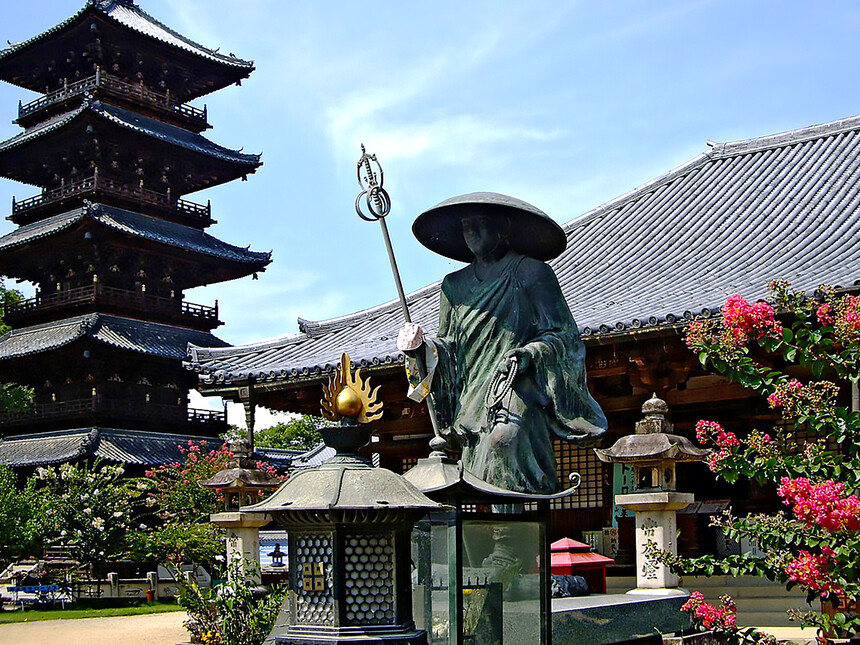
It was my second day walking the pilgrimage. The thin walls and crowded spaces of my previous night’s accommodation drove me into the chaotic aisles of a Don Quijote store, looking for earplugs. I received curious looks from almost every person inside, not because I was a tall, pale, tattooed foreigner in Japan, but because I was a tall, pale, tattooed foreigner wearing a traditional pilgrim’s outfit. My thin white robe (hakui), straw hat (sugegasa), and walking staff (kongōtsue) made me feel like part of the scenery on Kagawa’s verdant backroads and temple courtyards, but quite out of place whenever I found myself in more urban settings.
When leaving the store, I was approached by a trio of curious older ladies. With their shopping bags in hand, they enthusiastically cornered me, asking if I spoke Japanese. Breaking out my trusty Google Translate app, I quickly got to answering their questions, which mostly concerned where I was from and why I chose to walk this pilgrimage, the Shikoku Henro. In all honesty, the latter was a question I asked myself many times while walking from temple to temple that week, and one that never quite provided me with a clear answer.
A modern pilgrimage
Why did I travel halfway across the world, dress up in a traditional outfit, and walk part of a pilgrimage that I had no religious or cultural connection to? Of course, the obvious answer would be to broaden my horizons and learn more about Shikoku’s cultural heritage. But I could just as easily have done that with a few well-planned day trips, to be honest.
Another obvious reason would be a professional one: I was paid to visit and promote this part of Shikoku. If nothing else, it would allow me to write about the region and strike this item off my international to-do list.
But even if these seemingly mundane reasons merely set my feet onto one of Shikoku’s most religious and cultural landmarks, it would seem inevitable that I would eventually find deeper meaning in the pursuit of yet another temple stamp.
Maybe this pilgrimage was the perfect reason to explore questions that have been roaming around the back of my mind for a while now. Like, why am I pursuing this career of travel writing, and what actually drives me to keep going, trail after trail? How long do I plan on maintaining this permanent travel lifestyle? Would living in one place actually bring me comfort at this stage? And what is comfort to me, really?
Not that I felt ready to settle down yet, in any way. But after spending years building a sustainable source of income from freelance work, it was high time I took another good look at my life and where it was headed. After all, I didn’t start this traveling lifestyle to sit behind a laptop. I knew my next challenge would be to balance adventurous travel and becoming a full-time travel writer with freelance work that provided an actual income. And what better place to find balance than in a series of Buddhist temples?
Wishes and clarity
I would stop at each temple, perform a simple ritual of washing hands, approach a shrine with osameifuda (paper prayer slips) in hand, and deposit them in the appropriate box before clapping my hands together and making a wish (a foreigner’s alternative to reciting suitable prayers). As it turns out, thinking about what to wish for next is a great way to get your life’s priorities straightened out.
My first wishes were of a more generic nature, wishing good health and prosperity on myself and those close to me. But as the second day of meditative walking came around and the storm of thoughts in my head calmed down, I was better able to focus my musings on my immediate surroundings and the deeper meaning behind my life choices. These were the thoughts running through my head as I made my way from one temple to the next, along bamboo forest trails, hidden ponds, and ancient, overgrown mountain paths as half-hidden shrines and deity statues looked on from the undergrowth.
The ‘why’ of my travels became clearer to me as I looked around and saw nothing but beauty in an exotic culture that, with every trip, slowly seemed to reveal more of itself to me. This was why I dreamt of traveling the world full-time, why I left everything behind all those years ago. So what was I missing? Why did the idea of seeing new places not fill me with as much excitement as before?
Digging for motivations
I felt like I had already fulfilled my dreams, that I had granted my old wishes a while ago. I achieved self-actualization, and I’d proven to myself that I could handle most anything thrown at me. What new goal would set right this mixed-up Maslow pyramid that my life had become?
Traveling the world professionally was no longer enough of a goal for me; that much was clear. It’s the meaning behind the travels, the deeper motivations that this aging traveler needed to rediscover. And like an archeologist scraping away at layers of dirt built up over years of solo travel, I uncovered an old but well-known quote in the back of my head:
Happiness is only real when shared.
During the first years of my travels, I fervently kept up with my blogging, sharing my adventures in near-real time with the world. As Covid hit and my travels slowed down, I hit a bump but recovered eventually to find myself pursuing a more sustainable way of funding my travels. I found a way, but it came at the cost of losing a lot of the spontaneous freedom that drove me in those early years. And as a result, my enthusiasm for sharing my stories died down as well. I was no doubt successful in my goals, but it seemed I forgot to fulfill the deeper needs and motivations that were supposed to drive these ambitions.
After this realization, my wishes at each temple turned to a different nature. I wished for fortuitous meetings to lead me into new adventures, and I wished for making new interesting friends that would help me broaden my horizons. And I wished for something I wasn’t used to wishing for: an adventurous partner by my side to share endless scenic sunsets and open roads with; in other words, to find comfort in the presence of another.
Osettai
Osettai is a concept that is intrinsically woven into the Shikoku Henro and its etiquette: a way of showing support and kindness to strangers, and thereby indirectly becoming part of their pilgrimage and sharing in the blessings they receive.
As it turned out, the three older ladies that cornered me outside the Don Quixote store intended to show me osettai by offering me a small amount of money after they finished satiating their curiosity. Knowing the proper response, I thanked them, graciously accepted their gift, and presented each with an osameifuda with my name and country written on it. In the following days, I would receive similar shows of support from strangers: bits of candy, a refreshing sports drink, or even just a seat on a bench.
The concept of sharing, whether it is happiness or blessings, was fittingly interwoven with my short pilgrimage. And even though I only walked the last five days of a trail that usually takes almost two months to complete, I felt like I made the right choice in choosing this section.
Kagawa prefecture is the final stage for those walking the Shikoku Henro in its entirety, and it is known as the least ‘green’ section of the pilgrimage. Regardless, I feel that it is not to be underestimated. In my opinion, the alternating sections of green mountain paths with urban backstreets and alleyways actually are what make this stage unique, offering up glimpses of daily urban life and chance encounters with local curiosity.
Rejuvenation
For me, walking across Kagawa provided an insightful balance between the old and the new, between introspection and generous social interaction. My starting suspicion that this trail would inevitably turn my thoughts to deeper meaning proved correct, as the Shikoku Henro provided me with a renewed sense of purpose and fresh insights into the motivations behind my life choices. I never expected this when I started this five-day mini-pilgrimage, but I felt rejuvenated in a way, ready for a second wind in my travel exploits. I would keep my dreams alive by sharing them with more people, enriching them in new ways.
All this crossed my mind as I made my way uphill on the last day, following quiet, asphalted roads while a light rain summoned an enchanting fog that permeated the jungle around me. Okubo Temple, the final temple of the Shikoku Henro, waited somewhere in the mist ahead. It promised an end to the long days of walking, but not the end of my life as a traveler.
AloJapan.com