
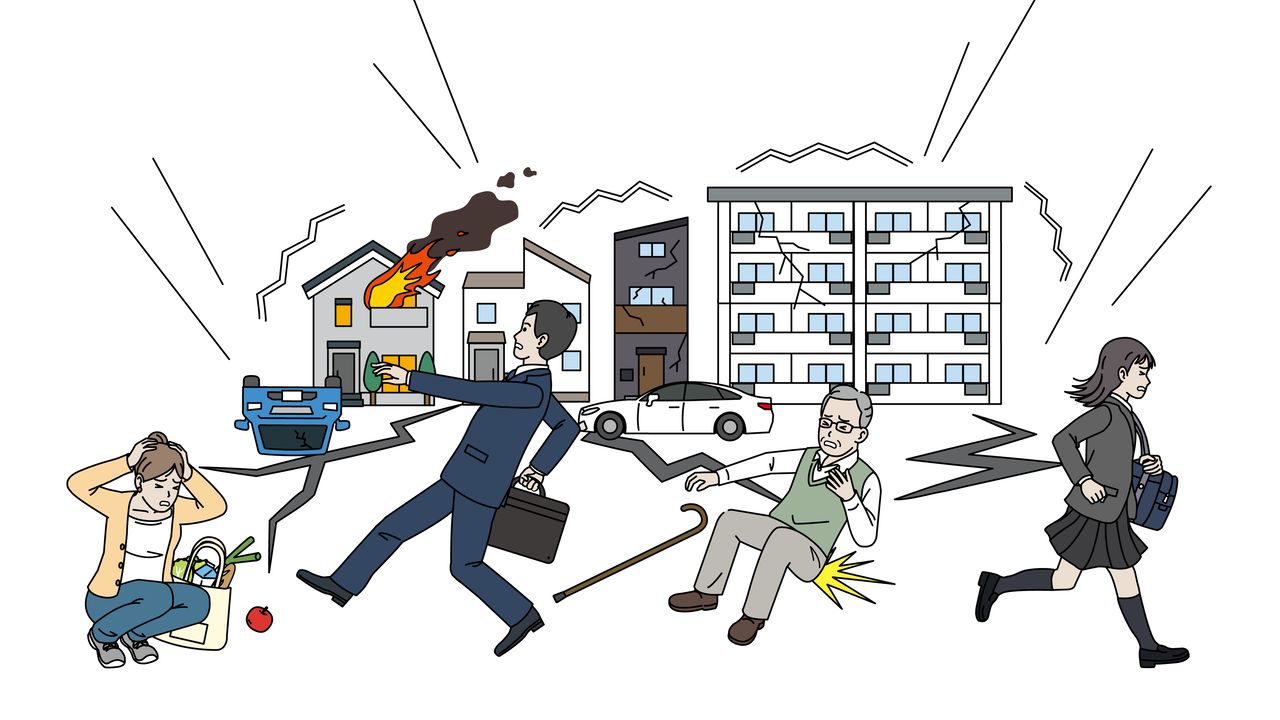
A report by Japan’s Central Disaster Management Council projected that a huge earthquake under central Tokyo could kill up to 18,000 people and cause financial losses of ¥83 trillion.
Revised Disaster Projections: Slightly Better than in 2013
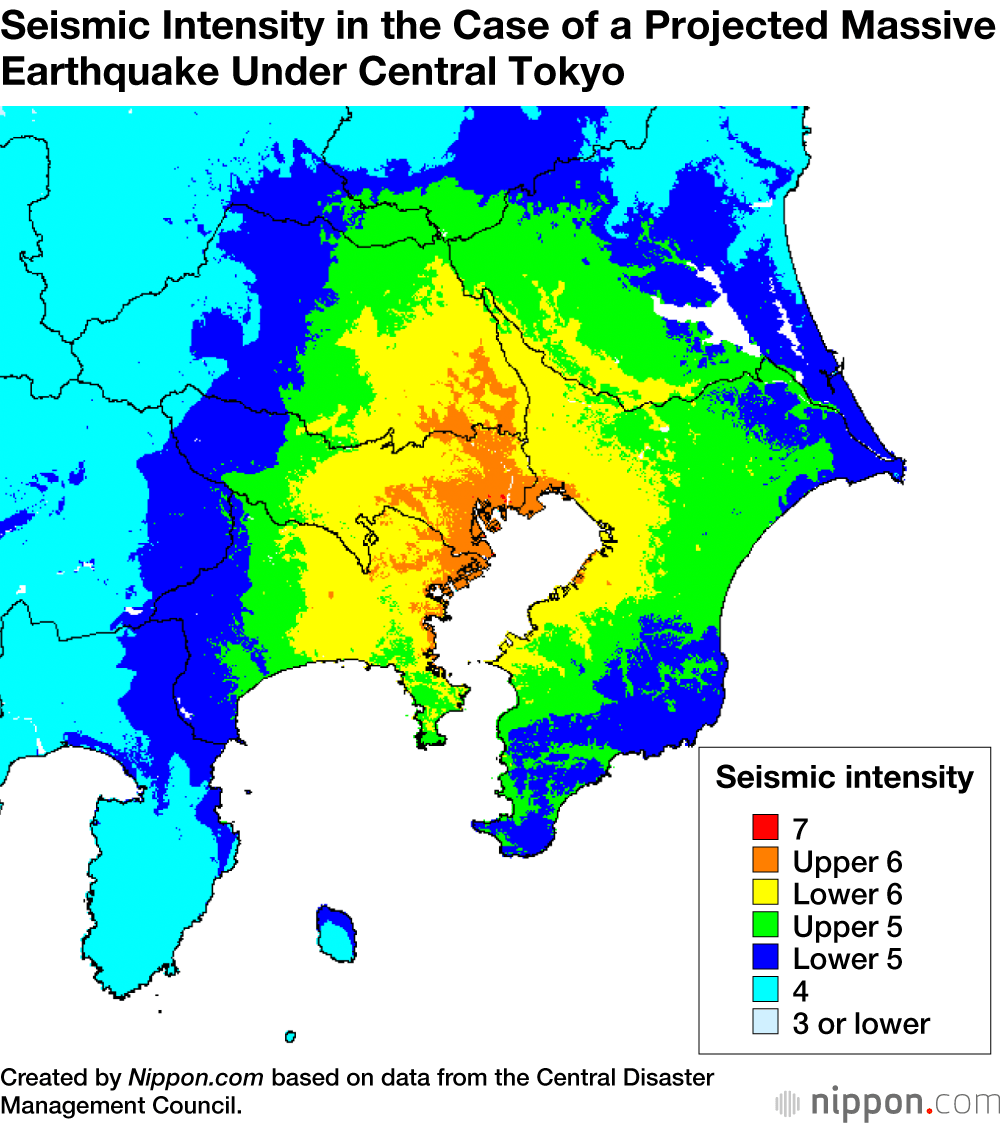
According to the Japanese government’s latest estimates, a magnitude-7 earthquake centered on central southern Tokyo would lead to widespread shaking of upper 6 on the Japanese seismic intensity scale. A worst-case scenario would see 18,000 deaths, mainly in the prefectures of Tokyo, Kanagawa, Saitama, and Chiba, and financial losses of ¥83 trillion.
This scenario is based on winds of 8 meters per second spreading earthquake-sparked fires at six in the evening in winter, which is the driest time of year. At 400,000, the number of buildings forecast to be destroyed or burned down would be more than 30% lower than in an estimate released in 2013, due to earthquake-proofing, wider adoption of circuit breakers that turn off automatically in the case of a major earthquake, and reduced use of open flames.
Of the buildings destroyed in the disaster model, 110,000 are forecast to be destroyed by the tremor and 270,000 by fire. The estimated fatalities from fire, at 12,000, are also greater than those due to the earthquake itself, at 5,300. Apart from these direct deaths, there would also be between 16,000 and 41,000 disaster-related deaths.
Power outages would affect up to 16 million households immediately after the earthquake, due to stoppages of thermal power plants around Tokyo Bay, and disruption to supply caused by issues including damage to utility poles.
Around half of telephone landlines in the four central prefectures would be unusable due to power cuts. There would also be the risk of half of mobile phone base stations in these prefectures shutting down because of power cuts and damage to communication cables. If emergency power for data centers falls short of what is needed, the internet may also become inaccessible.
Damage to water purification plants and pump stations would lead to 14 million people facing cuts to the water supply. If sewer treatment plants suffer damage, this could also cause disruptions. Restoring water and sewage services could take more than a month due to issues such as a lack of personnel and materials.
Projected Effects of a Massive Earthquake Under Tokyo
Created by Nippon.com based on data from the Central Disaster Management Council.
Data Sources
(Translated from Japanese. Banner photo © Pixta.)
AloJapan.com