
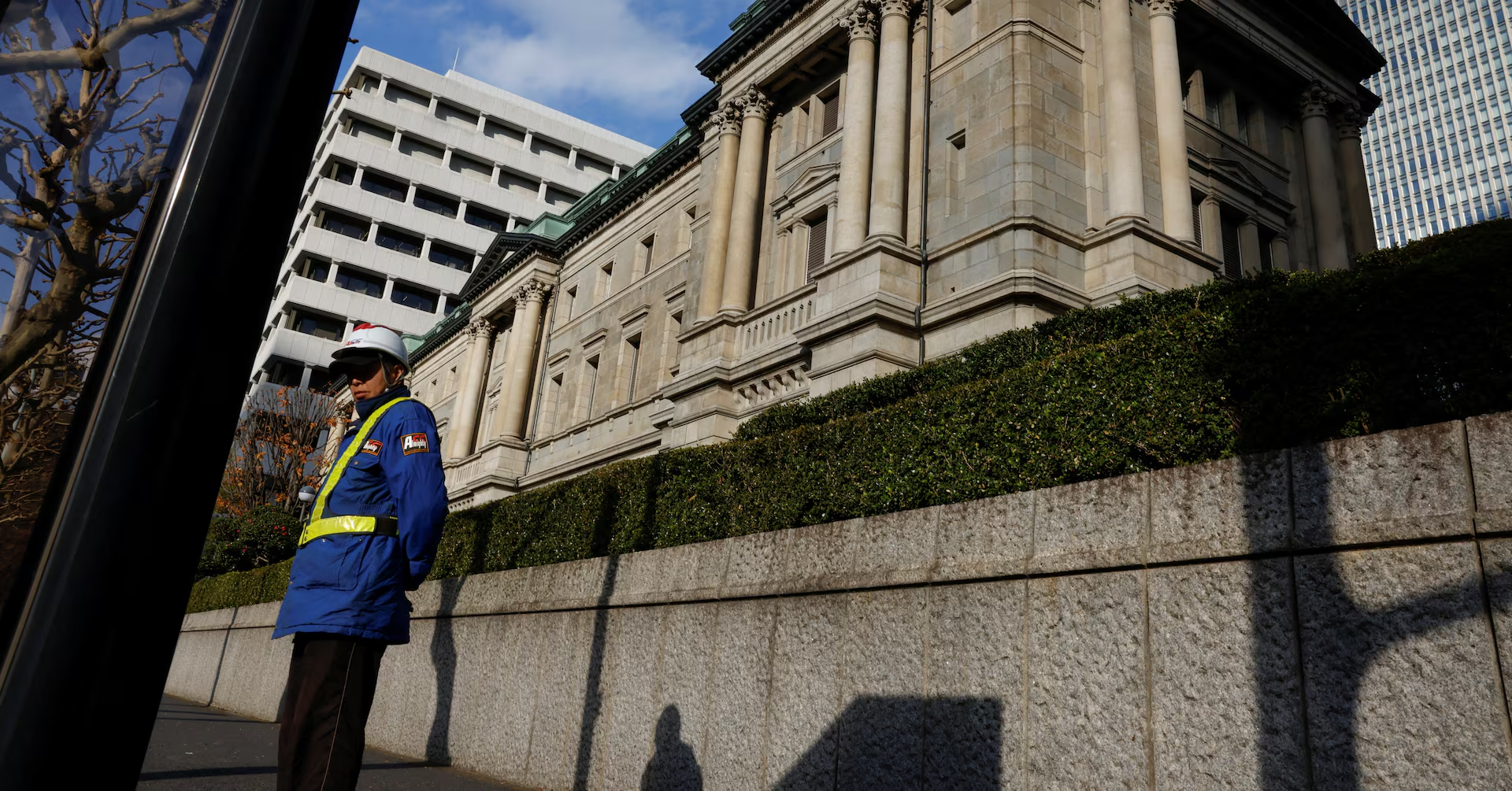
Dec 19 (Reuters) – The Bank of Japan raised interest rates on Friday to levels unseen in three decades, taking another landmark step in ending decades of huge monetary support and near-zero borrowing costs.
As widely expected, the central bank raised short-term interest rates to 0.75% from 0.5% by a unanimous vote.
Sign up here.
COMMENTS
BART WAKABAYASHI, BRANCH MANAGER, STATE STREET, TOKYO:
“I know it’s only three quarters of a percentage but it’s pretty historic. We haven’t been at this level for three decades, so I think it’s a significant move.
“(But) going forward, I think it’s going, at least data-wise, it’s more difficult for the BOJ to move.”
RAY ATTRILL, HEAD OF FX RESEARCH, NATIONAL AUSTRALIA BANK, SYDNEY:
“Arguably, (it’s) been sort of ‘buy the yen rumour, sell the fact’, I think, with no obvious hawkish tinges in the statement, other than we’ve obviously got two members who have got a somewhat more hawkish take on inflation than the majority view.
“I would think that the central view should be that BOJ Governor Ueda is going to be his usual ambiguous self… and probably just reiterate that view that we will continue to normalise policy if the outlook is realised, which doesn’t really give markets anything to go on. So, you’d have to deviate from that line, I think, to create a surprise, one way or the other that would likely move the yen.”
KIERAN WILLIAMS, HEAD OF ASIA FX, INTOUCH CAPITAL MARKETS, LONDON:
“There appeared to be a hawkish shift in the tone of the statement, with reduced uncertainty around the U.S. economy and trade policy, as well as dissent from Takata and Tamura pointing to a debate over the pace of normalisation. The post‑decision rise in USDJPY does suggest market scepticism that Ueda will commit to a forceful hiking path at the press conference. Focus will be on the outlook for future hikes and terminal rates.”
“Looking ahead to 2026, if Ueda credibly signals further hikes, USDJPY likely pushes lower, especially amid signs of a dovish Fed and benign inflationary environment in the U.S. However, if Ueda strikes a more cautious note, then the late 2025 highs around 158 look vulnerable.”
YUXUAN TANG, GLOBAL MARKET STRATEGIST, J.P. MORGAN PRIVATE BANK, HONG KONG:
“All eyes now turn to Ueda’s press conference. We’ll be watching closely for his remarks on real interest rates, which are still deeply negative, and what that signals for the policy path ahead. His outlook on the upcoming Shunto wage negotiations will also be critical. The results there will largely determine the timing of the next rate move. One key reason for the BOJ’s cautious approach in policy normalisation is that the real wage growth remains in negative territory.”
TAKAYUKI MIYAJIMA, SENIOR ECONOMIST AT SONY FINANCIAL GROUP, TOKYO:
“The BOJ said in a statement that real interest rates are expected to remain significantly negative after the change in the policy. This indicates more rate hikes could follow after today’s rate hike.”
TARECK HORCHANI, HEAD OF DEALING, PRIME BROKERAGE, MAYBANK SECURITIES, SINGAPORE:
“While the market acknowledges more hikes could come, it’s not fully buying into a fast or aggressive path. It’s still very dependent on wage growth momentum and inflation durability, which aren’t fully entrenched.
“If I had to guess, I’d say macro and policy divergence are still favouring USD/JPY upside in the near term unless Ueda’s press conference gets more hawkish. But the BOJ is clearly trying to build room to tighten further if needed, and that neutral rate comment (‘significantly low’ now) might be a quiet signal that 1% is just the beginning.”
KANAKO NAKAMURA, ECONOMIST, DAIWA INSTITUTE OF RESEARCH, TOKYO:
“Looking ahead, it will be important for Ueda to signal a somewhat stronger, more hawkish stance on the pace of future rate hikes. As the government’s large economic stimulus package and aggressive fiscal policy have contributed to yen depreciation, political intervention in the BOJ’s monetary policy could further exacerbate yen weakness.”
TOHRU SASAKI, CHIEF STRATEGIST, FUKUOKA FINANCIAL GROUP AND FORMER BANK OF JAPAN OFFICIAL, TOKYO:
“From the beginning, the focus today is the press conference by Ueda. The BOJ is getting more and more behind the curve. So, today could be a good chance to catch up with the market and show a little bit hawkishness towards next year. So, if Ueda-san is not hawkish enough, I think the yen will continue to depreciate.”
YOSHIRO SATO, ECONOMIST AT RESONA HOLDINGS, TOKYO:
“The BOJ said in a statement that real interest rates are at ‘significantly’ low levels. This indicates a risk that the BOJ’s terminal rate is higher than our expectation of 1%.”
TOM KENNY, SENIOR INTERNATIONAL ECONOMIST, ANZ, SYDNEY:
“The BOJ seems more upbeat on the economy and prospects for securing 2% inflation sustainably relative to October MPM. The BOJ says it’s ‘highly likely’ that the mechanism in which both wages and prices rise will be maintained. The BOJ states real interest rates remain significantly low (and thus stimulatory). This points to further tightening from the BOJ. How much so? Over to Ueda later this afternoon for guidance.
“We have just one more hike of 25bp (taking policy rate to 1%) in April 2026.”
MASATO KOIKE, SENIOR ECONOMIST, SOMPO INSTITUTE PLUS, TOKYO:
“The hike went through as expected. But depending on Ueda’s press conference, we may get information about the neutral rate. Depending on the nuance – whether this was a hawkish or a more dovish hike – there’s also a risk the yen could weaken further.”
BEN BENNETT, HEAD OF INVESTMENT STRATEGY FOR ASIA, L&G ASSET MANAGEMENT, HONG KONG:
“The decision to hike rates was widely expected, so the market reaction has been muted. The key will be how much Ueda focuses on future rate hikes in the press conference and whether he hints at the pace of such hikes. The yen is likely to be sensitive to any such clarification. Having weakened a fair amount in recent months, we quite like the upside potential for the currency here.”
HIROFUMI SUZUKI, CHIEF FX STRATEGIST, SMBC, TOKYO:
“Looking ahead, the BOJ is likely to continue hiking rates gradually without explicitly indicating where it sees the terminal rate. At the same time, a rapid pace of tightening is not expected, and downward pressure on the yen in the FX market is likely to remain persistent.”
NORIHIRO YAMAGUCHI, LEAD JAPAN ECONOMIST, OXFORD ECONOMICS, TOKYO:
“The hike was no surprise… The market’s attention will be more on the press conference later. While it is unlikely for Ueda to talk about the neutral rate given the central bank’s stance thus far, he is likely to emphasise that they will hike further to fend off yen depreciation pressures. Otherwise, the yen will depreciate and bond yields will turn lower.
“Based on recent Reuters reporting, the government is likely to accept a few further hikes. My baseline outlook is that the BOJ will hike again in June 2026, after monitoring the impact of today’s rate hike on the real economy and examining pay rises among SMEs. But what has persuaded the government to accept rate hikes is largely yen weakness, and the BOJ could find it more difficult to justify further hikes if pressure on the yen fades.”
CHRISTOPHER WONG, CURRENCY STRATEGIST, OCBC, SINGAPORE:
“The hike was largely priced in, shifting market attention squarely to Ueda’s press conference for signals beyond the immediate decision.
“The yen initially strengthened but quickly surrendered those gains, in part reflecting thin market liquidity that amplified short-term price action rather than a reassessment of fundamentals.
“A sustained recovery in the yen is therefore unlikely to be driven by this move alone. It would require clearer and more assertive forward guidance from the BOJ, complementary fiscal discipline from policymakers, and a supportive external backdrop, most notably a softer U.S. dollar.”
MEL SIEW, ASIA CREDIT PORTFOLIO MANAGER, MUZINICH & CO, SINGAPORE:
“Today’s rate rise was well signalled by Ueda’s speech at the start of December and largely expected by markets. Having been a major funding currency for a sustained period of time, we expect the Bank of Japan to remain gradualist in its approach to normalising monetary policy and to clearly signal any future changes.”
“We think Japanese corporates will increasing look to the offshore U.S. Dollar credit market for funding over their domestic bond market. Pressure on credit spreads from increased issuance will be offset by solid economic growth and strong corporate credit fundamentals, as well as by continued investor appetite for Japanese corporate credit.”
SHOKI OMORI, CHIEF DESK STRATEGIST, MIZUHO SECURITIES, TOKYO:
“Markets finally got through the monetary policy meeting and are feeling a sense of relief at the as-expected result.
“I do not see a major impact on rates. On the other hand, given that USD/JPY investors were feeling cautious going into the meeting, the yen was strengthening, but after the result came out, it resumed weakening. USD/JPY could fall if the dollar weakens depending on the state of the U.S. economy. But from the yen side, carry traders will push the yen lower and USD/JPY is likely to rise further.
“JGB markets will revert to being driven by supply/demand factors, with investors focused more on bond issuance rather than macro fundamentals.”
MASAHIKO LOO, SENIOR FIXED INCOME STRATEGIST, STATE STREET INVESTMENT MANAGEMENT, TOKYO:
“The market may interpret the hike as dovish, causing short-term JPY volatility. Longer-term target of 135–140 remains intact, supported by Fed easing and Japanese investors raising hedging ratios from historically low levels.
“Focus now shifts to Ueda’s press conference tone and forward guidance — likely neutral, signalling gradual normalisation into 2026–27 without leaning too dovish or hawkish. Ueda faces a delicate balancing act.”
Reporting by Reuters Asia markets team; Editing by Subhranshu Sahu
Our Standards: The Thomson Reuters Trust Principles., opens new tab
Purchase Licensing Rights
AloJapan.com