
MASAKI FURUMAYA / THE JAPAN NEWS / 2022
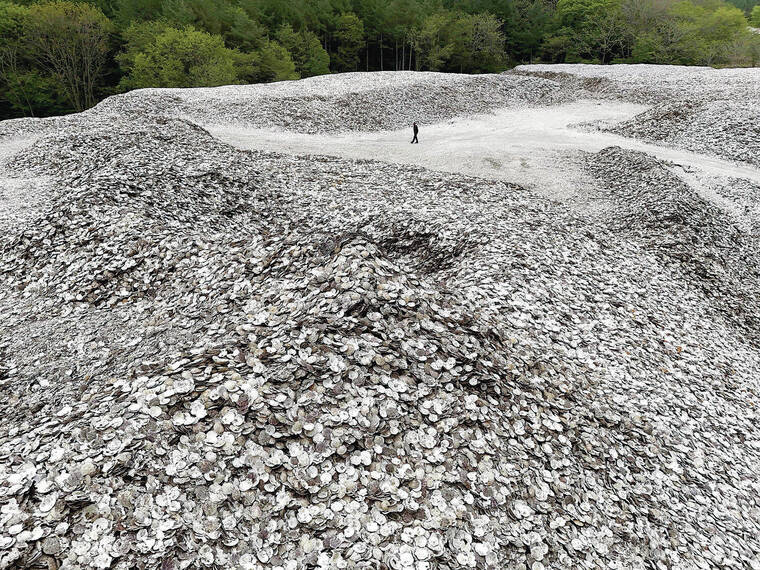
Hokkaido boasts the largest catch of scallops in Japan, and a research group there is studying methods for recycling the shells. A sea of scallop shells blanket a lot in Hokkaido’s Yubetsu town.
TOKYO >> Hills of white scallop shells were piling up in Yubetsu, a town facing the Sea of Okhotsk in Hokkaido. They looked like out-of-season snow mounds.
The shells blanketed every free space on a lot operated by Kyoritsu Sangyo, a company that processes seashells.
Scallop shells are often recycled for farmland drainage ditches and other purposes. But work on the ditches has slowed because of price hikes, lowering the demand for shells.
“We have had an ongoing excess of shells for a few years now,” said Masao Sasaki, president of the company, anxiously.
Yet the piles of shells at the site in Hokkaido have the potential to become treasure troves.
Hokkaido boasts the largest catch of scallops in Japan, and the Industrial Research Institute, a part of the larger Hokkaido Research Organization in Kita ward, Sapporo, has been studying methods for recycling scallop shells, hundreds of thousands of tons of which are disposed of every year.
Don’t miss out on what’s happening!
Stay in touch with breaking news, as it happens, conveniently in your email inbox. It’s FREE!
In 2005, the institute collaborated with chalk maker Nihon Rikagaku Industry Co. to develop chalk using the shells.
The chalk is made from shells crushed into 5-micrometer (about .0002 inch) particles and has resulted in a new product that users say is smoother to write with and more durable.
Because of increasing environmental awareness, scallop shells are gaining attention as a biomass material, since mixing crushed shells with plastics can reduce petroleum use.
In fact, the mixture has already been put to practical use to create food trays, and tests are underway to see if the material can be used for interior car parts.
In addition, “hotamet” (a combination of “helmet” and “hotate,” the Japanese word for scallops) were put to use at the 2025 Osaka-Kansai Expo as disaster equipment and for bicycle safety. The helmets were made of a resin that comprised 10% crushed scallop shells from Hokkaido.
“It’s so unexpected (that) a chalk ingredient could become biomass material,” said Kazuhito Nishikawa, head of the Nihon Rikagaku Industry plant in Bibai, Hokkaido, that manufactures the chalk.
AloJapan.com