
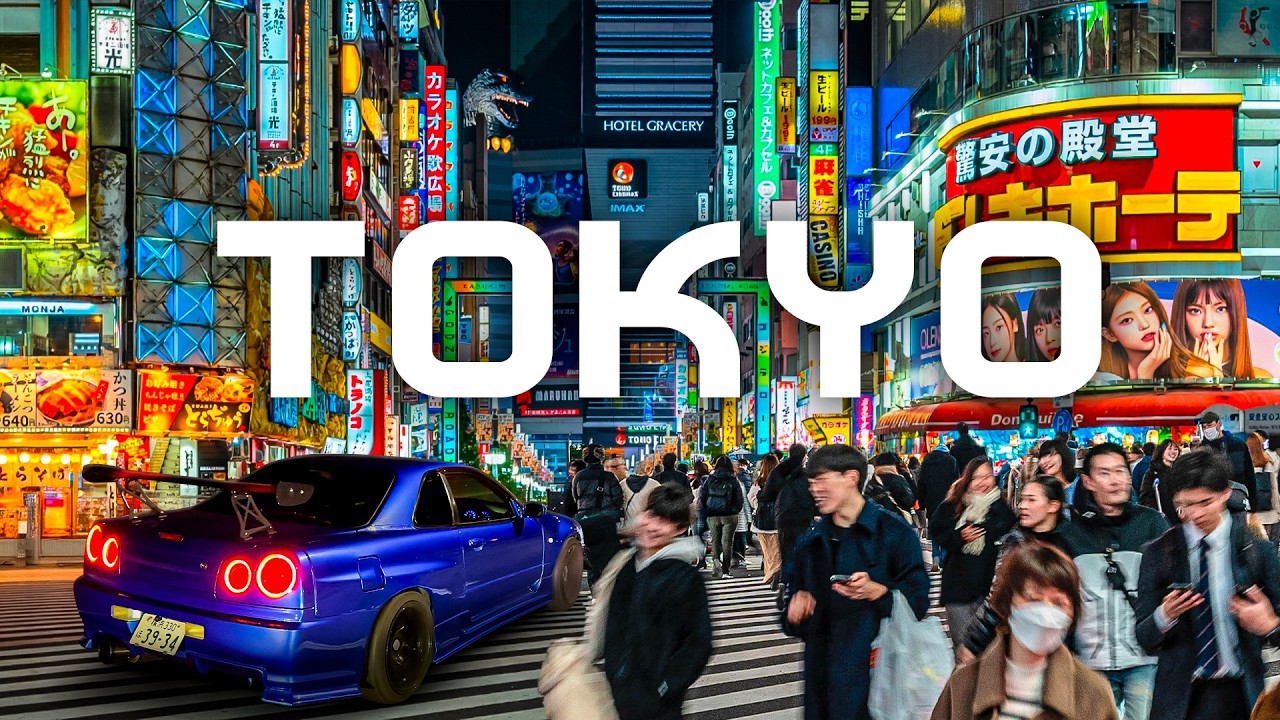
Tokyo: A City That Feels Like Another Planet
What's up, guys? Cool Vision here. Welcome to Tokyo. Tokyo, yo, Yoga. Ah. Starting right at the Imperial Palace, where samurai history meets a mega city of nearly 40 million people. neon lights, temples, JDM cars, sushi, and crazy intersections. And somehow all this chaos seems to be perfectly under control. So, let's dive in. In this video, we'll dive into Tokyo's underground car culture, its busiest streets, its gaming obsession, its legendary food scene, and even see how locals live on the outskirts of the city. This should be fun. Let's go. The city served by two major airports. Narita and Hanetta. I flew into Narita. Even on the high-speed train, it took about 1 hour and 20 minutes to reach central Tokyo. So, if you can choose, go with Hanetta. You're downtown in 20 to 30 minutes. Climate wise, Tokyo is kind of like New York, only slightly warmer. I'm here in November, 14 to 21°, basically ideal for filming, or maybe even for wearing flip flops like this guy. Now, let's dive into Tokyo's districts, Shibuya. My first hotel was in Shibuya, and honestly, it felt overwhelming. After a long flight, I was like, "Wow, crowds and crowds of people, traffic, go-karts, a literal sea of motion." This is the Tokyo that most people imagine. No surprise, it's home to the busiest pedestrian crossing in the world, the Shabuya Scramble, where thousands move at once in what seems like chaotic perfection. Over 2.4 million people cross here every single day. Right next to it stands Hachiko, the statue of the loyal dog who waited for his owner for almost 10 years after he passed away. They even made a film about it. Hachi, a dog's tale. If you haven't watched it, prepare to cry. Head up to Shabuya Sky, one of the best viewpoints in the city with a full 360° panorama. There's even a green lawn where people can lie down and watch the skyline drift by. But booking it for sunset is impossible though, even two weeks in advance. Shibuya feels futuristic during the day. Rooftop parks, open air yoga, random surprises, but after sunset, it switches to full Tokyo mode. Neon JDM cars, ramen, and loud night life. Did I just mention ramen? Yes, it's everywhere. And no two bowls are the same. They use different noodles like udon and soba. And every shop claims their ramen is the one. I even tried blue ramen. Yes, blue. I was like, what? Turned out it was a limited special dedicated to the blue-haired anime character, Hatsuni Miku. Yes, only in Tokyo. If you need a break, walk just a few blocks and suddenly you're under the forest canopy of Yoy Yogi Park where locals come to jog or walk their dogs. Right beside it is major shrine that sits in the middle of a forest of 100,000 trees donated from all over Japan. And even though it's in central Tokyo, it feels completely cut off from the rest of the city. >> Yeah. It's one of Tokyo's most important spiritual sites. I visited on November 3rd at the time of Autumn Grand Festival with archery, iikido, and horseback performances. Really got lucky. >> Harajuku is Tokyo's playground for fashion, color, and pure creativity. Takashidita Street feels like a live fashion show. Crepe stands in every flavor. Wild outfits, cosplay, teenagers dressed like anime characters, and girls in meticulously styled dolllike costumes. Capsule toy machines. They're everywhere. At first, I thought they were just for kids, but no, they're not. Everybody plays. >> So, which one got you excited, >> bro? The Hello Kitty clocks. The Hello Kitty clock cuz they're super cute. >> People get totally hooked. Tokyo has tens of thousands of them. stock rotates all the time and that's why it's so addictive. >> I'm going for these purses. They're really cute and I think my daughters will appreciate them. >> Wow. >> Isn't that cute? >> Yeah. Very >> beautiful. >> It's very beautiful. Wow. >> Then I found Cafe Reissue where your latte isn't just a drink. It's art. They can print your face, your pet, even anime characters in 3D foam. So, what do you think? Did they nail it? I think it's so good I'll use it for my passport. I think it's me. >> Walk just a few blocks and the vibe shifts completely. This is Omatando. Often called Tokyo Shamsiz. Wide elegant streets lined with designer boutiques. Avenguard architecture. Stale fashion but more mature, refined and polished. Now, a short train ride and we are in Shinjuku, a forest of skyscrapers and non-stop energy. Shinjjuku is home to the Tokyo Metropolitan Government Building, the place that basically runs this entire mega city. And the best part, there are observation decks on top that you can visit for free. Shinjjuku station is one of the busiest in the world, handling over 3 million passengers a day. It's overwhelming and confusing. But step outside and Tokyo flexes. Right above the station, there is that 3D cat billboard, ultra realistic, 9 m wide, casually staring down at thousands of people every hour. And on the street below, I stumbled upon a guy freestyle rapping. I couldn't understand a word, but I love the energy. Nice. >> Shinjjuku has a wilder side. Kabucho, Tokyo's red light district. This is where you'll spot the iconic Godzilla head towering over hotel gracery. Surrounded by restaurants, hostess bars, host clubs, love hotels, and massage parlor. Historically, parts of this area were linked to the Yakuza, Japan's organized crime groups. Officially, the government has cracked down hard, and their presence today is far less visible. I noticed a line of girls standing on the street. Locals told me they usually promote bars or clubs. One thing for sure, they were not big fans of my camera. To me, this is the most hipster Connor of Tokyo. >> For food lovers, Shinjuku is legendary. Visit places like Amo Yako, also known as the piss alley. It got that name after World War II when there were no toilets here. It's a nostalgic glimpse into post-war Tokyo. Smoky yakitori stalls, tiny eeries where you squeeze in shoulderto-shoulder sips sake and try local delicacies. I ordered some yakitori and beer. And this is where I made some friends. >> We called bean beer. It's Japanese traditional style beer. >> I think I got the same one. >> Yeah. Yeah, you're right. And what did you order to eat? >> Squid like a pork internal organ like a Yeah, I like here. >> Very nice. And what do you do for a living? >> Uh I'm a trainer. So >> Wow. Horse riding. >> Yeah. Yeah. >> Cheers, guys. Cheers. >> Cheers, guys. My new friend suggested we get some more beer at another popular location, Golden Guy. It's a maze of narrow alleys with tiny bars, often just five to eight seats, each with its own personality, full of locals and visitors alike coming here for late night conversations. >> Was it your face? >> No, it was like just straight up face. It was like >> getting around Tokyo is easier than it looks. Grab a SUI card, top it up once, and use it on almost everything. Metro, JR trains, buses, and even convenience stores. Then just follow Google Maps. It tells you exactly which line, platform, and even which train car to get on. >> The JR Yamanote line, Tokyo Circle route, loops around most major districts. Buses work great, too. But here's the rule I learned the hard way. You enter through the front door and exit through the middle. I try to hop in through the middle. The driver looked at me for two seconds and then just drove off. >> Try this one. Oh. Oh, wait a second. >> I was mad. But then I realized in Tokyo rules come before improvisation. >> Second try. I'm going to nail it this time. >> Front door. Oh, it worked. >> For short trips, taxis can actually be faster. If Google Map says 40 minutes by subway and 20 by taxi, believe it. The cars are similar to London cabs. Spacious, comfortable, and doors open automatically. >> Opens automatically. >> This is my taxi. Very, very nice. >> And the best part, you actually get to see the city while moving. The bridges, overpasses, and those layers of roads stack like some futuristic video game. With the metro, you basically vanish underground and respond somewhere else. Efficient, yes, but without ever seeing how Tokyo connects. Now, let's jump to Rapani, where Tokyo goes international. Embassies, expats, high-end night life, art galleries, and rooftop lounges. By day, it's all about sleek modern architecture. Rapani Hills, Tokyo Midtown, and the Mory Tower dominating the skyline with an art museum and an observation deck at the top and the giant spider sculpture waiting at the base. Around Christmas, Kik Kizaka Street lights up with nearly 800,000 snow and blue LEDs. And it's easily one of the best winter photo spots with Tokyo Tower glowing in the background. You'll see couples, photographers, and people living with arms full of shopping bags and loads of girls doing Tik Tok dances. Let's go talk to them. >> We have a conversation with the Japanese school girls and I'm going to ask three questions. So the first one, what do you do in your free time? social med. Okay. Thank you very much. >> Thank you very much. for social medchain. Thank you. >> By the way, that was Sichi, my tour guide, born and raised in Tokyo. If you ever need a guide here, you can find him on Instagram. Tokyo Tower itself stands 333 m tall, inspired by the Eiffel Tower. Built in 1958, it became a symbol of Japan's post-war combat. After all that, I think it's time for sushi. The options are insane. Lean tuna, fatty tuna, salmon. Everything tastes incredibly fresh. I mean, I've had many sushi before, but nothing comes close to this. If you really want to satisfy your sushi cravings, go to a conveyor belt sushi restaurant. I was shocked that locals can eat up to 15 plates in one sitting. I had nine and I was done. Don't forget miso soup. It goes perfectly with sushi. Japanese cuisine can get daring, though. Sushimi is just raw fish, right? But picture this. Some places offer horse sushimi and even dolphin sashimi. Wow. Now, here's a wild fact. Tokyo is the Michelin capital of the world. The city has over 500 Michelin listed restaurants with about 170 holding at least one star compared to 123 in Paris. Now, get ready for fashion, luxury, and straightup flex mode. Welcome to Ginsza. Fancy cars everywhere, wide boulevards, flawless streets, storefronts that look more like art installations. And right in the middle of it all stands the iconic Wacko Clock Tower. Just down the street is Ginsa 6, a super modern mall and above it, a rooftop park floating over the city. Trees, skyline views, a secret garden above luxury. And of course, all the major Japanese brands are here. Behind me is Unilo flagship store here in Ginsza. And what started as a small clothing shop back in 1984 in Hiroshima turned into one of Japan's global success stories. Ginsa even has a Dior cafe. A stylish little spot hidden on the sixth floor inside the Dior store. >> Thank you. >> Refined soft Paris Mids Tokyo. And yes, the coffee was good. Across the intersection is Nissan Crossing. Part showroom, part museum, part vision of the future. inside the legendary Nissan GTR, the Nissan Fair Lady Z, and sometimes cuttingedge concept cars. And yes, Ginsa is also famous for its insanely overpriced fruit. In Japan, luxury fruit is a premium gift. Happy birthday. Here's your $200 mango. I bet it's delicious. I decided to try something more reasonable, though. Mochi, a local favorite. If there's a line in front of the store, that means there's something interesting being sold, right? So, this line is for mochi. It's a very traditional Japanese food. And I just purchased some. And it's basically glutenous rice that's been pounded into sticky elastic dough. Do you guys still see me? So, mine actually came with a with an actual grape. It's good stuff. On weekends, they close the main street to cars, turning Ginsa into a massive pedestrian runway. >> Tokyo welcomes tens of millions of international visitors every year. Let's talk to these girls from Denmark. I can tell they did some serious shopping. >> Hello there. >> Hello. >> Where do you come from? >> Denmark. >> Oh, nice. Nice. And I see you did some shopping. >> A lot of shopping. >> A lot. >> Too much. A lot of skin care, hair products, beauty, eyel. >> Did you guys did your research about what you want to buy before coming here? >> A lot. We looked up on Tik Tok, >> right? >> To get some info. >> Yeah, we're getting easily influenced here. >> Okay, so what are like top three things to buy in Japan? >> Eyelash serum and rice mask. >> Rice mask. These especially these face masks are very good. >> And then uh and everything from co >> everything from co that's really good is the most popular cosmetic company. >> All right. Excellent. What's your name? >> Meline and Seline and Emma. >> Nice to meet you. Thank you very much. >> Nice to meet you too. Thank you. >> Shopping here is extra tempting. Japan's taxfree system gives you an instant discount right at the register when you show your passport. And yes, I found another Godzilla monument nearby. Tokyo Bay has long been his turf, so it makes sense that you'll find perfect fan photo spots here. I also randomly found this cool location. Open air film festival. You can just take a seat and enjoy some of the movie premieres. It's incredible. >> Wow. >> That's Tokyo. You don't just find the gems. Sometimes they find you. Now, let's jump on the Ginsa line. And 8 minutes later, we are in Akihabara. Neon signs, giant anime billboards, and arcade machines. Welcome to Electric Town, the global capital of Ataco culture, multifloor arcades, retro game shops, entire buildings dedicated to manga and anime, including some rated 18 plus. Even if you're not into that world, Akihabara is worth visiting for the atmosphere alone. It's like stepping into the '9s. Shelves stocked with new old cartridge games and comic books that you thought disappeared decades ago. There are made cafes where girls dressed in doll-like costumes serve food and play themed games with guests, but you cannot film. What surprised me most was these places stay busy. People are really here to play games and have fun. But Akihabara isn't just anime. It originally grew as a tech hub. Stores like Yodashi Camera sell everything from mirrorless cameras to laptops to smartome toilets. I even bought an SSD here about 20% cheaper than elsewhere. >> Before moving to the next neighborhood, we need to talk about something else Tokyo is secretly obsessed with. Thanks to Fast and Furious and Need for Speed, the world already knows about Japan's street racing culture. And honestly, sometimes it really does feel like a movie. GTRS, Supras, RX7 sliding past like they're late to a midnight race. Sometimes police step in, politely, of course. I joined an eye tour with Nich Drive, proper car people who know every spot. Depending on your budget, they can roll you in either a modded GTR or a cool minivan. First, we hit some iconic tuning shops, bucket seats, racing parts, limited edition models, and shelves of legendary merch. A true car lovers paradise. Then, the real action began as we jumped into the Wangan Expressway, featured in many video games and movies. Let's be clear, speeding is illegal, but every car fan in Tokyo will tell you the same urban legend. If you're going over 180, the police won't chase you or that they supposedly tolerate up to 39 km over the limit. Is any of that true? I have no idea. Probably not. Finally, we arrived at the Koku parking area. Tokyo's ultimate midnight car meet. But here's the twist. It's technically part of a police station parking lot. Yes. The most famous tuning meat spot in Tokyo is on police property. >> You want to tell me where we are? Absolutely. So, this is a place called Daikoku Parking area. Essentially a highway interchange on the Japanese toll road system. The only way to get in here is by car. And it is literally the home of JDM cars in Japan. Basically, this place opened in 1989. uh the peak of sort of Japanese tuning culture was late 80s early 90s and pretty much to this day it still carries on. Another cool thing if you come to Daikoku and you are not necessarily like a really big car fan and you just watch Fast and Furious something like that there's quite a lot of tribute cars here like they got the Evo, they got the RX7 Hards RX7, the orange one with the veilside body kit. So you can come here and not necessarily be super ticky into cars. All right, and just to top it off, this is a a crazy car. Uh this is a as we call it the bedazzled Lamborghini. It's on air suspension. Uh supposedly all of the gems on this car are genuine crystals. So in theory$1.2 billion US of genuual genuine Sorovski crystals. Uh it's built by a Japanese tuning company called Ania. Basically their whole thing is sparkly supercars. That night, the police shut it down around 7:30 p.m. due to complaints, but I still caught some insane machines. Now, tell me, which JDM car is your favorite? >> Now, if you love exotic cars, check out Bingosport. They have some of the rarest and most valuable cars in Japan. like this Lexus LFA for $2.5 million or this Ferrari F40. They told me it's priceless. But of course, if you make the right offer, everything could be negotiated. What a beauty. All right, now back to the streets where speed limits are respected. Right at the city's heart stands the Imperial Palace. It's home to Japan's emperor. Access to the inner grounds is restricted unless you book an official guided tour, but you can freely explore the east gardens. Surrounded by skyscrapers and traffic lies this oasis of calm. Here you'll find the imperial orchards where fruit trees are still cultivated for ceremonial use and what remains of the Edeto Castle. Tokyo was once called Edeto, beginning in the 12th century as a tiny fishing village. In6003, the Shogun, the country's top military commander, moved his base here from Kyoto, and the city exploded in growth. The palace sits behind moes and trees, but just outside is a different world. Wide plazas, jogging paths, and Tokyo's ultramodern business district. During the 1980s boom, this became the richest urban area on Earth. And even today, Tokyo remains the world's second largest metropolitan economy after New York, generating over $1 trillion a year. Welcome to Marinucci, the polished financial district. HQ's upscale cafes. The restored Tokyo Station Marinucci building, a red brick landmark, stands proudly at the center, surrounded by cuttingedge architecture. Head up to the Kamal observation deck for a perfect view. From up there, Tokyo unfolds as the worldass transport hub. Funny story, I went to a tiny noodle shop under the train tracks and they refused to serve me during lunch break because it was reserved only for local business workers. >> Oh, just for office people. I'm not an office person. Thank you. >> I get it though. Time is money here and cues of tourists could slow everything down. So, I headed to the Tokyo International Forum, a striking glass and steel structure that looks like a futuristic ship docked in the middle of the city. Outside, they had an open air food court with food trucks. So, I grabbed lunch here. And of course, even during a quick meal break, you'll see business people queuing in calm, perfectly orderly lines. From there you enter Nihon Bbashi, the historical commercial heart of Edeto. Tucked between modern glass towers is the Bank of Japan, a building that looks like it belongs in the 19th century Europe. Right beside it is the Tokyo Stock Exchange. This is the Tokyo Stock Exchange. And at one point, it was the largest in the world. And actually in the 1980s, the land of Tokyo was worth more than all of the land of California. And people thought that getting rich was just about buying some Japanese stocks. This area is Tokyo's financial spine. No neon, no chaos, just polished architecture, clean streets, and people in suits. Spot that black sedan. That's the Toyota Century, the preferred ride of Japan's top executives. A handbuilt hybrid V8 limousine that's all about quiet power and understatement. A few minutes away is Nagatacho, the site of the country's most important political institutions, where Japan's biggest decisions are made. Home to the national diet, that is Parliament, the Prime Minister's Office, and the Supreme Court. Japan is a democracy. So, just like in any democratic country, you'll occasionally see public protests, something you won't see in places like China or Singapore. I actually witnessed one in front of the National Diet Building. Most protests here are about US bases, nuclear energy, pensions, or wages. But this time, instead of complaining about American imperialism, they were protesting the construction of new mosques. What struck me was how calm and orderly everything was. The police were present, but didn't intervene. Even protests here feel respectful. >> Next stop, Weno. It centers around Weno Park. Family stroll, people and wine. It's where the city exhales. While you're here, check out the Tokyo National Museum, the oldest and largest in Japan. Home to more than 110,000 artifacts, including some of the nation's most prized cultural treasures, or the National Museum of Nature and Science, showcasing everything from dinosaurs and meteorites to cutting edge technology. By night, head to Amioko Market. Narrow lanes, sizzling street food, vendors shouting deals. It feels like Tokyo decades ago. I wandered in for a quick snack and somehow ended up eating sushi again. Now, let's visit Asakusa. Senoji is Tokyo's oldest temple built in 1628 AD and easily one of the most photogenic spots. You enter through the Kanaraman gate with its massive red paper lantern. Walk down Nakamisa Street filled with snacks and souvenirs and try local treats along the way. Si and I visited a dog cafe. These are really popular in Tokyo and not just with dogs. There are cafes with cats, miniature pigs, even cappy bears. >> For dinner, we went for yakiniku Japanese barbecue. So, when you're in Tokyo, you must try Wagyu beef. Let's go inside. >> Whoa, that's a lot of beef. And that's not even the biggest option. You grill small cuts of meat yourself right out of the table. The Wagyu beef was so tender, it literally melted in my mouth. Super social, casual, and often surprisingly affordable. All of this came to about $40. Asakusa isn't just temples. >> You can also catch a sumo themed dinner show nearby. It's entertainment, of course, not an official tournament, but it's incredibly fun. For $100, you're served dinner while two professional wrestlers explain the rituals, like sprinkling some salt before the fight, demonstrate the techniques, and battle it out over three rounds. Then they even invite guests from the audience to step into the ring. And that's when you realize Sumo is not just about size. One of the guests they chose was actually as big as the wrestler. Let's see how that went. >> Yeah, strength matters, but in sumo, technique and weight distribution win the fight. Tokyo Skytree. At 634 m, it's the tallest structure in Japan. Built in 2012, its design is inspired by a samurai sword. And from the two observation decks, you can see the whole city and on clear days even Mount Fuji. walk towards the Sumita River and you can hop on a boat straight from Asakusa. I took a river cruise and about 40 minutes later I arrived in Odaba. Odaba sits on artificial islands in Tokyo Bay. You've got the Rainbow Bridge, a glowing ferris wheel, the Montreal, Fuji TV's floating sphere, a realsized Gundam, and even a Statue of Liberty. Wait, what? Am I still in Tokyo? Apparently, yes. This is a Statue of Liberty. And no, Tokyo did not steal it from New York. France actually gave it to Japan in 1998. Yeah, but the statue itself is from the 19th century. So, apparently, it's a very interesting French hobby to give away Statues of Liberty all throughout the world. Also in Tokyo Bay, on yet another man-made island, you'll find one of the city's hottest attractions, Team Lab Planets. It's not just an exhibit. It's like walking inside a screen saver on psychedelics. You go barefoot through shallow water, wander into a digital forest of responsive light pillars, and finally float in a hall filled with thousands of suspended flowers. Kids will love it. Adults will be slightly dizzy and quietly thinking, "Cool, but I'm kind of glad it's over. Right next door is Tyosa Market, the world's largest fish market with thousands of buyers and sellers trading every day. If you want to witness the famous tuna auctions, you have to be here by 500 a.m. The auction is wild. Chefs shout and bids over giant frozen tuna like they trade in stocks on Wall Street. In 2019, one massive 278 kilo blue fin went for $3.1 million. That's over $11,000 per kilo. How does that make sense? I have no idea. Inside the market, there are sushi spots serving fish that was literally auctioned just hours earlier. It doesn't get fresher than this. Tokyo is home to over 140 universities. I visited the University of Tokyo, often called the Harvard of Japan. It was founded in 1877 and since then it has produced a number of prime ministers and Nobel Prize winners. Getting in is brutally competitive. I tried talking to a group of eight students but only one of them agreed to be filmed. What makes this university special? >> So I think like one of the biggest charms of this university would be like there are lots of like very cool smart students here. So it's very meaningful meaningful for me to like discuss a lot of like difficult questions with those kind of very smart guys. So I think yeah that's one of the biggest charms here. >> Let me ask you which program you chose to study. >> So for me low law low student law. >> Okay. Thank you very much. >> No it's it's nothing. >> Sei invited me to his hometown. So I traveled to Tokarawa to grasp the scale of Tokyo. Just look how far it is from other districts that we visited so far. It's about 1 hour by car and slightly less by train from the city center. >> This is called Tokuro Zawa and it's only 1 hour away from Tokyo and this is where real Japanese people live. So you don't see any tourists, you don't see any foreigners. So this is very good place to live in. Honestly, I expected countryside, but even here, the city continues. Slower pace, quieter, and cheaper, but still unmistakably Tokyo. Bowling alleys, coffee shops, shopping malls, and of course, gaming areas. >> We tried a typical lunch at a local restaurant. This is what we had. >> I think this is our food. >> So, we are at the very Japanese authentic local restaurants and we are eating sobba noodle. This is sobba. And this is very thin and it's very nutritious. It's made from buckwheat. So, usually we pick some noodle and we dip in this soup. This is soba soup. And this is also tempura. It's a Japanese tempura. And we got this giant shrimp and also some veggies. And this is um tuna kaisen. Kaisen means seafood bowl. So, and there's a rice underneath. So, we picked some we put some seafood on the top. This is also very typical Japanese food. >> Then we visited Si's grandma. There she is waving at us. She preferred not to be on camera, though. Si's grandma lives in a three- room apartment considered spacious by Tokyo standards. >> Would this be a typical apartment in Tokyo, or is it bigger than normal? >> Uh, this is much more spacious, I would say, cuz this is the living room and also we have two more rooms. >> Oh, wow. >> Yeah. So in Tokyo usually people have only one room and also toilet and shower room is combined because this is called kotatu table and this is very warm inside and anytime we invite friends or guests to the house we sit on this table and we have some snacks and green tea like this. >> Yeah. >> What keeps the table warm on the inside? >> So actually there's a heater inside if you look at it. Yeah. Inside >> there's no magic. There's a heater. >> Yeah. It's very >> I was like, why does it feel so warm on the inside? >> The best part about this apartment is that you can see Mount Fuji >> right from your balcony. So, you start your day with a beautiful beautiful view. But Tokyo is enormous. You know, this is still technically part of Tokyo. And some people living in this area, they go work in central Tokyo, take take a train, you know, 30 minutes later, they are in Tokyo. Oh, wow. Not as crowded as Akihabara. >> Yeah, of course. It's very quiet. >> Then we walked around the neighborhood, calm and peaceful. Lots of beautiful homes with fruit trees and bonsai trees in front yards. We visited a local temple. You will see these vending machines all over Tokyo. And somehow people just love them. I don't know. Around every corner. I'm not exaggerating. And I have to mention convenience stores. 7-Elevens, Lawson's, and Family Marts. They are a massive part of daily life here. Most people don't bother with breakfast at home. They just grab an aniri, a pork bun, and a coffee. Cheap and quick. >> Make some coffee. >> You'll see a lot of K cars, tiny boxy vehicles with yellow plates. They get lower taxes, cheaper insurance, and they're extremely affordable. Brand new ones start at around $6 to $11,000. But in Tokyo, you can't even buy a car. Unless you already have a parking space waiting for it. >> So if you don't have parking lots contract, you cannot uh owe your car. So this parking uh 100 bucks every month. >> Is that a good price? >> Yeah, considerably cheap. Like other Yeah. >> What if you live in central Tokyo? How much would you be paying then? >> 400 bucks, I would say. >> Every month. >> Yeah, every month. >> Kids playing baseball might surprise you, but it's one of Japan's most popular sports. Introduced in 1872 by an American teacher, it quickly spread through schools and universities. We finished the day by visiting an onen, a traditional Japanese hotring. Usually, they're packed and filming is not allowed, but we got lucky and we had it all to ourselves. Fun fact, people with visible tattoos are often denied entry to onens. Now, let's talk about cultural differences. Tokyo may not stun you at first like Dubai, Shanghai, or Singapore, but it's a city that grows on you through details. Look how clean everything is. The streets are unbelievably clean. The metro, too. Just look at this. Even the public restrooms are on another level. They had this project called Tokyo Toilet Project where they invited world known architects to turn public restrooms into small works of art. And this is a good example. Look how beautiful it is. Let me show you some more. This one actually turns transparent when empty, but only in warmer months. So cool. Let's check out a few more. By the way, toilets here have so many buttons, they practically need a manual. Just make sure the person before you didn't leave the bday on full blast or you'll discover a level of intimacy you did not sign up for. Smoking on the street is banned and people respect public space and each other. They line up quietly before boarding. They don't talk loudly in the metro. Just listen to it. Nobody pushes, shouts, or tries to sell you anything. Road rage here unheard of. At worst, drivers will shout a few words, but nobody's stepping out to fight. There's no tipping in Japan. Incredibly convenient. There are no garbage bins on the street. At first, it's confusing until you learn that trash sorting is taken seriously. Different days for different types of waste, and everyone follows it. And that's the essence of Tokyo. Everyone does their part and the city runs smoothly because of it. The best part, crime is almost non-existent. You can focus on exploring, not on guarding your phone every second like in London or Cape Town. >> I've never encountered any crimes in my life. >> Do you know any friends that encountered any crimes? >> Any crimes? Some of my friends just um they their bicycles got stolen. >> Okay. >> But only that's it. >> So petty crime exists a little bit, right? Just just a light ones. Yeah. Yeah. >> But when you're talking about like violent crimes, nothing like that ever >> exist. Mother or robbery. >> Yeah. >> That's that never happened. >> Any downsides? Yes. Work culture is the big one. Let's talk to Sichi about it. >> What time people go to work normally? What time they get off work? >> I'll say if you're working very normal Japanese company, you need to go you need to leave your house maybe 8:00 a.m. and you just come back 10 p.m. >> 10 p.m. >> 10 p.m. Yeah. Yeah. because of the commute time. >> Because of commute time, that's also part of the reason. And also, we are very known for long working hours, >> right? >> Yeah. And I would say >> so typical working days, how many hours? >> Typical working days. Um, it could be 10 hours easily. >> Wow. >> Yeah. >> I've heard that some people take it to the extremes like the work themselves to death basically. And there's a word called kroshi. >> Kroshi. Very big thing in Japan. Really? Yeah. It's very sad. Yeah. >> Wow. So basically koshi definition of kroshi is dying from too much work. Okay. >> Yeah. So when you just stressed out too much, you got depressed and then some people just go. >> Now what about vacation time? >> Vacation time. >> So I had a conversation uh with a Japanese guy at a bar and he said last time he took a vacation was a few years ago. He went to Thailand for 4 days. >> Four days. Okay. >> Not a week, not two weeks. >> Too short. Yeah. Yeah. So, how does that work? Can you take full two weeks to to go on vacation? >> Um, that's almost impossible if you work in Japanese company. Yeah, cuz >> Yeah, I've never heard any people taking more than a week vacation from Japanese company, right? >> Cuz on the on the documents, you can technically take like PTL. It's like a paid vacation if you apply for it. But, you know, your boss and all the senior, they don't allow you to take break. >> Yeah. cuz they don't. If they don't, you cannot. >> Despite the strong work ethic, salaries are modest, about $47,000 a year before taxes. Also, many Tokyo apartments are tiny, just 20 to 25 m. It's an amazing city, but you definitely have to adjust because daily life can feel very compact. Tokyo is surrounded by incredible dayrip destinations. The most iconic one is Mount Fuji. Especially stunning in November when the air is crisp and the maple leaves burn bright red. We started with Terra Pagota. This five-story pagota offers one of the most iconic views of Mount Fuji. The Fuji area is made up of five lakes, each offering its unique angles and photo spots. We visited a couple of lakes and the scenery felt unreal. And while it looks peaceful, remember Mount Fuji is an active volcano. >> It's red, it's maples, it's that time of the year, the maple season. It's November. Leaves fallen. It's just so beautiful. I'm surrounded by At this point, I was honestly lost for words. Mesmerized by the beauty. I've never seen anything as red as this. Another classic escape from Tokyo is Niko, a small city in the mountains famous for its temples and natural scenery. To get there, most people take a train, but Sichi and I chose to drive because I love road trips. So, we are in Japan driving car, listening to Chinese song, speaking English. He's a Japanese guy and Russian guy. >> Oh, yeah. >> Very international. very diverse. >> The main attraction is Toshugu Shrine, a beautifully decorated UNESCO site dedicated to Tokugawa Yasu, the shogun who unified Japan. Just outside the temple grounds is Kean Falls, a 97 m waterfall plunging straight into a rocky basin. And the drive here is unreal. Winding mountain roads, dense forest everywhere. Just look at this curvy road. No wonder drifting was born in Japan. Lake Chisanji spreads out below. Calm, glassy water with lakeside houses lining the shore. In 2023, the G7 foreign ministers met right here, choosing this exact lake for its quiet isolation and scenery. On the way back, we stopped at a uniquely Japanese highway service area, not your typical gas station. I had an amazing time in Tokyo. If you visit, stay in different parts of the city. A few nights in Shibuya, then maybe Akihabara or Ginsza. It completely changes how you experience Tokyo and saves time getting around. There's so much I couldn't cover. Tokyo Disneyland, Legoland, and Gibli Museum. So, when I come back with my family, this is where we're going. Thanks for watching, guys. Please leave a comment, share it with your friends, and I'll see you in my next video.
Welcome to Tokyo, Japan.
In this episode, I explore the world’s most fascinating megacity: from Shibuya Crossing and ancient temples to JDM cars, Japanese food, and the real life of locals.
This trip had everything — drifting roads in Nikko, Mt. Fuji, breathtaking views from Shibuya Sky, peaceful shrines, high-tech toilets with more buttons than my camera, and the amazing energy of Tokyo’s people. Japan truly feels like another world.
📍 In this video you’ll see:
00:00 – Tokyo intro
01:03 – Shibuya: the busiest crossing in the world
04:12 – Harajuku streets & youth culture
05:48 – Shinjuku: neon, crowds & energy
09:36 – Getting around Tokyo (transport system)
11:20 – Roppongi
12:19 – Interview with Japanese girls
14:26 – Sushi & Japanese food
15:15 – Ginza: luxury side of Tokyo
19:28 – Akihabara: anime & electronics
20:37 – Japan’s car culture
24:13 – Imperial Palace
28:38 – Ueno Park
29:39 – Asakusa & Senso-ji Temple
30:57 – Sumo show
31:45 – Tokyo Skytree
32:25 – Odaiba
33:40 – Toyosu Market
34:20 – University of Tokyo
35:13 – Tokorozawa
39:49 – Cultural differences in Japan
44:20 – Mount Fuji
45:19 – Nikko road trip
🎥 What I film with
Sony A7S III
Sony FE 24–105 F4
Iphone 16 pro
Rode NTG-1
DJI Mini 4 Pro
If you need a solid guide in Tokyo you can contact Seichi.
https://www.unlockjapantours.com/
https://www.instagram.com/unlock_japan_tours?igsh=MWVydTg0djJmZTd2YQ%3D%3D&utm_source=qr
#Tokyo #JapanTravel #CoolVision #Tokyo2025 #TravelVlog #Shibuya #JapanVlog
22 Comments
For once im the first viewer 😅😅
Cool. Always wondered why didn't you cover Japan in your videos.
I just wanna say that I love your style. It's like a mix of documentary and casual vlogging. I hope others travel vloggers will follow it.
I've waited so long just to watch your trip to Japan
I'm here now and I'm a long time fan!
👍 ❤❤
Good 👍 job 🎉
Babe wake up, CoolVision just dropped a video!
Please tell me you’re going to Osaka next!! I’ve heard that the locals are really fun!! 😃😁
coolvision is lowkey a car guy, love it
I'm watching from Kurdistan. I hope one day I going Tokyo 🗼
Always coming up with informative videos..Hats off, and thank u…
Hi Slava, How're doing brother?? Did you visit other cities as well in this trip? Like Osaka,Nagoya,Kyoto or probably Northern city Sapporo??
Please start a new video series focusing on South Korean cities individually, similar to the series you did on China.
Man,Love your Videos❤…
Cool
28:31 It's sad to see that they're protesting Against building Mosques..I am guessing they probably Don't Understand what is a mosque.. Maybe fed up by anti-Islamic propaganda.. Mosques are just Prayer Places for Muslims..I believe it doesn’t effect the Japanese society in any way
Thanks.
What's the next video is about Slava?? 🤔
Sitting in the office at work…. Can’t wait to watch it later today 😀
Sume bukur.Nje qytet modern.Urime per kete realizim nga studio negro🎉
Your travel vlogs are the best. I totally totally love them. Please bring them more frequently. A month between the videos are quite a long wait.
babe wake up. New coolvision just dropped