
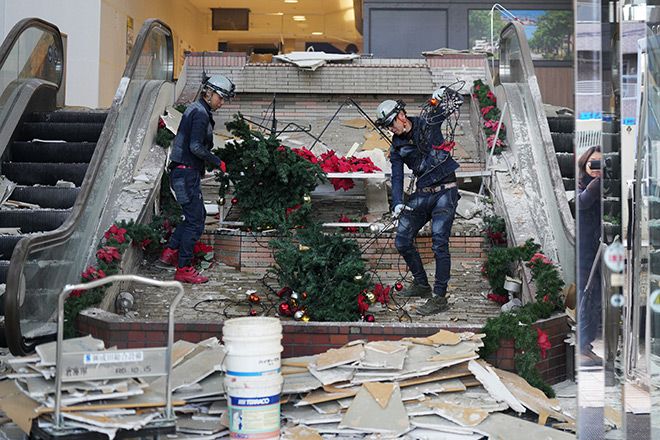
A megaquake advisory that had been issued for the first time following a major earthquake off the eastern coast of Aomori Prefecture the previous week was lifted at midnight on Dec. 15.
One week after the alert went out, the government ended its call for special preparedness for disaster prevention under the “off the coast of Hokkaido and Sanriku subsequent earthquake advisory.”
However, since the possibility of a sudden powerful earthquake still exists, the government will continue recommending preparedness measures such as securing furniture to prevent it from tipping over.
“We appreciate that people responded calmly to the advisory without any major confusion,” Jiro Akama, state minister for disaster management and food safety, said at a news conference on the morning of Dec. 16. “We plan to assess the extent to which the advisory contributed to disaster management and preparedness later.”
Akama said that the Cabinet Office would survey local governments and businesses in the regions targeted by the advisory to identify the best practices and challenges.
The earthquake struck off the eastern coast of Aomori Prefecture at 11:15 p.m. on Dec. 8, with a maximum seismic intensity of an upper 6 on the Japanese scale of 7 observed in Hachinohe, Aomori Prefecture.
A tsunami of up to 70 centimeters was recorded in Kuji Port in Iwate Prefecture.
Concerned that a major earthquake could occur in succession, the government issued the subsequent earthquake advisory at 2 a.m. on Dec. 9, covering 182 municipalities across seven prefectures from Hokkaido to Chiba along the Pacific coast.
This marked the first time the advisory had been issued since its introduction in December 2022.
The government urged people to continue social and economic activities while rechecking daily preparedness measures such as securing furniture and confirming evacuation sites and routes.
It also called for “special preparedness,” including sleeping in clothing that allows for immediate evacuation and keeping emergency supplies by the bedside.
According to the Japan Meteorological Agency, seismic activity that intensified on Dec. 8 is gradually declining, but the number of earthquakes is expected to remain higher than usual for the time being.
The subsequent earthquake advisory anticipates a magnitude 8 or higher earthquake. In the worst-case scenario, a massive magnitude 9 earthquake along the Japan Trench or Chishima Trench could trigger tsunami of up to 30 meters high and cause as many as 200,000 deaths.
Globally, the likelihood of a major subsequent earthquake occurring within a week after a magnitude 7 earthquake is estimated at about one in 100. Two days before the 2011 Great East Japan Earthquake, a magnitude 7-class quake occurred.
On the morning of Dec. 12, while the advisory was in effect, an earthquake struck off the eastern coast of Aomori Prefecture, registering a maximum seismic intensity of 4 in 38 municipalities across Hokkaido, Aomori, Iwate, Miyagi and Akita prefectures.
A tsunami advisory was briefly issued for parts of Hokkaido and Aomori Prefecture, as well as Iwate and Miyagi prefectures.
However, the quake was smaller than the magnitude 8-class event feared as a subsequent earthquake.
AloJapan.com