
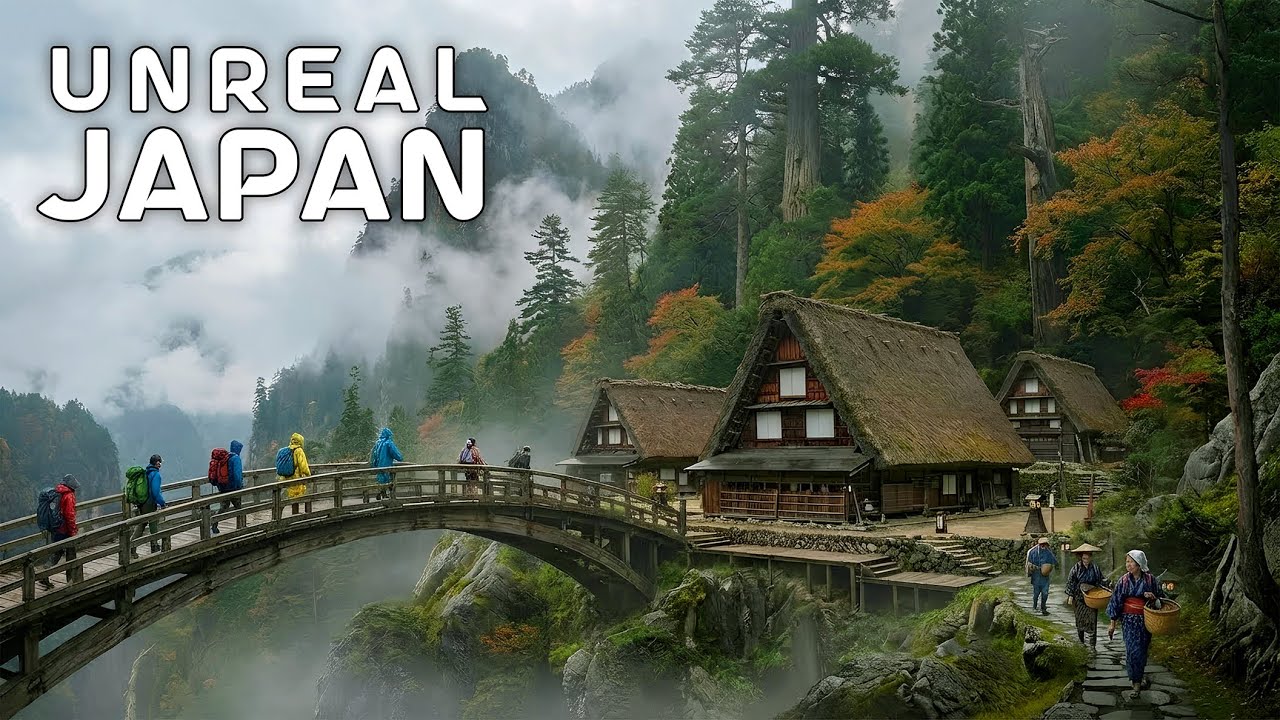
UNREAL JAPAN | Most People Never See | 4K Travel Documentary
How does a culture face annihilation? through earthquakes, tsunamis, firebombings, nuclear disaster, and respond not with bitterness, but with cherry blossom festivals, tea ceremonies, and the belief that beauty matters most when it’s temporary. The answer rewrites everything about resilience. The world thinks it knows Japan. Neon towers, robot restaurants, efficiency measured in seconds. A nation that turned devastation into dominance, tradition into technology, and tea ceremonies into touchscreens. But that story, the one told in travel guides and trending videos, is only the surface. It’s the reflection on water, not the depth beneath. The real Japan exists in the spaces between. In mountain villages where snow falls on thatched roofs unchanged for three centuries. In forests so ancient they’re considered gods. In the way an elderly woman arranges flowers with the same precision her grandmother did and her grandmother before her. In the silence of a temple garden where a single drop of water hitting stone becomes the loudest sound in the universe. This is not a country that chose between old and new. This is a civilization that learned to hold both in the same breath. Where a salary man in a gray suit bows to a Shinto shrine on his way to work. Where high-speed rail cuts through rice fields still planted by hand. Where the future was built on top of the past, not instead of it. What the world sees as contradiction is actually continuity. What looks like change is actually preservation. And what appears to be moving forward at impossible speed is really standing still, rooted in something deeper than any skyscraper foundation. This is Japan. Not the one most people never see. The one that’s been hiding in plain sight all along. Tokyo materializes from the airplane window like a circuit board come to life. 16 million people, more Michelin stars than any city on Earth. Vending machines selling hot coffee and cold fresh juices on the same street corner. This is the image the world holds when it thinks of Japan. Organized chaos, controlled density, the future arriving 15 minutes early. Shabuya crossing pulses with synchronized precision. 3,000 people cross at once and no one collides. The train system operates with tolerances measured in seconds, not minutes. Apologies broadcast when delays reach 30 seconds. Every transaction feels choreographed. Every interaction follows invisible rules perfected over centuries. But efficiency is not what makes Tokyo extraordinary. What makes it extraordinary is what efficiency protects. Between the glass towers stand wooden shrines built before America existed. Maji Jingu, a forest planted by human hands, tree by tree, now so wild that Tokyo’s roar vanishes five steps past the Tory gate. Salary men in perfectly pressed suits pause, bow, clap twice, stand in silence before ancient wood. The ritual unchanged, the meaning preserved. This is the first revelation. Modernity in Japan is not the eraser of tradition. It’s the armor built around it. The story Japan tells itself begins not in 1945 with ashes and occupation, but in isolation. For 200 years, the Tokugawa Shogunate closed the country. No one in, no one out. While Europe raced through industrial revolution and colonial expansion, Japan turned inward, perfected, refined, developed an aesthetic philosophy so precise it could transform emptiness into art, silence into music, and the simple act of pouring water into meditation. Then in 1853, American warships arrived in Tokyo Bay, forced the ports open, and Japan faced a choice that had destroyed countless civilizations before. Adapt or disappear. What happened next defines everything visible today. In 50 years, Japan transformed from feudal isolation to industrial empire, built factories, railways, universities, a military that would defeat Russia in 1905, the first time an Asian power defeated a European one in modern warfare. But here’s what the history books miss. Japan didn’t become Western. It modernized on its own terms. Adopted Western technology while keeping Japanese essence. The emperor remained. The temples remained. The tea ceremony remained. The language remained. The soul remained. What looks like contradiction is actually conviction. The ability to change everything while changing nothing that matters. And that’s the lens through which to understand every street, every city, every mountain village that follows. Japan didn’t just survive modernization. It designed modernity to serve something older than industry could ever comprehend. Walk through Asakusa and watch it happen in real time. The ancient Senoji temple draws 10 million visitors a year. But they’re not tourists. They’re pilgrims. Office workers buying Omakuji fortune papers. Families lighting incense. Teenagers in street wear bowing to cannon. The goddess of mercy carved in the 600s. The gift shops sell keychains and t-shirts, but they also sell protection amulets blessed by priests. And the distinction between commerce and spirituality never existed here the way it does in the West. The sacred and the everyday were never separated. Still aren’t. This is the paradox western minds struggle to grasp. Japan is not holding on to the past. The past is still the present. It just looks different now. The neon is not a mask. It’s a new kind of lantern. The skyscrapers are not replacing temples. They’re built around them, sometimes literally. Capsule hotels coexist with Rioan Inns where guests sleep on tatami mats unchanged for 400 years. 7-Eleven convenience stores stand across from shops selling handmade washi paper using techniques from the Han period. The question was never will Japan preserve its culture or embrace the future. The question Japan answered was why not both? And Tokyo, crowded, electric, impossible Tokyo is not the exception. It’s the thesis statement written in concrete and light. The Japanese Alps, where gods live in snow. 2 hours west of Tokyo, the mountains begin. Not gradually, not gently. The land simply stands up and becomes stone. The Japanese Alps. Three ranges cutting through the center of Honshu like the spine of a sleeping dragon. Peaks reaching 3,000 m. Valleys so deep they hold their own weather systems. villages where snow falls six meters high and children walk to school through tunnels carved in white walls taller than houses. This is where Japan learned humility, where human ambition meets its limit and bows. Kamikochi Valley sits at500 m cradled between peaks that still hold ice in August. The Isusa River runs crystal clear. So pure it reflects mountains with mirror precision. The trail follows ancient paths where monks once walked seeking enlightenment in altitude. Now hikers come for the same reason even if they call it by different names. The mountains here don’t feel geological. They feel intentional. Every rock placed with purpose. Every tree positioned in natural composition. Reality imitating the ink paintings that tried to capture it a thousand years ago. But the Alps are not wilderness in the western sense. These mountains have been inhabited for millennia. The onsen towns, hotring villages, hide in valleys where volcanic heat meets snow melt. Noa onen shibu onen places where tradition didn’t survive. It never left. In Shiraawa Go, farmhouses stand with roofs so steep they shed snow like water. Gasho Zukuri style hands in prayer built without nails some 400 years old inside hearths burn charcoal for warmth and fish smoking and conversations held in dialects so pure even other Japanese struggle to understand these villages were isolated until the 1960s, accessible only on foot. Winter meant months alone, so they built for survival. Multigenerational homes under one massive roof, silk farming on the upper floors, rice in the patties, miso aging in barrels. Everything needed for winter made in summer. The modern highway came. UNESCO designation came. Tourists came. But something about the mountains keeps Shurikawa Go from becoming a museum. People still live here, farm here, raise children who might leave for university in Tokyo but often return because the mountains offer something the cities can’t. Space to think, space to breathe, space to remember what humans are beneath the suits and screens, higher still at the peak of Mount Tate, one of Japan’s three sacred mountains. The air thins and the world drops away. The pilgrimage here is ancient. First recorded in 701 AD, but surely older. Climbers spend the night in mountain huts, wake before dawn, reach the summit as the sun breaks across cloud seas. The Japanese word for this moment is goriku, the coming of light. And standing there watching the world emerge from darkness. The distinction between mountain and temple dissolves. The peak is the altar. The sunrise is the sermon. And every person standing in that cold wind becomes for a moment connected to everyone who has ever stood here before. The mountains don’t care about modernity. They existed before Japan was Japan. Before humans were humans, they’ll exist after. But they’ve taught this civilization something essential. That power comes not from conquering nature, but from understanding how to live within it. The inland sea where water connects not divides. The Satuchi region wraps around the inland sea like cupped hands protecting a treasure. 700 islands scattered across calm water that connects four of Japan’s main islands. Not wilderness, but not tamed either. A landscape shaped by tide and trade and time. This is where Japan learned about connection. How water doesn’t separate. It carries ideas, goods, culture, art. Naoshima Island rises small and green from the sea. Population 30,000 until 1989, slowly dying like so many rural places. Then came an idea. What if contemporary art could save a community? What if museums weren’t building cities built, but destinations that built cities? Now art installations dot the island. Museums designed by Tadawo Ando emerge from hillsides like geometric flowers. Yayoi Kusama’s yellow pumpkin sits on a pier reflected in water becoming two pumpkins neither more real than the other. Tourists arrive by ferry, stay in renovated traditional homes, eat local fish, inject money and meaning into an economy that had nearly flatlined. But Naoshima is not Disneyland. It’s still an island where elderly residents tend vegetable gardens and repair fishing nets. The art didn’t replace the life. It supported it. gave young people a reason to stay or return or arrive from elsewhere and plant new roots in old soil. Across the water, the Shimanami Kaido connects Honchu to Shikoku, not by tunnel, but by bridge. Seven bridges spanning 70 km. And remarkably, each bridge includes a bicycle path, a dedicated lane where cyclists ride suspended above the inland sea, wind in their face, islands passing below. This is infrastructure as poetry. The practical need to connect regions transformed into an experience. Thousands cycle this route annually, not for speed, for the sensation of being between earth and water, movement and stillness, arrival and departure. Stop on Iuchima Island and the scent hits first. Citrus. Lemons growing on hillsides so steep they require specialized ladders. This island produces lemons so prized they sell individually in Tokyo department stores boxed like jewelry. Not because Japanese lemons taste different. Because they’re grown with an attention to detail that makes difference inevitable. The woman selling lemon cakes at the ferry terminal is 78. Her mother sold them before her. The recipe unchanged, the price barely changed. She doesn’t use social media or credit cards, but cyclists line up anyway, cash ready, because the scent alone is worth the stop. Further west, it’s Sukushima, the island shrine. The Tory gate stands in water, red pillars rising from the sea. At high tide, it appears to float. At low tide, visitors walk beneath it on exposed sand. Touch the wood, leave prayers and coins. This shrine has stood here for 1,400 years. Rebuilt when typhoons destroyed it. Repainted when salt wore it down. The gate is not fighting nature. It’s dancing with it. Rising and falling with the tide. Wet and dry, visible and reflected, solid and elucory. The inland sea is calm compared to the Pacific, protected, but it still carved this culture. taught fishermen patience, taught traders roots, taught artists that beauty often appears in the space between land and water, certainty and possibility. the far south where Japan becomes tropical. Okinawa sits 2,000 km south of Tokyo, closer to Taiwan than to Mount Fuji. Tropical, different, not quite Japan or not in the way the mainland imagines itself. The history here is complicated, layered, sometimes painful. This was the Ryuku Kingdom, independent until 1879 when Japan annexed it, then battleground in 1945, the last stand of World War II on Japanese soil. A quarter of the civilian population died. The land was destroyed. And after surrender, Okinawa remained under US occupation until 1972. But Okinawa also holds something the mainland lost. A slower rhythm. A culture of longevity that makes this the home of more centinarians per capita than anywhere else on Earth. Researchers come here trying to decode the Okinawan secret. Diet, community, genetics, purpose. The answer might be simpler. Icky, the reason for being. The thing that gets you out of bed. Not ambition, not achievement, just reason. In aim village, population 3,000, average age 80, elderly residents maintain vegetable gardens, practice traditional dance, care for grandchildren, laugh often, drink aamorei rice liquor in moderation, eat bitter melon and seaweed and pork that’s been simmered for hours until it becomes silk. This is not performance for tourists. This is simply how life continues. Purpose embedded in daily ritual. Connection maintained through community and time measured not in productivity but in seasons and sunsets and the growth of things planted. The ocean here glows turquoise. Coral reefs creating color that seems artificial until you swim through it. Ishigaki, Mako, Kurama Islands. Water so clear it reveals depth. Shows coral gardens and fish schools. And the way light bends as it descends. These reefs are ancient ecosystems, fragile now, warming water, bleaching the coral, typhoons growing stronger. But Okinawans have always understood that beauty and fragility coexist, that preservation requires attention, that islands teach you limits because the border is always visible. The traditional houses here are different, too. Red tile roofs topped with shisa, lion dog guardian statues, stone walls surrounding small courtyards built low and strong against typhoons. The architecture of survival that became the aesthetic of place. in the far north of Okinawa Island. Yandaru forest, Japan’s Amazon, subtropical jungle, where endemic species evolved in isolation. The Okinawa Rail, a flightless bird found nowhere else. The Ryukyu long-haired rat. plants that exist on these islands only. UNESCO designated it world heritage in 2021, not for history, but for ecology. A recognition that preservation isn’t just about culture. It’s about the web of life that makes culture possible. Okinawa resists easy categorization. Is it the real Japan? Is it its own thing? The answer yes both. Like everything here, identity is layered, complex, capable of holding contradiction without breaking. What Okinawa offers is an alternative narrative. that Japaneseeness isn’t defined by a single story. That the edges of the nation, geographical and cultural, hold truths the center sometimes forgets. That resilience looks different in different landscapes. And that longevity might simply be what happens when purpose and peace and pork belly align. sacred mountains and ancient forests where earth becomes spirit. Religion in Japan is not about belief. It’s about presence. The sacred is not somewhere else. It’s here in the tree, the mountain, the stone, the river. Shinto never asked for faith. It asked for respect. The Kumano Codo. Ancient pilgrimage trails winding through the key peninsula. Paths walked for a thousand years by emperors and peasants, monks and merchants, seekers, and the simply lost. These trails connect three grand shrines. But the journey is the point, not the destination. Walk through cryptoria cedar forests. Trees towering 40 m high. Trunks wider than embracing arms can span. Moss covers everything. stones, roots, fallen logs decomposing into soil. The air itself feels green, thick. Breathing it becomes a kind of prayer. The trail markers are simple stone signs weathered smooth by centuries of rain. No arrows pointing toward enlightenment. Just direction, just next step at Nachi Falls. Water drops 133 m in a single unbroken column. The tallest waterfall in Japan. A Shinto shrine sits at its base, not to worship the divine above, but to honor the divine in the water itself. The fall is the god, the spray is the blessing. And standing there, mists soaking through clothes, the distinction between observer and observed dissolves. This is animism refined over millennia. Not primitive belief that modernity should have erased, but sophisticated recognition that consciousness exists beyond human boundaries. That the forest lives. That mountains think. That water remembers On Yakushima Island, 2 hours by ferry from Kyushu, this philosophy becomes overwhelming. The island is essentially one massive mountain rising from the ocean. Peaks over 1,800 m. Rainfall measured in meters, not millimeters. And forests so ancient they inspired Haya Miyazaki’s Princess Moninoi. The Janssugi cedar tree stands hidden deep in the forest. Over 2,000 years old, maybe 7,000. The trunk requires five people linking hands to encircle moss and ferns grow from its bark. It’s not just a tree. It’s an ecosystem, a world, a silent teacher that’s been standing since before Buddhism arrived in Japan. Reaching it requires hours of hiking. Boardwalks built to protect roots from trampling feet. The island receives so much rain that rivers appear suddenly swell recede. The weather changes by the hour. Fog rolls in thick as wool. then lifts to reveal mountains that weren’t there moments before. UNESCO designated this forest world heritage not for what humans built, but for what they didn’t, for what they protected simply by recognizing it as sacred before science could explain why. The Japanese term is shin reinoku. Forest bathing. Not hiking, not exercise, just presence. Breathing the fight and sides trees release. Lowering cortisol. Resetting nervous systems calibrated to artificial light and deadline stress. But this isn’t new age wellness imported from California. This is ancient knowledge that modern research finally caught up to that forests heal. That silence teaches that some questions don’t need answers if the asking itself brings peace. Mount Koa Koyasan sits at 900 m in Wakayyama Prefecture. Founded in 8:16 by the monk Kukai who brought Shingong Buddhism from China and planted it in these mountains. Over 100 temples remain. Thousands of monks and the largest cemetery in Japan. 200,000 graves among towering cedars lit by stone lanterns wrapped in moss and thyme. Stay overnight in a shukubo temple lodging. Wake before dawn for morning prayers. Chanted sutras echoing in wood hallo. Incense smoke spiraling upward. The ritual unchanged for 12 centuries. Breakfast is shojin riori Buddhist vegetarian cuisine. Tofu, pickled vegetables, miso soup, rice. Simple food prepared with extraordinary care. Each bite is meditation. Each bowl is teaching. That abundance is not about quantity. That satisfaction comes from attention, not excess. Walk the cemetery at dusk. Lanterns begin to glow. Shadows deepen. And among the graves of feudal lords and common farmers, all equal now beneath the cedars, the lesson becomes clear. Impermanence is not tragedy. It’s just truth. And accepting it doesn’t diminish life. It intensifies every moment. people, culture and modern life. The train from Kyoto to Osaka takes 15 minutes. The distance between worlds is longer. Kyoto moves like a woman in kimono. Measured steps, conscious grace, every gesture considered. 17. UNESCO World Heritage sites, 2,000 temples, the capital for a thousand years before Tokyo took the title. Here tradition is not performance, it’s profession. Geisha still train for years in tea houses hidden behind wooden facads. Masters still make washi paper by hand, pounding koso bark into pulp, spreading it thin on screens, drying it in sun. The resulting paper lasts a thousand years. Modern paper lasts 50. In a matchia townhouse, traditional wooden home with narrow frontage and deep interior, a craftsman shapes a teabole. His family has made pottery for 400 years. Same clay source, same kiln design, same commitment to subtle imperfection that makes each piece unique. This is shokunin kishu, the craftsman’s spirit. Not just skill, but devotion. The belief that doing one thing with complete attention for an entire lifetime is not limitation. It’s liberation. Mastery measured in decades, not diplomas. The tea ceremony, Shaoyu, embodies this philosophy completely. Every movement choreographed, the angle of the bowl, the number of sips, the way the host bows, the guests response. What appears rigid is actually deeply generous, eliminating uncertainty, creating space where two strangers can meet in perfect understanding without words. It takes years to learn, decades to master, a lifetime to comprehend that the tea itself is secondary, that the ceremony is really about creating a moment of complete presence in a world designed for distraction. But Kyoto is not museum city. Students flood the universities. Startups innovate in converted warehouses. Young chefs reimagine kiiseki cuisine traditional multicourse meals using techniques from molecular gastronomy while maintaining seasonal philosophy. The balance is not accident. Its intention, the city has rejected chain stores in historic districts, preserved building height restrictions so temples remain visible, subsidized traditional crafts so apprentices can afford to learn, made conscious choices to remain itself while allowing change where change makes sense. Osaka, by contrast, never apologized for embracing chaos. The city eats first, thinks later. Street food culture so intense that quidor eat until you drop becomes the unofficial motto. Takoyaki octopus balls. Okonomiyaki savory pancakes. Kushi katsu fried skewers. Food served fast. Eaten standing. Price cheap. Tasting spectacular. The merchants here shaped a culture distinct from samurai Kyoto or imperial Tokyo. Osaka valued profit over pedigree, trade over tradition, and that pragmatism created a city comfortable with contradiction. Neon and temples, skyscrapers and shopping arcades, formality and foul-mouthed comedy. The Canai dialect spoken here sounds rougher than Tokyo’s standard Japanese, more direct, funnier, and Osakans are proud of it. The linguistic rebellion that signals this city never quite submitted to the capital’s rules. But beneath the energy, the principles remain. The emphasis on quality, on freshness, on the connection between maker and consumer. The best sushi chef in Osaka might serve from a counter seating at no sign outside. Reservations booked months ahead because excellence doesn’t need advertisement. Word spreads. Language itself reveals Japanese values. The language has multiple levels of politeness. Casual, polite, honorific, humble, each with distinct verb forms and vocabulary. Speaking requires constant calculation of social position, context, relationship. What sounds restrictive actually creates nuance, allows emotional precision. Western languages struggle to match. Japan is not frozen. It’s simply selective about what changes and what stays. Cherry blossoms Sakura demonstrate this perfectly. Every spring, the entire nation watches weather reports tracking the Sakura front moving north. Parks fill with families claiming spots for hanami. Flower viewing parties. Salarymen get drunk under pink petals. Lovers take photos. Tourists arrive by millions. What looks like nature appreciation is actually impermanent celebration. The blossoms last one week, maybe two. Then wind scatters them and that brief beauty, fragile, fleeting, finite, becomes the perfect metaphor for existence itself. Life peaks and passes. Acknowledging this doesn’t bring sadness. It brings urgency to appreciate what’s here now. This philosophy, accepting transiencece, finding beauty in imperfection, honoring the moment because it won’t last, shapes everything. The crack in a tea bowl. The asymmetry of a flower arrangement. The changing seasons celebrated in food and clothing and festival. The recognition that trying to hold on too tight makes everything break. And maybe that’s why Japan survived modernization without losing itself because the culture already understood that change is inevitable. That what matters is not resisting it but flowing with it. That preservation doesn’t mean freezing in place. It means carrying essential truths into whatever form the future demands. The airplane lifts from Narita and Tokyo shrinks beneath clouds. From this height, the contradiction disappears. The neon and the temples become one landscape. The ancient and the modern merge into something singular. Japan was never actually caught between past and future. That was always the wrong framing. A western assumption projected onto a culture that never saw them as opposing forces. What Japan understood, what it’s been demonstrating for 150 years is that tradition is not the opposite of progress. It’s the foundation that you can build the fastest trains in the world and still bow to shrines. That automation doesn’t eliminate craftsmanship. It creates space for craftsmanship to matter more. That efficiency isn’t cold. It’s generosity. Respecting other people’s time. The real revelation is this. Japan is not keeping the old alive despite the new. The old is the reason the new works. The discipline came from tea ceremony. The attention to detail came from pottery. The commitment to improvement came from martial arts. The respect for collective harmony came from rice farming in narrow valleys where cooperation meant survival. These weren’t quaint traditions that needed protecting. They were competitive advantages disguised as culture. And maybe that’s what the world misreads about Japan. It sees preservation where there’s actually application, museums where there are manuals, past where there is present. The woman selling lemon cakes on that island. The monk chanting sutras at dawn. The craftsman shaping tea bowls by hand. They’re not resisting modernity. They’re insisting that some things, care, quality, presence, purpose, never become obsolete, no matter how fast technology moves. Standing in that mountain temple garden, watching water drop onto stone, the sound traveling across centuries, it becomes clear Japan is not teaching the world to slow down. It’s demonstrating that speed and stillness can coexist. that a nation can be both the oldest continuous civilization and one of the most innovative. That the future doesn’t require abandoning what came before. The neon was never hiding the temples. It was illuminating them. showing that sacred and secular, spiritual and material, ancient and modern, are not choices. They’re both, always have been, always will be. The hidden Japan was never actually hidden. We just weren’t looking at it, right? If this journey sparked something, a question, a memory, a desire to see deeper, share it in the comments. And if you want more stories like this, where we go beyond the surface to find what really makes a place breathe, subscribe. There are more worlds hiding in plain sight, waiting to be understood.
How does a culture face annihilation—through earthquakes, tsunamis, fire bombings, nuclear disaster—and respond not with bitterness but with cherry blossom festivals, tea ceremonies, and the belief that beauty matters most when it’s temporary? This documentary explores the real Japan beyond the neon and stereotypes—a 2,000-year-old civilization that never forgot its past while building the future.
From the ancient cedar forests of Yakushima to the neon streets of Tokyo, from sacred mountain temples to tropical Okinawa beaches, this is Japan as you’ve never seen it: a nation where bullet trains bow to passengers, silence holds meaning, and tradition isn’t the opposite of progress—it’s the foundation.
⏱️ CHAPTERS & TIMESTAMPS
00:00 – Opening: The Japan No One Sees
02:15 – Tokyo – Breaking Stereotypes
10:30 – The Japanese Alps – Where Gods Live in Snow
16:45 – Shirakawa-go Village & Mountain Life
20:10 – The Inland Sea – Islands of Art & Connection
26:35 – Naoshima: How Art Saved a Community
29:50 – Okinawa – Japan’s Tropical Paradise
34:20 – The Secret to Living Past 100
37:45 – Sacred Mountains & Ancient Forests
41:10 – Yakushima: The 7,000-Year-Old Tree
44:30 – Mount Koya & Buddhist Wisdom
47:50 – Kyoto & Osaka – Culture & Modern Life
51:20 – The Art of Impermanence
54:45 – Closing Reflection: What Japan Teaches the World
—
📍 PLACES FEATURED IN THIS DOCUMENTARY
Tokyo Region:
Shibuya Crossing & Shinjuku
Meiji Jingu Shrine
Asakusa & Senso-ji Temple
Japanese Alps:
Kamikochi Valley
Shirakawa-go Historic Village
Mount Tate (Sacred Mountain)
Nozawa Onsen & Shibu Onsen
Setouchi (Inland Sea):
Naoshima Art Island
Shimanami Kaido Bridges
Ikuchijima Island
Itsukushima (Miyajima) Floating Shrine
Okinawa:
Ogimi Village (Longevity Capital)
Ishigaki, Miyako & Kerama Islands
Yanbaru Subtropical Forest
Sacred Sites:
Kumano Kodo Pilgrimage Trails
Nachi Falls
Yakushima Ancient Cedar Forest (Jomon Sugi)
Mount Koya (Koyasan) Buddhist Complex
Cultural Centers:
Kyoto Temples & Historic Districts
Osaka Food & Culture
🇯🇵 ESSENTIAL JAPAN FACTS
Population: 125 million
Capital: Tokyo (16 million metro population)
Languages: Japanese
Currency: Japanese Yen (¥)
Best Time to Visit: Spring (March-May) for cherry blossoms, Autumn (September-November) for fall colors
UNESCO World Heritage Sites: 25 sites including Shirakawa-go, Yakushima, Kumano Kodo, Mount Fuji.
🎌 KEY HIGHLIGHTS & WHAT TO KNOW
Geography: Archipelago of 14,125 islands sitting on 4 tectonic plates—earthquakes are frequent, shaping the culture’s relationship with impermanence.
Philosophy: Concepts like “mono no aware” (the pathos of impermanence), “wabi-sabi” (beauty in imperfection), and “ikigai” (reason for being) define daily life.
Food Culture: From Michelin-starred restaurants to street food, Japanese cuisine emphasizes seasonality, freshness, and presentation as art.
Transportation: The Shinkansen bullet train system connects major cities at 320 km/h with legendary punctuality (average delay: 54 seconds per year).
Etiquette: Bowing shows respect, shoes are removed indoors, silence on trains is expected, and public harmony (“wa”) takes precedence over individual expression.
Ancient & Modern: 1,000-year-old temples coexist with skyscrapers; traditional tea ceremonies continue alongside robot cafes; the past isn’t preserved—it’s lived
Longevity: Japan has the world’s highest life expectancy (84.3 years), especially in Okinawa where centenarians attribute longevity to purpose, community, and diet.
Natural Disasters: Japan experiences 1,500 earthquakes annually, leading to world-leading disaster preparedness and a cultural acceptance of impermanence.
🎥 ABOUT THIS DOCUMENTARY
This 4K cinematic documentary explores Japan through the lens of resilience and cultural continuity—showing how a nation repeatedly faced with destruction chose to create beauty, refine tradition, and build a society where efficiency serves humanity rather than replacing it.
Documentary Style: Cinematic, long-form storytelling
Runtime: 55 minutes
Filming Locations: 40+ locations across Japan
Theme: How catastrophe shapes culture, and why impermanence creates meaning
💬 JOIN THE CONVERSATION
Have you been to Japan? What surprised you most? What place from this documentary do you want to visit? Share your thoughts and experiences in the comments below.
🔔 SUBSCRIBE FOR MORE
If you want more documentaries that go beyond the surface to reveal the soul of a place, subscribe and hit the notification bell. We’re traveling the world to show you the stories no one else tells.
—–
UNREAL JAPAN | The Beauty Most People Never Notice | 4K Travel Documentary
SACRED JAPAN | What Tourists Never Find | 4K Travel Documentary
#Japan #TravelDocumentary #4K #JapaneseCulture #TokyoJapan #Kyoto #Okinawa #JapaneseAlps #HiddenJapan #CulturalDocumentary #Yakushima #MountKoya #TrueGlobe #CinaticTravel #JapanTravel
3 Comments
This is absolutely stunning! Japan's ability to honor its past while building the future is what makes it so fascinating – you captured that duality perfectly. The way the video goes beyond the neon and stereotypes to show that 2,000-year civilization is exactly what travel documentaries should be doing. The cinematography and pacing are exceptional. Looking forward to more deep dives into destinations that reveal what most tourists miss! 🎌
It's Really Amazing documentary about Japan. Well Done 😊❤
I enthusiastically anticipate more videos. I loved this and the documentary on Poland.