
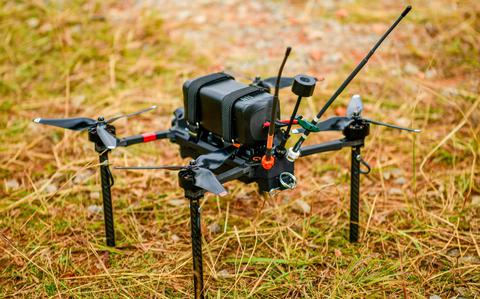
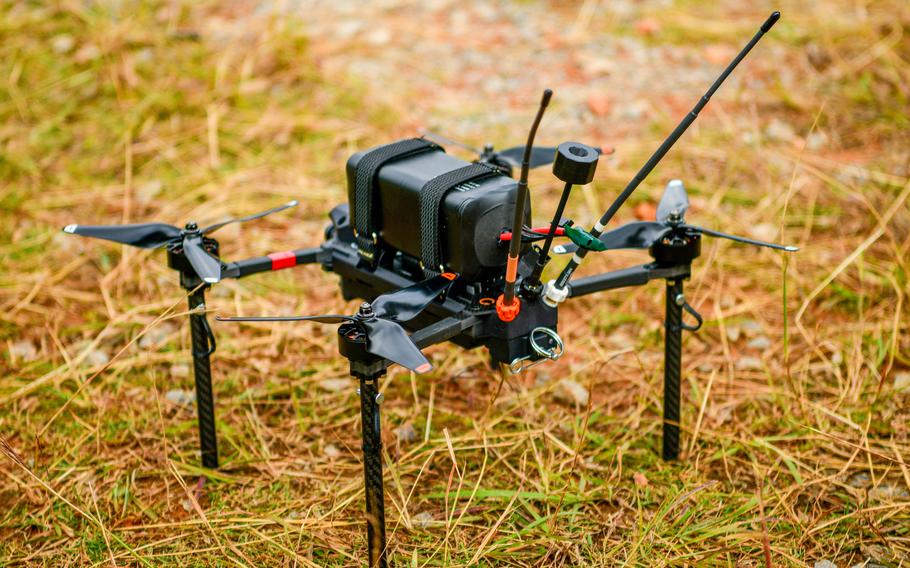
Marines employed drones to strike a training target during an attack drone competition on Camp Schwab, Okinawa, Dec. 11, 2025. (Ryan M. Breeden/Stars and Stripes)
CAMP SCHWAB, Okinawa — The Marine Corps certified Okinawa’s first 12 attack drone operators during a two-week competition this month, creating the means to make precision strikes while keeping Marines out of harm’s way.
The competition began Dec. 1 and culminated Thursday with a kinetic strike at Schwab’s Range 10, where Marines piloted and detonated two drones carrying C-4 explosives over a rusted-out tank more than half a mile downrange.
About 50 Marines and sailors, including Lt. Gen. Roger Turner, commander of the III Marine Expeditionary Force, and Vice Adm. Pat Hannifin, commander of U.S. 7th Fleet, witnessed the strike.
The exercise goal was to “defend this piece of terrain from some type of enemy that has some type of armored vehicles,” Col. Scott Cuomo, commander of the Weapons Training Battalion in Quantico, Va., told reporters before the strike.
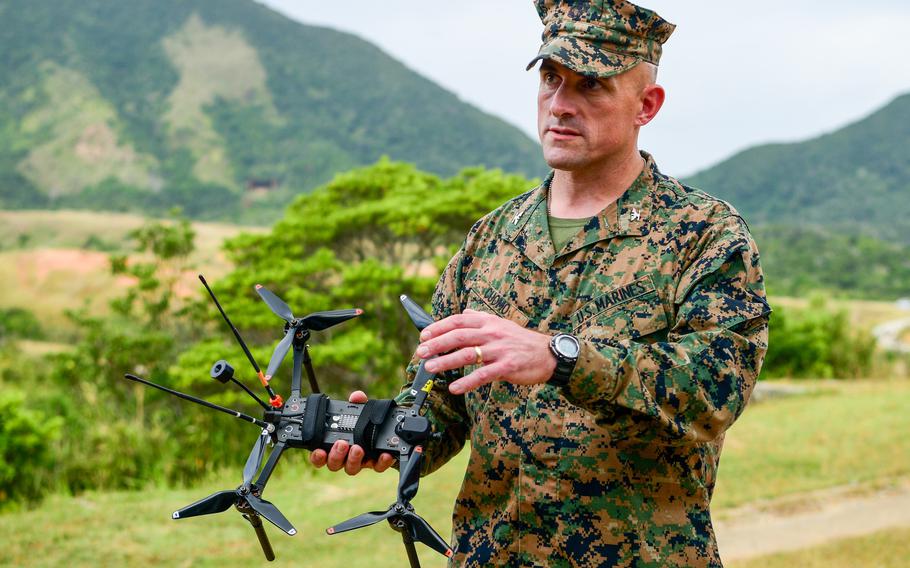
Col. Scott Cuomo, commander of Weapons Training Battalion in Quantico, Va., speaks with media on drone technology during an attack drone competition on Camp Schwab, Okinawa, Dec. 11, 2025. (Ryan M. Breeden/Stars and Stripes)
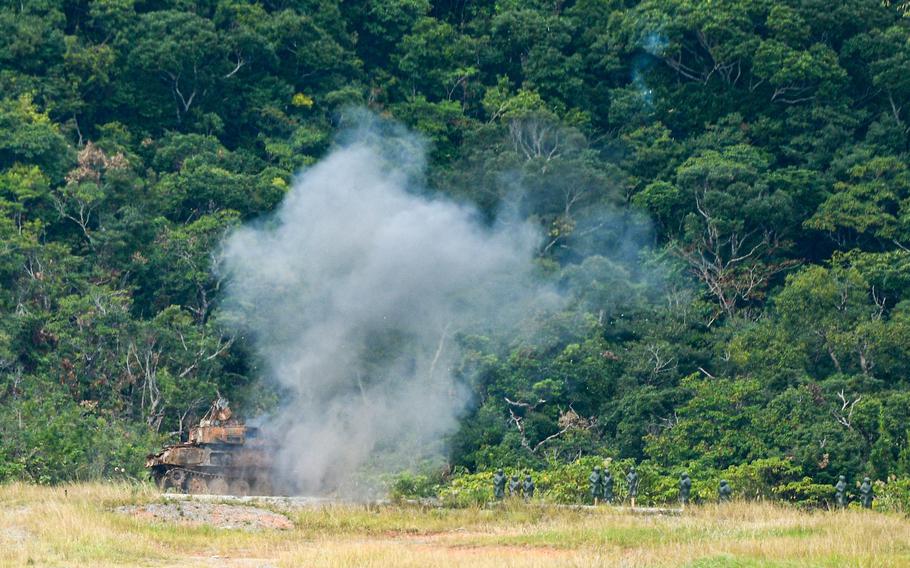
Drones operated by Marines drop explosives on training target during an attack drone competition on Camp Schwab, Okinawa, Dec. 11, 2025. (Ryan M. Breeden/Stars and Stripes)
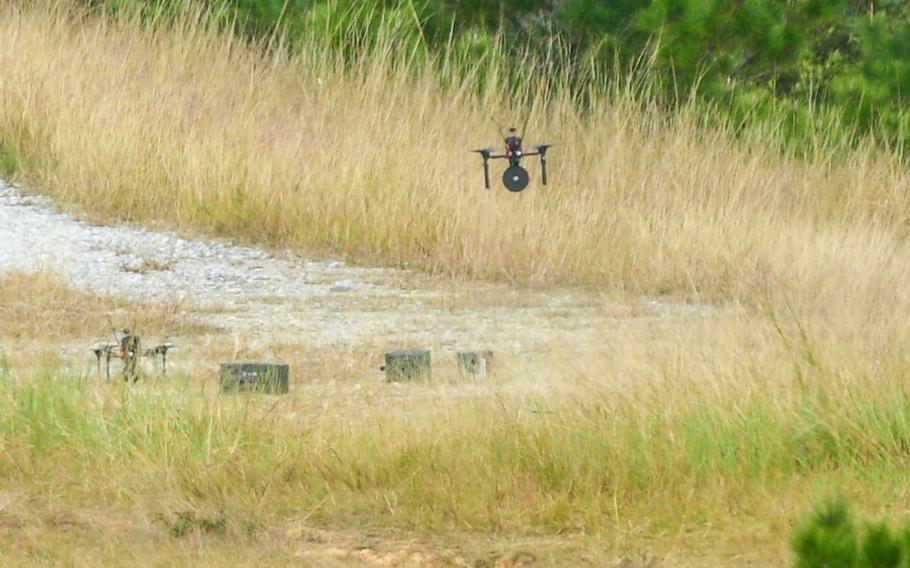
Marines launch attack drones to strike a training target during a competition on Camp Schwab, Okinawa, Dec. 11, 2025. (Ryan M. Breeden/Stars and Stripes)
The Marine Corps in March announced formation of the Attack Drone Team in response to the “rapid proliferation” of armed, first-person view drone technology in modern conflicts, especially in Eastern Europe. The drones have emerged as a critical weapon on the battlefield in Ukraine.
Drones provide a way to keep Marines safe while striking the enemy, 3rd Marine Division spokeswoman Lt. Col. Diann Rosenfeld told Stars and Stripes before the exercise.
“It just extends our reach into the battlefield,” she said. “We have the Marines operating here, and if the target’s over there, let’s keep our Marines safe in the defensive position and launch a drone to hopefully eliminate that target.”
The attack drone “100% supports the expeditionary advanced base operations concept,” Cuomo said.
The concept is a key tenet of the Corps’ Force Design reorganization that calls for small, mobile groups of Marines to disperse within the range of enemy missiles to seize and hold islands and sink enemy vessels.
“The beauty of this thing, … I can put it in my backpack, I can go run up the mountain if I need to, and if I have to protect you, I can use this capability,” he said.
The competition at Schwab is the third since the team’s formation, Cuomo said. Three more are planned around the world.
“Our relationship is critically important with the Japanese Ground Self-Defense,” he said. “Certifying Marines to make sure that we can train on all the installations here in Okinawa and do it safely is critically important.”
The 12 certified Marines are with units across the III Marine Expeditionary Force.
Additionally, five attack drone instructors, two payload specialists and two payload specialist instructors were certified during the event.
On Thursday, a team of about 10 Marines pulled pins to activate the two explosive-laden drones, then ran about 300 feet back, the “minimum safe distance,” Cuomo said. Drone operators at the control station about 950 feet away then flew the drones downrange and detonated them over the tank.
The drones and their payloads cost about $3,600 each, Cuomo said. They have a range of about 12 miles.
“Normally with weapons that shoot this far and that are this precise, they cost so much more money,” he said.
AloJapan.com