
SINGAPORE – Singaporeans heading to Japan might be unsure if they can continue with their trips, after a powerful
7.5-magnitude earthquake struck
the country’s north-eastern region late on Dec 8.
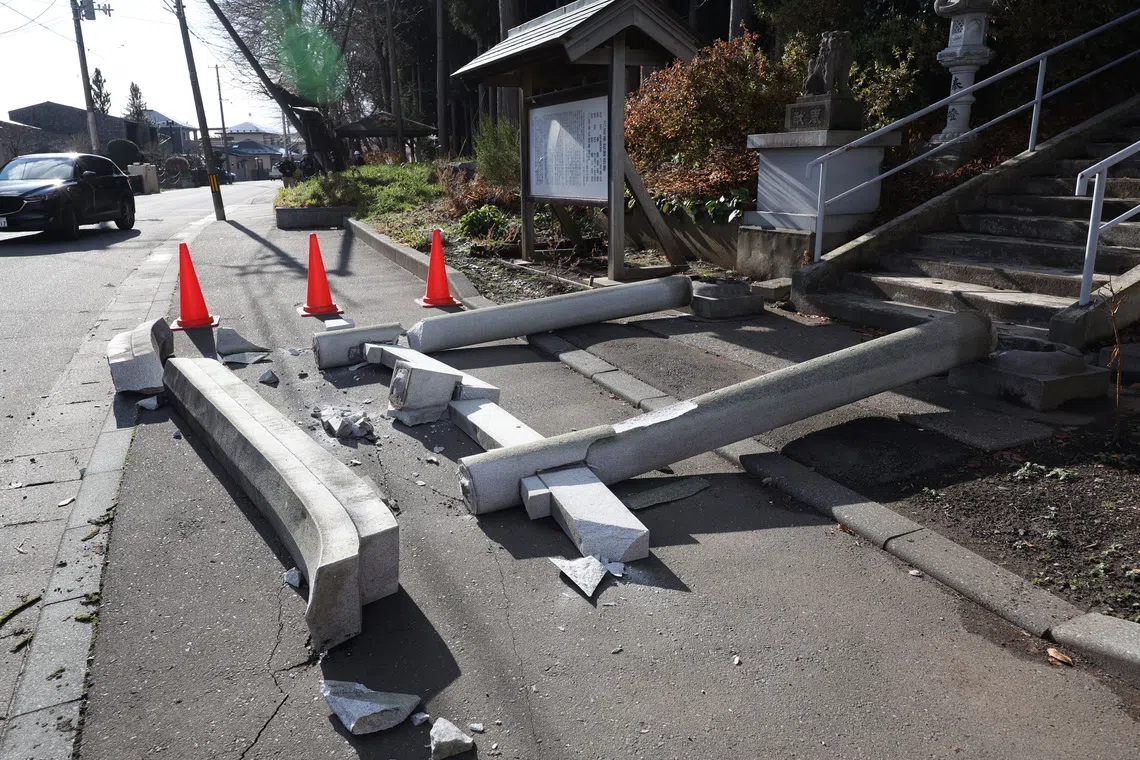
At least 30 people were injured and about 90,000 residents were forced to evacuate their homes.
The country’s meteorological agency had initially said a tsunami as high as 3m could hit the country’s north-eastern coast.
The Straits Times looks at what travellers need to know if they are travelling to Japan during the year-end holiday season.
A: The quake, which struck at 11.15pm local time (10.15pm in Singapore), had its epicentre 80km off the coast of Aomori prefecture, at a depth of 54km, the Japan Meteorological Agency (JMA) said.
The prefectures of Hokkaido, Aomori and Iwate were issued tsunami warnings, and the prefectures of Miyagi and Fukushima were issued tsunami advisories. Tsunamis from 20 to 70cm were observed at several ports, JMA said.
The warnings were downgraded to advisories by the early hours of Dec 9, which were later lifted. There were no reports of major damage.
However, people in the area should stay alert to the possibility of a powerful quake hitting again within the week, particularly from the northernmost island of Hokkaido down to Chiba prefecture, east of the capital Tokyo.
In that advisory, issued at 2am local time on Dec 9, those in the areas are advised to:
Be ready to evacuate even at night,
Keep an emergency kit on hand,
Ensure access to emergency information,
Be ready for collapses caused by earthquakes, and,
To double-check that everyday preparations have been made.
The probability of a massive earthquake occurring while the advisory is in effect is about 1 per cent, according to Japan’s Cabinet Office, as quoted by The Japan News.
Experts continue to urge vigilance
against future quakes in one of the world’s most earthquake-prone countries, with a tremor occurring at least every five minutes. Its north-eastern region suffered one of the country’s deadliest earthquakes on March 11, 2011, when swathes of the Pacific coastline were destroyed and nearly 20,000 people killed.
A: Up to Dec 9 afternoon, at least 34 people have been injured, Kyodo News reported.
Fires and power outages were reported in Hachinohe city on Honshu island, Japan chief Cabinet secretary Minoru Kihara said. About 800 households in Iwate prefecture had lost power, he said, adding that expressways and rail services were disrupted.
About 1,360 homes in the prefectures of Aomori and Iwate were without water due to damaged pipes, Kyodo News reported.
No abnormalities have been reported at nuclear power plants in Hokkaido, Aomori, Miyagi and Fukushima prefectures.
A: Checks on Changi Airport’s website on Dec 9 show that flights to Japan operated by national carrier Singapore Airlines and its budget arm, Scoot, have not been affected.
All Nippon Airways, Japan Airlines and regional airline Airdo are operating as usual, NHK reported.
Train operator JR East said on Dec 9 that bullet train services on the Tohoku Shinkansen Line between Morioka in Iwate prefecture and Shin-Aomori in the neighbouring prefecture of Aomori were suspended for inspections, with operations expected to resume the same day.
Passengers holding JR tickets valid between Dec 9 and Dec 16 who decide to postpone or cancel their trips can have their tickets refunded without a handling fee, according to the JR East website.
However, those with unlimited ride passes such as the Japan Rail Pass and the JR East Pass cannot be refunded if they have begun using them.
A: Those going to earthquake-prone countries like Japan should familiarise themselves with earthquake preparedness measures and buy comprehensive travel insurance,
according to a January 2024 ST report
.
They should also download earthquake alert apps that help provide information and communication during natural disasters.
Such apps include the Japan Tourism Agency’s warning app, which alerts travellers during an earthquake of seismic intensity measuring four or more on the Japanese seismic intensity scale, and when a tsunami is on its way.
The Japanese seismic intensity scale, also known as shindo, ranges from one (slight earthquake) to seven (severe earthquake with heavier damage).
The Singapore Embassy in Tokyo, in a Facebook post on Dec 9, has
advised Singaporeans to monitor local conditions closely and stay away from water bodies
. It added that people should refer to
JMA’s website
and NHK for latest advisories and warnings.
Singaporeans in Japan who need consular assistance can contact the embassy on +81-3-3586-9111, or if after office hours, on +81-90-5258-3252.
The embassy can also be reached by e-mail at
singemb_tyo@mfa.sg
Singapore has two other missions in Japan, one in Nagoya and another in Osaka. More details on the missions can be found on the
Ministry of Foreign Affairs’ (MFA) website
.
Singaporean travellers should also register the details of their trip online with MFA at
https://eregister.mfa.gov.sg
A: Those who are indoors during an earthquake can protect themselves by getting down on their hands and knees, and covering their head and neck under a sturdy shelter, according to the United States Centres for Disease Control and Prevention (CDC).
There are eight ways to stay safe during tremors and earthquakes, according to the Singapore Civil Defence Force’s
Civil Defence Emergency Handbook
.
They are:
Keep away from windows and display shelves that can fall and lead to injuries.
Hide under a strong table, preferably made of wood, and hold on until the shaking is over.
Move to a safe place nearby if no furniture is available to serve as shelter.
Turn off all gas and electrical appliances when tremors stop to prevent fires.
Avoid using matches on naked flames as there might be a gas leak caused by tremors.
Examine your surroundings for structural defects and cracks on walls, columns and beams.
Follow updates on the earthquake by listening to local radio or television stations.
Avoid jamming emergency lines. Call the authorities only if there is an emergency.
People who are outdoors during a quake should stay clear from buildings and overhead electrical cables, and remain in an open space until tremors stop.
SCDF added that during earthquakes, most injuries occur when people attempt to leave or move around buildings while the ground is still shaking. If there is a need to evacuate, SCDF said, people leaving the building should do so in an orderly manner using the staircases, and not lifts.
According to the CDC, the greatest danger from falling debris is outside doorways and close to the outer walls of buildings.
If a person is in a vehicle, he should stay away from trees, bridges, overpasses and overhead electrical cables.
AloJapan.com