

The Japanese Yen (JPY) extends its sideways consolidative price move through the early European session on Monday, though the near-term bias seems tilted in favor of bullish traders. Japan’s wage growth data reaffirmed market bets for an imminent rate hike by the Bank of Japan (BoJ) in December, which helps offset the dismal Q3 GDP print and should continue to underpin the JPY. Apart from this, the cautious market mood should contribute to limiting losses for the safe-haven JPY.
Meanwhile, rising BoJ rate hike bets and fiscal concerns keep the Japanese government bond (JGB) yields close to a multi-year peak. The resultant narrowing of the rate differential between Japan and other major economies validates the near-term positive outlook for the lower-yielding JPY. Moreover, dovish Federal Reserve (Fed)-inspired US Dollar (USD) weakness keeps the USD/JPY pair close to a three-week low touched on Friday as traders await the FOMC decision on Wednesday.
Japanese Yen bulls remain on the sidelines despite divergent BoJ-Fed expectationsGovernment data showed earlier this Monday that Japan’s Nominal Wages rose 2.6% YoY in October, surpassing expectations of 2.2% and marking the strongest increase in three months. However, inflation-adjusted real wages shrank for the 10th consecutive month, by 0.7% from a year earlier, amid the 3.4% rise in consumer prices.This adds pressure on the Bank of Japan amid speculation that policymakers may opt for another rate hike at its December policy meeting and provides a modest lift to the Japanese Yen during the Asian session. The uptick seems unaffected by the revised Q3 GDP, showing Japan’s economy contracted faster than initially reported.The revised Gross Domestic Product report from the Cabinet Office revealed that Japan’s economy shrank 0.6% in the July-September period compared with the initial estimate of 0.4%. On a yearly basis, the economy contracted by 2.3%, or its fastest pace since Q3 2023, vs the forecast for a 2.0% fall and 1.8% fall reported originally.Investors, however, seem convinced that higher wages will increase household purchasing power and boost spending, which should fuel demand-driven inflation and bolster the economy. Furthermore, BoJ Governor Kazuo Ueda said last week that the likelihood of the economic and price projections being met is rising.This, along with Prime Minister Sanae Takaichi’s reflationary push and massive spending plan, lifted the benchmark 10-year Japanese government bond (JGB) yield to its strongest level since 2007 last Thursday. Moreover, 20-year and 30-year JGB yields reached levels not seen since 1999, further underpinning the JPY.In contrast, the CME Group’s FedWatch Tool indicates that traders are currently pricing in a nearly 90% chance that the US Federal Reserve (Fed) will lower borrowing costs again on Wednesday. This, in turn, keeps the US Dollar depressed near its lowest level since late October and exerts pressure on the USD/JPY pair.The USD bears, however, might refrain from placing aggressive bets and opt to wait for more cues about the Fed’s rate-cut path. Hence, the focus will remain glued to the updated economic projections, including the so-called dot plot, and Fed Chair Jerome Powell’s comments during the post-meeting press conference.USD/JPY needs to surpass the 100-hour SMA hurdle to back the case for a meaningful recovery
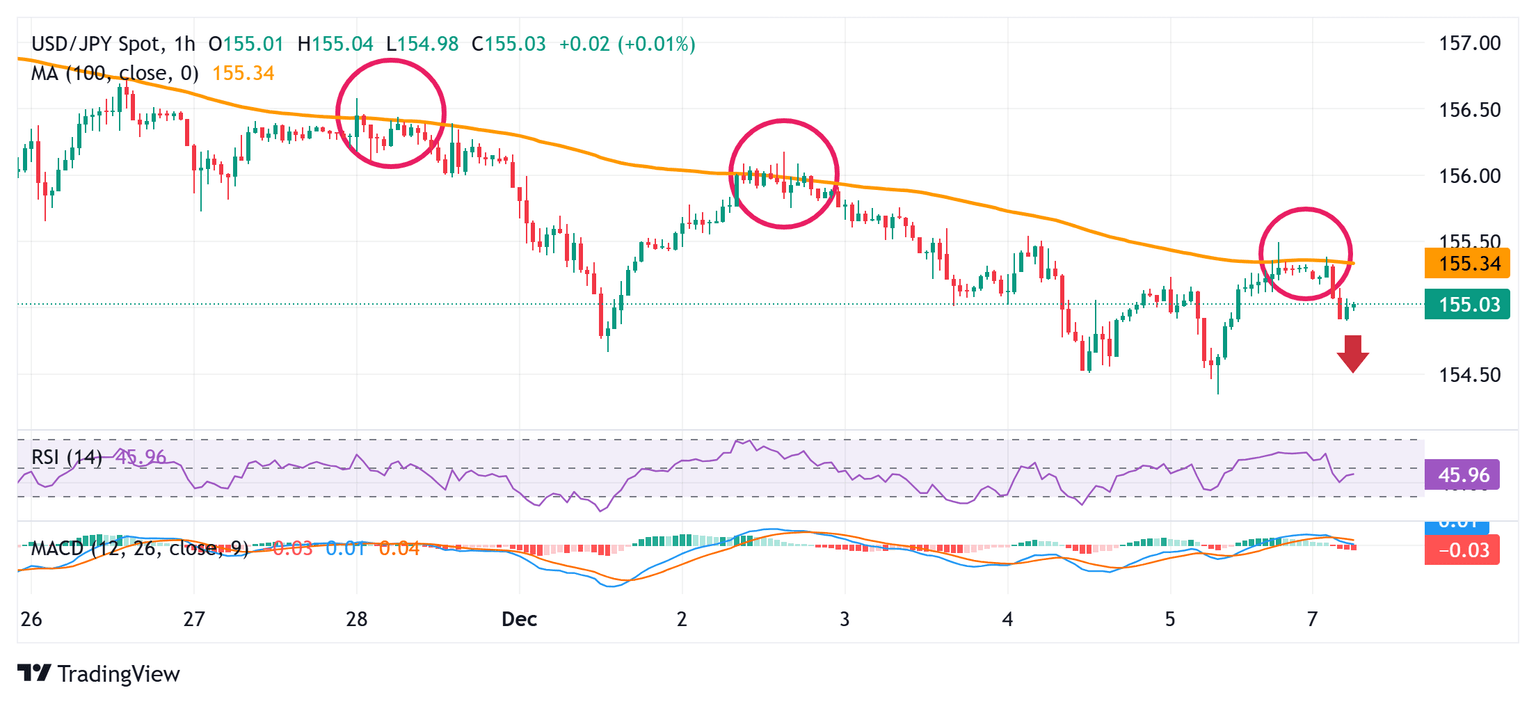
The USD/JPY pair continued with its struggle to move back above the 100-hour Simple Moving Average (SMA) on Friday, and the subsequent slide favors bearish traders. Furthermore, technical indicators on hourly charts are holding in negative territory and back the case for additional losses, though neutral oscillators on the daily chart warrant some caution. Hence, any further intraday slide could find some support near Friday’s swing low, around the 154.35 region, below which spot prices could fall to the 154.00 round figure.
On the flip side, any meaningful recovery attempt is likely to confront a stiff barrier near the 155.35 region, or the 100-hour SMA. Some follow-through buying beyond Friday’s swing high, around mid-155.00s, might trigger a short-covering move and allow the USD/JPY pair to reclaim the 156.00 mark. The momentum could extend further towards the next relevant hurdle near the 156.60-156.65 region en route to the 157.00 round figure.
US Dollar Price This Month
The table below shows the percentage change of US Dollar (USD) against listed major currencies this month. US Dollar was the strongest against the Swiss Franc.
USDEURGBPJPYCADAUDNZDCHFUSD-0.53%-0.67%-0.53%-1.08%-1.32%-0.76%-0.00%EUR0.53%-0.13%0.02%-0.55%-0.79%-0.23%0.53%GBP0.67%0.13%0.39%-0.42%-0.66%-0.10%0.67%JPY0.53%-0.02%-0.39%-0.56%-0.82%-0.25%0.52%CAD1.08%0.55%0.42%0.56%-0.30%0.33%1.09%AUD1.32%0.79%0.66%0.82%0.30%0.57%1.34%NZD0.76%0.23%0.10%0.25%-0.33%-0.57%0.77%CHF0.00%-0.53%-0.67%-0.52%-1.09%-1.34%-0.77%
The heat map shows percentage changes of major currencies against each other. The base currency is picked from the left column, while the quote currency is picked from the top row. For example, if you pick the US Dollar from the left column and move along the horizontal line to the Japanese Yen, the percentage change displayed in the box will represent USD (base)/JPY (quote).
AloJapan.com