
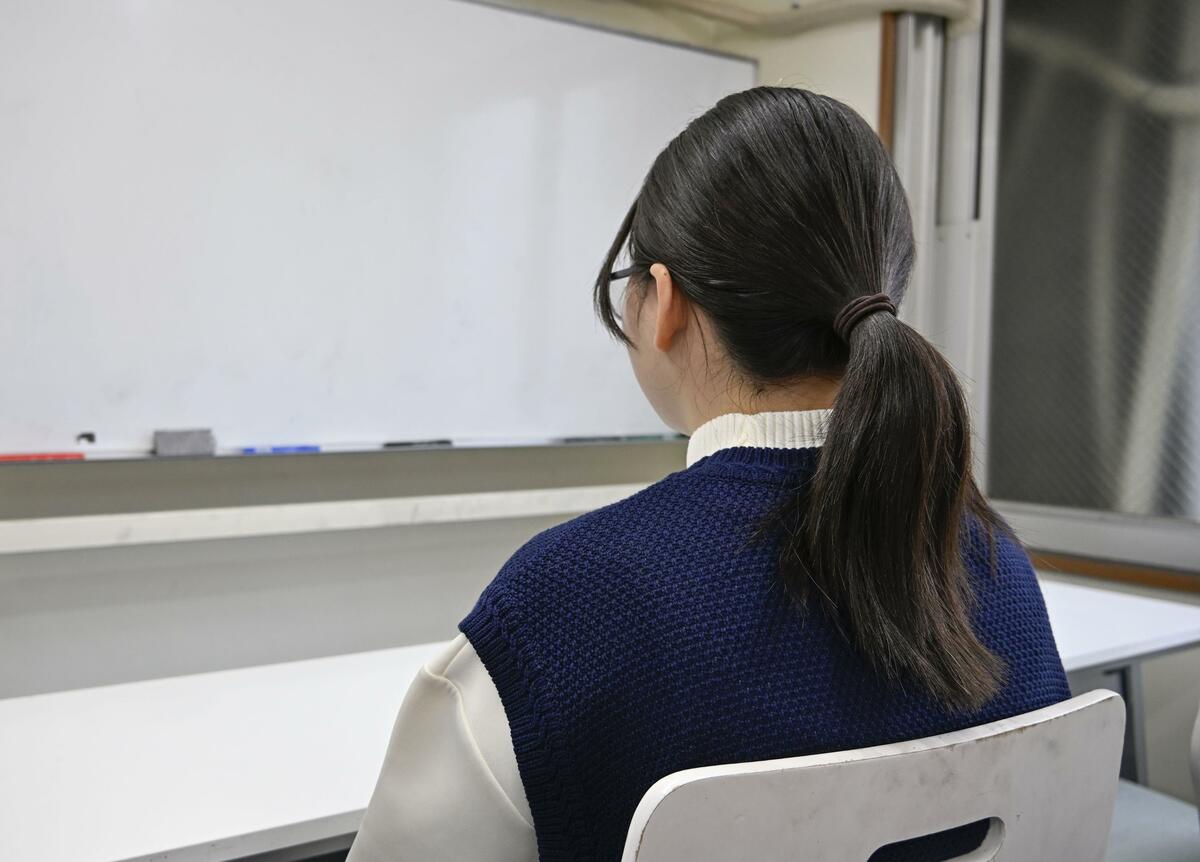
OSAKA – When Tomoko Nakamura entered high school in April 2024, she was confident about getting good grades, having consistently ranked in the top five in junior high school. But her problems began when she realized that she literally could not understand her physics teacher.
Nakamura, a pseudonym, has normal hearing and can carry on conversations with her friends and family. But she cannot make out what her physics teacher says, only his tone of voice and how loudly he is talking.
The 17-year-old living in Hyogo Prefecture in western Japan has been diagnosed with “listening difficulties,” a condition for which diagnostic guidelines were only established in Japan in March 2024.
According to some estimates, individuals who have trouble understanding speech may account for up to 1 percent of the population.
Nakamura was able to understand her other teachers. It was only her physics teacher — a man in in his late 50s to early 60s — whose “voice seemed to vanish” the moment she would hear it.
“I’d hear the sounds but couldn’t pick up any words,” she said.
After scoring just two points out of 100 on the second-semester physics final exam, she was at a loss. “I didn’t know what to do. There was nothing to do.”
Around this time, she read about symptoms of listening difficulties online. Nakamura consulted her mother and visited a specialist, who diagnosed her with the condition, also called auditory processing disorder.
People with listening difficulties have normal hearing test results yet struggle to understand conversations involving noise, fast speech or multiple people. It is thought that some type of impairment occurs in the brain when processing language, but the exact cause remains unknown.
Symptoms vary from person to person, and how sounds are perceived also changes depending on the environment. For example, some people hear ambient noise mixed into what they hear, others hear only fragments of conversations, and some people, like Nakamura, cannot understand certain voices.
Nakamura had occasionally had trouble understanding conversations. In most cases, it happened with her friends, so she could simply ask them to repeat themselves. When speaking with several people, there were times when she felt left out, but she would laugh it off and say, “My hearing is like an old lady’s.”
If she tried very hard to concentrate when her physics teacher was talking, she sometimes was able to understand. But when she did that, she couldn’t write anything down. And there were limits to how much she could make up for this through homework and by reading her textbook.
Listening difficulties are not a progressive condition, but there are also no definitive treatments. Experts say it is crucial to create environments conducive to communication while learning how to manage the disorder effectively.
Strategies include using noise-canceling earphones to reduce disruptive sounds, or transcription apps to convert conversations into text.
Even without using technology, simply speaking slowly or making eye contact when talking can make it easier for people with listening difficulties to understand, experts say.
In November 2024, Nakamura asked to record her physics teacher’s lectures so she could transcribe them through an app. But her school refused, with her homeroom teacher telling her it would violate the privacy of students who ask questions.
Nakamura and her mother began appealing to her school, explaining symptoms of listening difficulties, coping methods, and how transcription apps work. They also visited the board of education.
It took about five months. Gradually, the teachers began to understand, learning about listening difficulties themselves through videos and articles written by specialists. Eventually, Nakamura was allowed to record her physics class and use a transcription app.
She was pleased with the result when she used it in March 2025. “I heard everything my physics teacher was saying!”
For the first time in a year, she could understand the lessons, but she regretted those five lost months.
“It was because listening difficulties weren’t well-known, and because I don’t look like I have a disability in the first place,” she said. “There must be others struggling like me.”
People with listening difficulties have been establishing support groups across Japan since around 2018. There are now 10 nationwide.
Diagnosed with the disorder in 2018, Yoshitada Watanabe is the representative of a group in the Kinki region that includes Osaka and Hyogo.
“Government offices and schools place too much emphasis on precedent,” said Watanabe. “But listening difficulties only gained diagnostic criteria last year, so of course there will be no precedents.”
Symptoms often go unrecognized. In March, Kyodo News conducted a survey of 147 individuals who say they have listening difficulties or their families.
The survey revealed that within the past year, 29 people — 20 percent of the total — had experienced challenges in the workplace or in school.
“Many people only realize it after starting their jobs. They join a company in April and get scolded by their boss or senior colleagues for ‘being slow to learn’ or ‘not listening.’ That’s when they start researching and discover listening difficulties,” Watanabe said.
Consultations at support groups peak every year after the Golden Week holidays from late April to early May. The monthly average of about 30 cases jumps to around 100. People learn about the disorder online during the holidays and seek help immediately.
There are few medical institutions that can diagnose listening difficulties, and getting a diagnosis can take several months.
“During that time, problems caused by listening difficulties continue to occur daily. There have been cases where people quit their jobs because of this,” Watanabe said.
AloJapan.com