
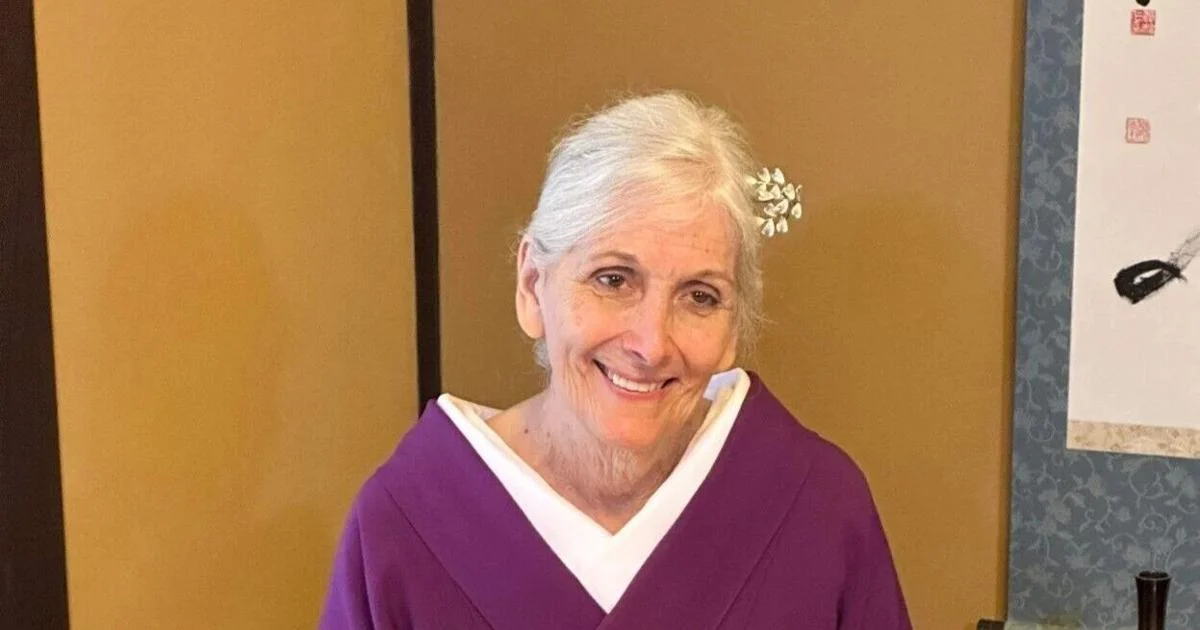
I take a photo of my reflection in the mirror, a woman with shoulder-length gray hair dressed in unflattering kimono undergarments.
I’m in Kyoto, Japan, in the upstairs room of a teahouse — the name given to the places where geisha entertain guests with music, dance, conversation and drinking games. (It’s mostly beer and sake that are served in these places, rather than tea.) I’m waiting awkwardly while my dressers, a former geisha and her daughter, finish collecting the things they need to array me in the complicated garb of a geisha. This is a research trip for a historical novel I’m working on, “The Geisha and the Millionaire,” based on the relationship between George Denison Morgan and a Japanese geisha named Yuki Kato.
As the title suggests, the book spans the East and the West. Although my story is set in the early 1900s, here in Kyoto, the geisha world still exists, as it has for centuries. I’ve been told that it is the best place to learn first-hand what it’s like to wear a real geisha kimono.
Author Claire Griffin photographs herself in “unflattering kimono undergarments” during a research trip in Kyoto, Japan.
PROVIDED BY CLAIRE GRIFFIN
To be dressed by others is a strange experience, and we’re just getting started. A growing pile of wraps, stiffeners, sashes and pads of various sorts sits on a nearby shelf, and a woman is kneeling on the floor, struggling to fit a pair of split-toed tabi socks onto my feet. Unlike the knitted variety worn by many Japanese, the tabi that geisha wear are made of cloth. This kind of tabi has no stretch, and this particular pair of tabi simply cannot be made to fit my size nine feet, which embarrasses my dresser. Eventually, after much searching through drawers and cupboards, the woman’s daughter apologetically offers me a pair of new white tabi socks, the stretchy kind. She bows. I smile and nod. Everyone is happy again.
The rest of the experience goes according to plan. And eventually, the woman looking back from the mirror is wearing a sumptuous robe of plum-colored silk wrapped with a 12-inch-wide obi in an eye-catching shade of lime green. When I’m given a hand mirror to check my reflection from behind, I see that, after being wound around my waist two times, the obi has been tied in a boxy knot that sits at the small of my back. In a few more minutes, the two women finish me off — pinning up my hair with a pair of artfully placed combs and positioning a delicate hair ornament over one ear.
Then I get to walk around, instinctively adopting the small-stepped, slightly pigeon-toed gait that keeps the skirts of the kimono from flapping open. Walking is the easy part. Kneeling turns out to be excruciating for a 74-year-old. And standing after kneeling proves impossible, without a total loss of dignity, in part because I’m worried about stepping on the hem of my costly silk robe and tearing it. This is a genuine geisha kimono, not one of those flashy synthetic ones rented to tourists in storefronts all over town.
The dress-up experience has given me exactly what I was hoping for. Now I know how a woman feels inside a kimono: comfortable — the robe is loose; snug and protected — there’s a lot of soft padding under that obi; definitely constrained. The outfit gently limits a woman’s movements, ensuring that her gestures and steps are smooth, graceful, unhurried. There’s no running in a kimono. A rapid shuffle is the best that can be managed. Anyway, running is considered impolite in Japan, where etiquette constitutes another layer of constraint.
Author Claire Griffin traveled to Kyoto, Japan, to learn how a geisha would feel in her kimono. The trip was research for her forthcoming novel, “The Geisha and the Millionaire.”
PROVIDED BY CLAIRE GRIFFIN
My guide in Kyoto is Peter MacIntosh, an expatriate Canadian who has lived here for 30 years and is an expert on geisha culture. In addition to arranging my dress-up experience, Peter takes me on strolls through Gion, the largest of Kyoto’s geisha neighborhoods. We go to the festive Miyako Odori dances, performed every spring by several hundred geisha and their apprentices (called maiko) who still work in Gion today. He arranges informal geisha encounters and formal teahouse visits. He encourages me to strike out on my own, assuring me that it’s perfectly safe to wander through Gion at night and have a chance to see geisha and their maiko hurrying between appointments.
INSPIRED IN LENOX
But what about the Western half of my story?
That had begun more than a year earlier when my husband and I visited the Ventfort Hall Gilded Age Mansion and Museum in Lenox. During our tour, I was captivated by the docent’s tale of the scandalous marriage of George Denison Morgan — the globe-trotting, ne’er-do-well son of Sarah Spencer Morgan and George Hale Morgan — to the geisha Yuki Kato. As one might imagine, when George brought his bride home to meet the family, things did not go well.
George Denison Morgan, son of Sarah Spencer Morgan and George Hale Morgan, spent his summer’s in Lenox at Ventfort Hall.
PHOTO PROVIDED BY VENTFORT HALL
I couldn’t get the story out of my head. Several weeks later, I emailed Ventfort Hall and explained that I was interested in writing about George and Yuki. I asked if they had any suggestions for how to begin my research. When they responded with an offer of access to the Morgan family letters, I was hooked. Over the next 18 months, I made a dozen trips to Lenox, going through the Ventfort archives, poring over letters, photographs and newspaper articles, many from The Berkshire Eagle.
Gradually, a picture of George emerged. Unlike his brother or his cousins, George Denison Morgan failed to graduate from Yale (or anywhere else) and refused to work in his uncle J.P. Morgan’s bank. In addition, he was a notorious womanizer. In October 1896, his engagement to a New York socialite was announced in The New York Herald, only to be “unannounced” three weeks later, following the discovery of George’s secret love nest at an obscure downtown location. He was indeed the Morgan family’s black sheep.
Here in the U.S., my research did not involve wandering through dark streets in a foreign city, but it was fascinating nonetheless. There turned out to be an early connection between George’s family and Japan. George’s brother Junius — the well-behaved son — was married to Josephine Perry, and “Josie” was related to Commodore Matthew Perry, the American naval officer who opened Japan to trade with the West in 1854. A strange twist of fate!
The most revealing discovery, and one that tells a great deal about American attitudes in the early 1900s, were the descriptions of Yuki in the American press. New York reporters gloried in mentioning her yellow skin, slanted eyes, her silk kimono — appropriate for a boudoir! — her sandaled feet. The newsmen, and they were always men, never got past these superficial descriptions, in part because Yuki spoke no English and George always answered reporters on her behalf. But the real problem was that Yuki was Japanese. The idea that a Western man, and a wealthy one at that, would choose to marry outside his race was so scandalous that it became the sum total of the story.
Yuki Kato Morgan photographed with her dog circa 1912.
PHOTO IN THE PUBLIC DOMAIN VIA WIKIMEDIA COMMONS
However, as it turned out, the racism operated in both directions. It took four years for George to persuade Yuki to have him, partly because he wasn’t Japanese. Yuki lost her Japanese citizenship the moment they married, and she remained a stateless person for the rest of her life. Unwelcome in both America and Japan, the beleaguered couple spent most of their marriage in Paris. Did they find happiness there? Another research question!
AloJapan.com