
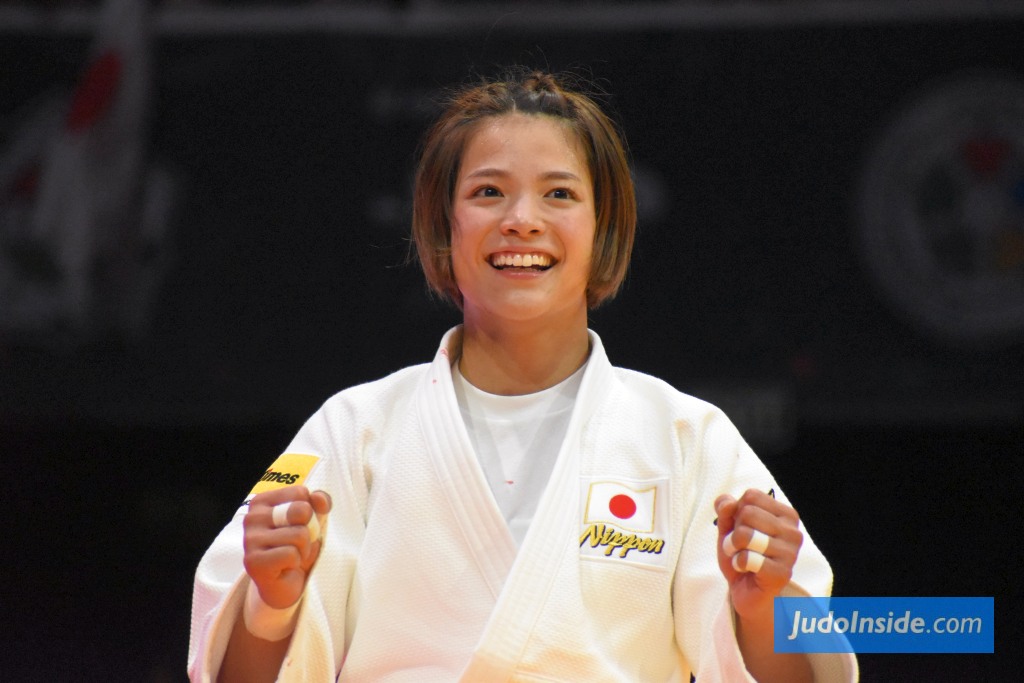
The women’s events begin on Saturday in Tokyo with the lightweight categories opening the final IJF World Tour competition of the year. The Tokyo Grand Slam is recognised as the true season finale, a fixture that traditionally closes the international calendar with exceptional quality rather than volume.
At -52kg, Olympic champion Abe Uta heads a formidable Japanese line-up. Kisumi Omori is Japan’s second entry and may well meet Abe in the semi-finals if both progress cleanly. Spain’s Ariane Toro Soler is expected to make a deep run but must first negotiate Nanako Tsubone. Abe is chasing a remarkable fifth Tokyo Grand Slam title which would equal the record held by her brother Hifumi.
France brings a compact but highly capable team. Shirine Boukli leads the -48kg field and is likely to face a strong challenge from Japan’s Harada, while Wakana Koga remains a regular podium threat in a different section of the draw. Overall, this category is not among the strongest in Tokyo, but Boukli’s experience should carry significant weight.
The -57kg division places world champion Eteri Liparteliani of Georgia as top seed. She shares her pool with Akari Omori, one of Japan’s rising stars. France’s Sarah Leonie Cysique has the credentials to threaten the podium but will have to pass both Takano and Zueva to get there. Momo Tamaoki, placed in a strong Pool C, looks like one of the main contenders for gold.
In the -63kg category, Haruka Kaju is top seed and shares her pool with double European champion Renata Zachova of the Czech Republic, provided Zachova can come through Kerem Primo in her opening contest. European challengers such as Lubjana Piovesana of Austria and Angelika Szymanska of Poland face a difficult path, particularly with Brazilian Nauana Silva and Korea’s Kim Jisu also in the mix.
Sunday begins with the -70kg category, a weight division that appears more open than usual due to the absence of several leading names. Australia’s Aoife Coughlan is top seed, while Madina Taimazova returns to the Russian team and lands in an interesting pool with Tais Pina and a powerful Japanese opponent. Spain’s Ai Tsunoda is again expected to perform strongly in Pool B where she is joined by Austria’s Michaela Polleres, making her return to competition. Pool C is headed by Japan’s Shiho Tanaka, one of the most technically complete athletes in the category. Sweden’s Ida Eriksson will need to work hard for a place in the final block.
The -78kg category, traditionally strong for Europe, features Patricia Sampaio of Portugal as the leading seed. Inbar Lanir of Israel and Fanny Estelle Posvite of France are also seeded, though Japan often produces top-tier judoka in this division. Ikeda heads Pool C, a section filled largely with Asian athletes. Lanir meanwhile finds herself in the same pool as Umeki Mami, a perennial contender for gold.
In the women’s heavyweight division, all eyes will be on the first round where Romane Dicko of France meets the unseeded Akira Sone in one of the most anticipated early contests of the weekend. That pool also includes Russia’s Startseva, creating one of the most demanding paths to the final block.
Since 2008, 157 of the 210 women’s Tokyo Grand Slam gold medals have been won by Japan, an extraordinary seventy five percent. With such depth and history behind them, the host nation is once again expected to dominate many of the podiums as the World Tour season draws to a close.
AloJapan.com