
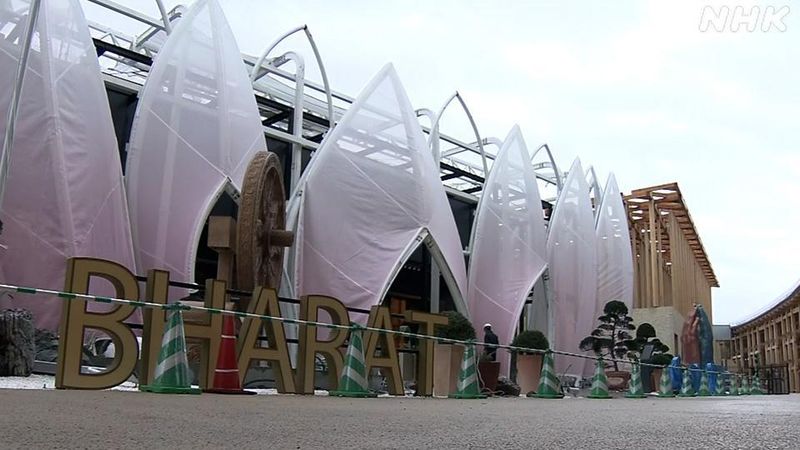
The story of the Osaka Pavilion is filled with intrigue and secrecy. For reasons unknown, an innovative project was dropped at the last minute and the government’s lotus petal pavilion substituted in its place – a structure noteworthy in its eminent thoughtlessness and self-conscious forgettability.
One of the unfortunate tragedies of Indian design is its ready and easy submission to thankless mediocrity and second-rate status. Often on occasions where there is an opportunity to portray India’s unique place in the world, we have not only failed to proclaim that uniqueness, but produced work of such visual and aesthetic incoherence that it only confirms our place as incompetent and wholly bereft of original ideas.
The recently concluded Osaka World’s Fair, which ran from April-October 2025, is a case in point. Its theme, ‘Designing the Society of the Future’, clearly called for an exploration of how individual countries would address their design needs in the years to come.
The Indian pavilion was quick to state that it would merely, and quite contentedly, continue down the well-worn path it had followed since Expo 67 in Montreal. To ensure that that the international public got that message, the Indian contingent spent Rs 400 crore on a set of prefabricated lotus leaves that concealed a box-like building and contained the standard state-sponsored view of Indian arts and crafts gathered from various states – a pastiche of products, pictures and paraphernalia displayed as cluttered and colourful bazaar.

Indian Pavilion at the World’s Fair in Osaka. Photo: Author provided.
The perennially pictorial stereotype of India was not just regressive but clearly demonstrated a failure of a sub-continental imagination, asking in no uncertain terms, why change a formula that has worked successfully for 50 years.
The pavilion’s official promotion also continued to mouth standard phrases about heritage and environment: ‘A testament of sustainable eco-friendly architecture reflecting India’s diverse culture and varied traditions’.
Why would statistical dioramas and industrial production graphics still remain centre-stage in the exhibition? Is it to reinforce Indian commercial performance and showcase India as a ready commodity on par with others? Or as a warehouse of products from a country on perpetual discount? Has nothing changed in India since independence? Do bureaucrats still decide how best to present India to the world? Instead, should we not reveal models and ways of thinking that make our country different from Germany and Brazil?
For most foreigners, the temptation to visit the India Pavilion surely lies in the multitude of valuable secrets the country holds within its historic vault – access to which requires a careful and co-ordinated curatorial effort.
For this reason, the project was initially awarded through the government tendering process to one of the country’s foremost scenographic design firms. A team of professionals with experience and background that would ensure that the pavilion would be conceived and built as a wholly original idea, emphatically reminding the foreign audience of the difference that India could make to the world in traditional crafts and contemporary products.
Having designed notable exhibitions such as the Golden Eye 1985, the Basic Needs Pavilion at Hannover 2000, the Silk Route Festival in Washington 2002, among others, the firm does something truly unique in an international setting. They took the design of the structure into an entirely new experimental realm: an AI generated wholly experimental building that – at the end of the exhibition – would degrade naturally into the site on which it was built. An organic architecture, first seeding, then growing, and eventually disappearing.

The design initially proposed for the fair. Photo: Author provided.
The magic of rapid and seamless construction and its organic disappearance would enact an architecture innovation so far unseen. Within the extended space of the structure’s spread, other products and exhibits that described India’s unique identity were to be placed. The craft presentations were meant to be so varied that they would have weaved a unique narrative of their origin.
A cryptic message of curiosity and inquiry, the mesmerising storyline would engage the viewer with flashes of the past and the future, as discovered in the lives of people in Indian villages and cities. As if craft, objects, handlooms and fabrics, homes and landscape, were a record of the inescapable rhythms of Indian daily life.
The storyline consequently took on a transcendental meaning, drawing on the five variables elements of fire, earth, water, air and space, thus linking Indian arts to their original source – the clay of earth, fired into pottery; stone pigments and natural dyes in painted craft and fabrics; and of course the architecture itself, in the age of AI, stated as vulnerable and transitory. A past and future demonstrated in a consistent cultural narrative.

The design initially proposed for the fair. Photo: Author provided.
Sadly, the story of the Osaka Pavilion is filled with intrigue and secrecy. For reasons unknown, the innovative project was dropped at the last minute and the government’s lotus petal pavilion substituted in its place – a structure noteworthy in its eminent thoughtlessness and self-conscious forgettability.
The substitution, right before the inauguration, was baffling and unjustified, especially as no explanation was provided. India opened its pavilion to the public almost a month after the Expo opened. The exhibition lasted six months, and conveyed to the Japanese that India was just another trading partner waiting in line.
What was the value of a Rs 400-crore budget allocated to this when there is no evident impact? Moments of visible failure in India invariably begin and end with the petty nepotism and corruption that still clings to every form of public exposure with a high price tag, and the desire to turn such opportunities into foreign vacations at government expense. But there lies a deeper underlying malaise: it betrays to a global audience India’s complete lack of cultural self-belief, and an inability to step out of the shadows of conventional expectation and adulation. However mediocre, we still want to be a world player.
How these prolonged international events are perceived in a now increasingly connected world is hard to say? Shouldn’t national originality be all the more essential when global identity reduces everything into a bland sameness? Had Osaka been viewed as a cultural memorial to Indian originality, perhaps its value may have been retained in long-term memory.
Gautam Bhatia is a Delhi-based architect
This article went live on December fourth, two thousand twenty five, at seven minutes past five in the evening.
The Wire is now on WhatsApp. Follow our channel for sharp analysis and opinions on the latest developments.
AloJapan.com