
![Hokkaido Nippon-Ham Fighters pitcher Noriaki Koki Kitayama (left) and pitcher Hiromi Ito (right) [Photo: provided by the team]](https://www.alojapan.com/wp-content/uploads/2025/12/eXcKDisHzp0b7dmipIvuI8qLPZdxQaFm8h3e7PPs.webp.webp "BB has been the lowest in the league for the third consecutive year. The “Shinjoism” permeates Hokkaido Nippon-Ham pitcher pitching staff | Pacific League")
BB has been the lowest in the league for three consecutive years. The “Shinjoism” has permeated Hokkaido Nippon-Ham pitcher pitching staff.
Pacific League Insight
2025.12.3(水) 11:00
Hokkaido Nippon-Ham pitcher pitchers had the second-best ERA in the league.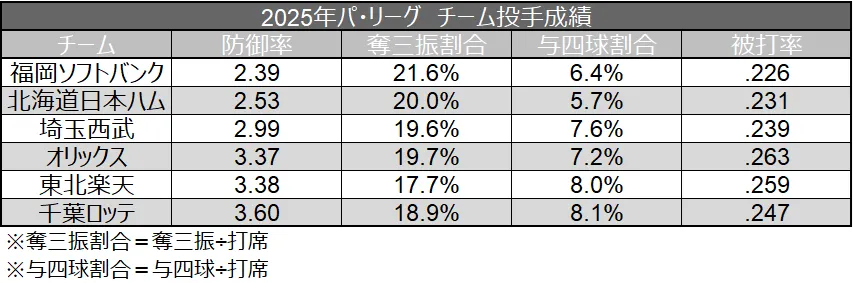 2025 Pacific League team pitcher performance ©Data Stadium
Hokkaido Nippon-Ham Fighters fought a fierce battle for the championship in the regular season, and in the following “2025 Persol Climax Series Pacific League,” they fought until the very last game of the final stage. Although they were unfortunately beaten by Fukuoka Softbank Hawks, their high-level pitching and batting performance was just as impressive as this season’s champion team.
This time, we’ll be looking at the performance of Hokkaido Nippon-Ham Fighters’ pitcher through data. This season, they have posted a team ERA of 2.53, second in the league, and have also performed well in other areas, but one thing that stands out in particular is the low number of BB. This isn’t just a story for this season; the team has led the league in BB and BB rate for three consecutive years since 2023. The fact that they have few runner that are wasted due to Walk is a major strength of the team.
Whether the first pitch is strike or not is a turning point in the game.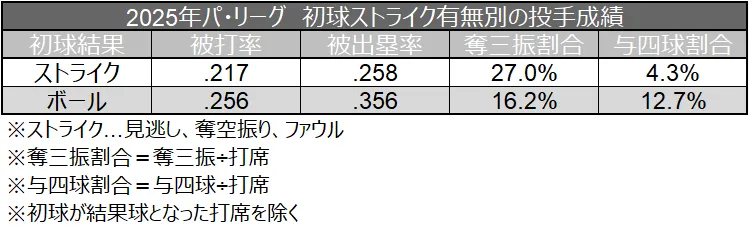 pitcher performance with or without a first-pitch strike ©Data Stadium
The way the first pitch is thrown is crucial in closer BB to a minimum. The table above shows the overall performance of pitcher in Pacific League this season, broken down into cases where the first pitch was strike and cases where it was a ball. As you can see, whether or not you can get strike on the first pitch makes a big difference in BB rate. In addition, there are also differences in Avg and strike out rate, and it is clear that if you can get strike on the first pitch, you have an advantage in the matchup against hitter. This trend shown in the numbers is probably also intuitively convincing.
Hokkaido Nippon-Ham pitcher pitchers take the lead from the first pitch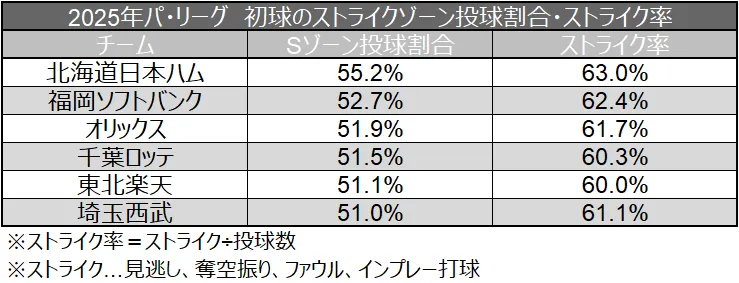 First Pitch strike Zone pitch Percentage and strike Rate © Data Stadium
Hokkaido Nippon-Ham pitcher team has the highest percentage of first pitches thrown into the strike zone in the league, and along with that, the first pitch strike rate is also the highest in the league. Since taking office, coach Tsuyoshi Shinjo, who has been in charge since 22, has often preached the importance of “competing in the strike zone” in front of the media. The pitch percentage of strike zones on the first pitch has been the highest in the league for four consecutive years, and the strike rate of the first pitch has been ranked first in the league for two consecutive years, and the coach’s thinking has firmly permeated the pitcher team.
There is also ingenuity in how strike are taken.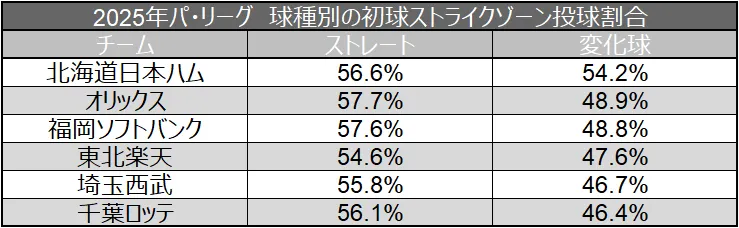 First pitch by pitch type strike Zone pitch Percentage © Data Stadium
Furthermore, a distinctive feature of the way he takes the first pitch strike is that he actively throws breaking ball into the zone. While the difference between fastball and breaking ball ‘s first pitch strike pitch the zone is about 9%, Hokkaido Nippon-Ham has a small difference of 2.4%, and breaking ball is also throwing into the zone at a rate comparable to fastball. In addition, the pitch rate of the first pitch by pitch type is fastball 39.3% and breaking ball 60.7%, and the rate of throwing breaking ball on the first pitch is also the second highest in the league. If you just want to take a strike, you can throw a fastball into the zone that is easy to control, but of course it is aimed at and hit hard. By weaving in breaking ball well, Hokkaido Nippon-Ham pitcher the first pitch Avg to the lowest in the league of .307 (league average of .323), while closer achieving a high first-pitch strike percentage.
Aggressive pitch into the zone creates a favorable count pitcher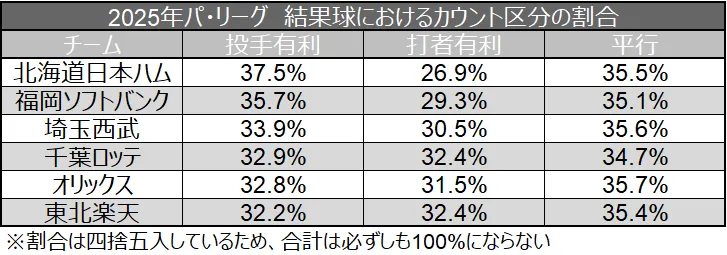 Percentage of count categories in result balls ©Data Stadium
This season, Hokkaido Nippon-Ham pitcher pitchers had the highest percentage of at-bats in the league that ended in pitcher hitter count at 37.5% of all at-bats that ended in a tie with the hitter, while the lowest count of at-bats that ended in pitcher favor at 26.9%. The difference of 10.6% between the two teams means that they were able to throw strike ahead and take on hitter in a favorable position. This was the result of their aggressive approach to strike zone, and was likely a factor in their excellent performance this season, including the low number of BB.
Hokkaido Nippon-Ham has steadily grown stronger under Shinjo’s leadership, finishing second for the second year in a row. However, on the flip side, these two years have also seen the frustration of losing in the championship race and the difficulty of reaching the top. At the “F FES 2025 Supported By Fanatics” event held on November 22nd, Manager Shinjo expressed his sentiment that “second place is good enough,” which likely reflects the consensus of players, staff, and The Fighters fans. Will the people who embody “Shinjoism” be able to seize glory? We can’t wait to see what happens next season.
*All figures in the text and tables are as of the end of the 2025 season.
Text and Data Stadium
AloJapan.com