
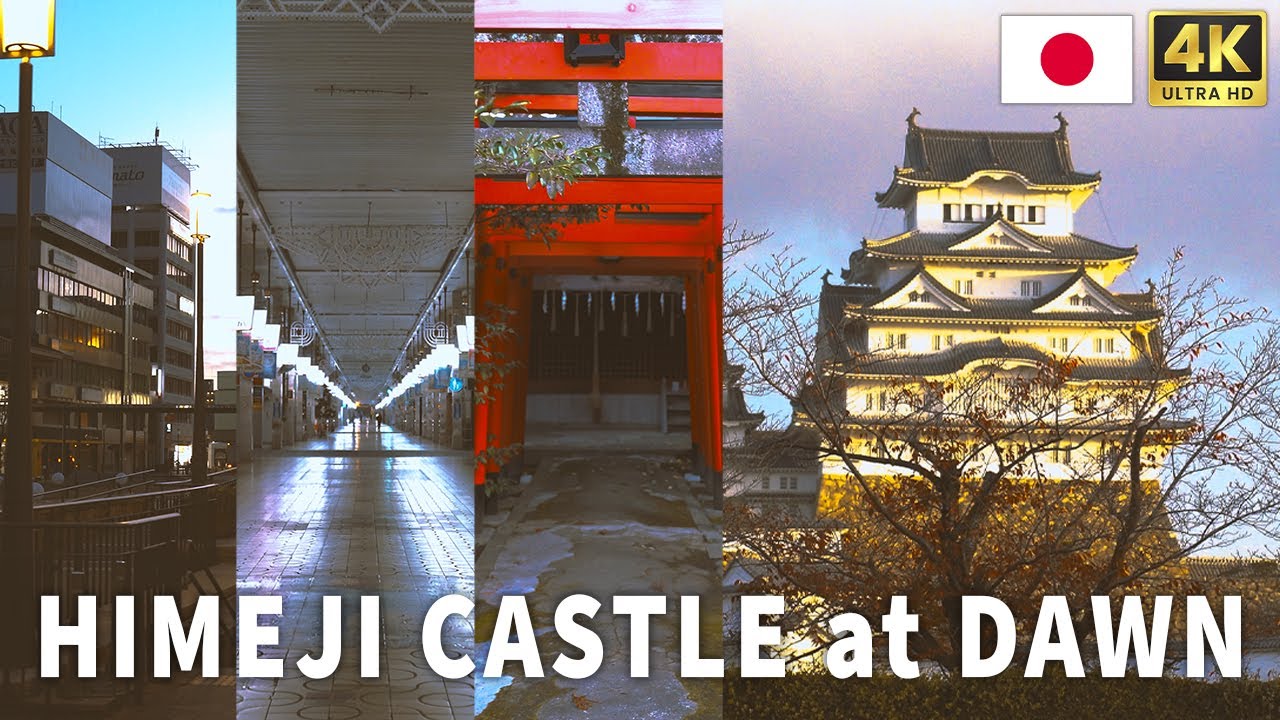
Himeji, Japan 4K Walking Tour – Himeji Castle at Dawn (Silent Early Morning Walk)
Welcome to Dawn Walks Japan. This channel captures Japan’s famous locations just before dawn and at the moment the sun rises. Enjoy the scenery and short explanations as if you were walking with me. Today’s route starts at Himeji Station, goes to Himeji Castle, and then loops once around the outer grounds. It’s currently 6:20 AM. The first train leaves Himeji Station at 5:00 AM, so even before sunrise, commuters and students are already inside the station. Himeji is the second–largest city in Hyōgo Prefecture, and Himeji Station is a major hub where several railway lines meet. Many people travel through Himeji to commute to Kobe—the largest city in Hyōgo—or even to Osaka in the neighboring prefecture. The train ride from Himeji to Osaka is about one hour, so it’s natural to see office workers here at this time. Now we’ve exited the north side of Himeji Station. The north exit leads to the rotary, department store, and, of course, today’s destination—Himeji Castle. When people hear “Himeji Station,” most imagine this north side. You can walk straight down the main street to reach the castle, but since we’re here, let’s go through Miyuki-dōri first. Miyuki-dōri is Himeji’s representative covered shopping arcade. It’s a comfortable walking street even on rainy days, with many shops ranging from dining to fashion to general goods. This historic arcade connects JR Himeji Station and Himeji Castle, and its origin dates back to the Meiji era(1868 – 1912). In 1903, for the Meiji Emperor’s visit, a new road was built from the station to the castle. At 9 meters wide, it was the widest road in the city at that time. The Japanese word for an emperor’s outing is “Miyuki” and from that, the street was named “Miyuki-dōri.” There aren’t any shops open at 6:30 AM, but during the day and into the evening it’s very lively. This is Ōtemae-dōri, the main street in front of Himeji Station. It runs straight from JR Himeji Station to Himeji Castle and is one of the city’s symbolic streets. A major renovation was completed in 2019, separating pedestrian and bicycle lanes to make it safer and easier to walk. Plants and wooden decks were added to the center, making it a pleasant space for shopping, dining, or relaxing on benches. Since August 2022, tables and chairs are set out daily along the street. People can enjoy meals outdoors, have coffee meetings, or simply relax in the open air. You can experience the comfort of being outdoors near Himeji Castle right here on Ōtemae-dōri. From November to February, the “Himeji Ōtemae-dōri Illumination” lights up the entire street. Under the supervision of world-renowned lighting designer Motoko Ishii, the area is decorated with 250,000 full-color LEDs. Even early in the morning, traffic is fairly active. Continue straight and the castle will soon come into view. Ōtemae Park hosts many events during the day and serves as the gateway to Himeji Castle. Its 25,000-square-meter grounds are filled with greenery around a central open plaza. The Karo Yashiki-ato Park stands where the residence of Takasu Hayato—the chief retainer of the Sakai clan—once stood in the 18th century. The park incorporates the layout of Edo-period castle streets and recreates the atmosphere of the old castle town. Four restored buildings—“I-no-Yashiki,” “Ro-no-Yashiki,” “Ha-no-Yashiki,” and “Ni-no-Yashiki”—sell souvenirs and are popular with visitors. This stone marker indicates that Himeji Castle is designated as a “Special Historic Site,” one of Japan’s most important cultural landmarks. Here is a sign for the “DANDELION Himeji Castle × NAKED, INC.” illumination event. Projection mapping across the lawn and trees creates an immersive, synchronized art experience. The Sakuramon Bridge was built to evoke the wooden bridge that once crossed the inner moat during the Edo period(1603 – 1868). It’s 7 meters wide and 22 meters long, completed in February 2007. Since its opening ceremony, it has become a beloved landmark for locals and visitors alike. Beyond the gate lies San-no-maru Square, a vast open lawn offering a clear, unobstructed view of the main keep. It’s one of the best spots to admire the castle against the sky. Now let’s talk briefly about Himeji Castle itself. The castle was originally built around 1333. Many of its main structures—such as the keep and watchtowers—were built in the early 1600s and still remain intact today. They are designated as National Treasures and Important Cultural Properties. Himeji Castle is also known as “Shirasagi-jō(It’s mean “White Heron Castle”), said to be named after its elegant white appearance or the fact that it stands on Mount Sagiyama(It’s mean “Mount Heron”),. There are several theories. Himeji Castle usually opens at 9:00 AM.
Closing time is 5:00 PM during the summer season (May 1 – Aug 31), and 4:00 PM during the rest of the year. Admission is 6.4 US dollar for adults and 1.9 US dollar for children.
Groups of 30 or more receive a 20% discount. In fiscal year 2023, the castle recorded its highest number of visitors ever—about 450,000 people.
Roughly 30% of them were international tourists. In recent years, there had been discussions about raising the admission fee for foreign visitors only. Currently, the city has decided to introduce a “dual pricing” system:
Adults aged 18 and over who live outside Himeji City will see their admission fee raised from 1,000 yen to 2,500 yen.
This will take effect on March 1, 2026. Himeji Castle has stone walls built in different eras.
Among them, this is one of the oldest and most significant ones to look out for. It’s known as the “Kanbei Stone Wall,” believed to have been constructed in 1580. “Kanbei” refers to Kuroda Kanbei, a highly respected samurai and military strategist in Japanese history.
He is famous enough to have been the subject of a major TV drama. Japan was unified by three great leaders: Oda Nobunaga, Toyotomi Hideyoshi, and Tokugawa Ieyasu.
Kanbei served all three of them during his lifetime. Kuroda Kanbei was born at Himeji Castle and later succeeded his father as the castle lord. He advised Toyotomi Hideyoshi—then the most powerful man in Japan—to use Himeji Castle as his main base.
Hideyoshi later carried out major renovations, laying the foundation of the Himeji Castle we see today. If you ask Japanese people, “Who is the most famous lord of Himeji Castle?”,
most will likely answer: Kuroda Kanbei. Kanbei was known for his rare talent of persuading enemies to surrender without fighting,
playing a major role as a strategist in Hideyoshi’s unification of Japan. This is Himeji Shrine, established in 1879 to enshrine the Sakai family, the former lords of the Himeji Domain. A Shinto shrine is a place in the traditional Japanese belief system “Shinto,”
where deities are enshrined—ranging from gods of nature, daily life, and professions
to the spirits of ancestors and historical figures. This particular shrine enshrines the Sakai clan, who once governed Himeji. The grounds cover about 1.6 acres. Although the shrine escaped the air raids of World War II, it did suffer significant damage in the past and has been rebuilt several times. This statue depicts Kawai Sun’ō, a senior retainer of the Himeji Domain.
Sun’ō Shrine is dedicated to him. This is Himeyama Park, which spreads mainly across the northern side of Himeji Castle. You can enjoy seasonal plants such as cherry blossoms, azaleas, and maple trees. Unlike the busy southern gate area, the northern side is covered with natural forest,
making it quiet and peaceful—offering a different view of the castle. The area around the castle, including this park, also features museums, a zoo, a library,
and other cultural facilities, forming a large integrated park. I can’t introduce it today, but the Himeji City Museum of Art is especially recommended—
a beautiful historic red-brick building. After visiting the castle, why not walk around it using this video as your guide? Perhaps these are local seniors?
It seems this area also serves as a relaxing community space for residents. This is the Minami-seigakushi-mon gate ruins, a defensive enclosure designed to block enemies from entering the main keep. There are countless historically important spots like this scattered throughout the castle grounds—
that’s part of what makes Himeji Castle so fascinating. We’re getting close to the end of the walk.
Thank you for watching until the end.
Please enjoy the morning sun. See you next time.
Welcome to Dawn Walks Japan.
Enjoy the calm atmosphere of Himeji in the early morning.
This dawn walk starts at Himeji Station and leads to Himeji Castle, followed by a gentle loop around the outer perimeter. The streets are much quieter than during the day—mostly empty with only a few early risers passing by—letting the castle and city speak for themselves as the sunrise slowly appears.
You can use this video to:
• Relax – unwind with natural early-morning ambience
• Explore – experience Himeji as if you were walking there yourself
• Learn – enable subtitles for short notes about the locations and history along the route
Route length: 2.3 miles (3.7 km)
Time: 6:20 AM – 7:20 AM
Weather: 52°F (11°C), cool and serene
Filmed on: November 28, 2025
If you enjoy peaceful dawn walks across Japan, consider subscribing to Dawn Walks Japan.
#Himeji #JapanWalkingTour #4KWalk #HimejiCastle #DawnWalk
AloJapan.com