
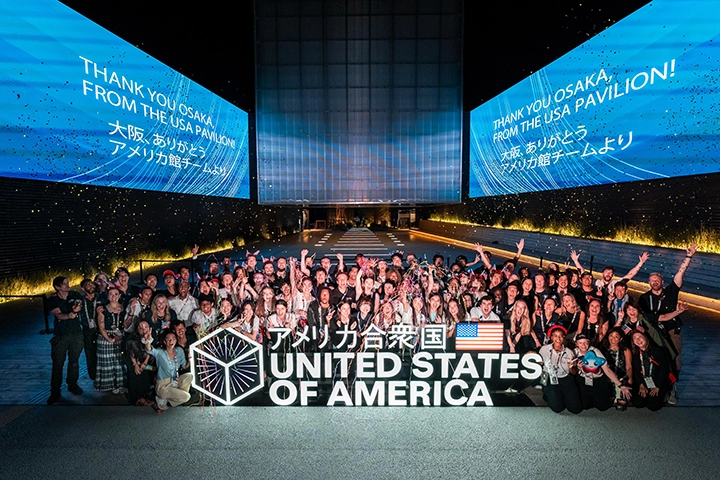
UWM student Gabrielle Sweeney had an unusual summer job: She was a youth ambassador at the American Pavilion at the World Expo in Osaka, Japan.
What, exactly, is a World Expo?
“That’s what I wondered at the beginning!” Sweeney laughed. “But come to find out, Expos have been going on since they were dubbed the World’s Fair.”
World’s Fairs began in 1791 in Prague as a way to showcase new technologies and strengthen the exchange of culture and ideas between nations. The telephone was famously introduced at the 1876 World’s Fair in Philadelphia, and audiences were delighted to ride the Ferris Wheel, which debuted at the Chicago World’s Fair in 1893.
These days, the World Expo is held roughly every five years. Each nation that participates is invited to build a pavilion to display their technical and cultural accomplishments. If you’re wondering what it looks like, picture a giant Epcot. In fact, said Sweeney, “When I was applying, they dubbed it kind of a ‘Diplomatic Disneyland.’”
Representing Wisconsin
Sweeney is a political science major with a Japanese minor. She started her college career at UW-Whitewater, but transferred to UWM because of the strength of the university’s Japanese program. Then, last year, one of Sweeney’s teachers altered her to a cool job opportunity. She applied and became one of the 100 U.S. youth ambassadors chosen to work at the American Pavilion at the World Expo. She was the only person chosen from Wisconsin.
“I think my mission in coming here was to represent us as a people – Americans, Wisconsinites – and to do that in the best way possible,” she said.
 Gabrielle Sweeney enjoys the cherry blossoms in Osaka, Japan.
Sister Cities International worked with the U.S. State Department to provide housing for Sweeney and her cohort. Every day, they helped organize the long lines waiting to enter the American Pavilion and provided tours once the patrons finally entered.
And oh, the sights they saw.
The American Pavilion
The World Expo took place on a large, artificial island built within Osaka. Millions of people – mostly from Japan, but many from China, Europe, and the United States – poured in every day to visit the different pavilions.
The American Pavilion was impressive, Sweeney said. When guests entered, they passed through a long hallway describing various exchange programs. The next section featured technological innovations developed in the U.S., including micro-robots from MIT and snow sports equipment made from algae. Beyond that lay a travel room showing more scenery – including images from Door County, Wisconsin.
“I would always be so proud to be like, ‘That’s Wisconsin! That’s where I’m from!’” Sweeney said.
The tour rounded out with displays about NASA and the Space Program, topped with a simulated space launch.
“After that, our final showcase was the lunar sample. In the 1970 Expo, which was also in Osaka, we brought a moon rock, a lunar sample, to the USA pavilion, and people lined up for three, four hours just to see that lunar sample,” Sweeney said. “And so, to honor that, we brought a different lunar sample so that people could take a look. I had so many older folks that had come to the 1970 Expo as a kid, and they would come up and say, ‘I remember that rock. This is so exciting to be able to see this one.’”
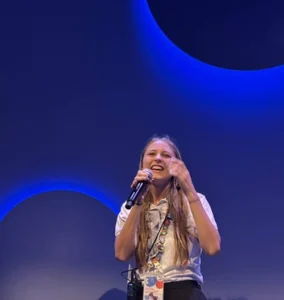 Gabrielle Sweeney gives a presentation to her Japanese audience at the American Pavilion.
On the job
As a youth ambassador, Sweeney had several jobs. She might be on crowd control duty outside (“We would cut the line off at about a two-hour wait every day. People were really wanting to come inside the USA Pavilion and see what we had to offer”), or she might have to escort a VIP delegation through the pavilion (“We did have an imperial visit. I think it was the princess who came through our pavilion”).
Or she might use the Japanese language skills that she learned at UWM to give presentations about American technology to her Japanese-speaking audience.
“I was really nervous to get on stage at first in the innovation room. It took me a while to get up there, but once I did, I enjoyed it a lot,” Sweeney said. “You would have to do some crowd work as people were filling in before the show would start. You’d always be trying out new bits.”
Sweeney always started by asking the audience to guess where she was from. She was shocked when one Japanese family guessed correctly; it turned out they had lived in Milwaukee for a while, and their young son was a Milwaukee Bucks fan.
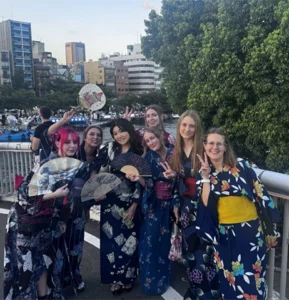 Gabrielle Sweeney (second from right) and her friends from the Baltic Pavilion dress in yukata, or summer kimonos, at a festival in Osaka.
Travel and takeaways
Outside of work, Sweeney explored Osaka and other locales in Japan. She and her friends had a picnic under the trees to mark Hanami, which is when the Sakura, or cherry blossoms, bloom. She learned to play the shamisen, the traditional Japanese three-stringed guitar, and attended a calligraphy class.
One of her favorite things, though, was the pin-trading culture at the Expo.
“We received pins that were the USA Pavilion official pins, and you would trade them for other countries’ pins. But then, as it caught on to the public, the public would bring their own pins to trade,” Sweeney said.
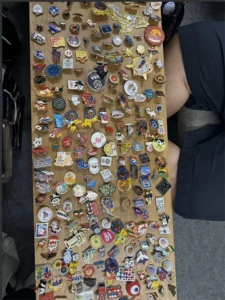 The Youth Ambassadors’ pin collections
The World Expo lasted from April to October. When it was over, Sweeney walked away with a lot of new pins and a deep appreciation for the skills she learned.
“I think (I learned how) to stay cool under pressure when you have a million different things going on and a million different people asking you questions,” she said. “(I learned) to connect with people across culture barriers. … My perspective on life, on the world, has broadened so much thanks to this experience.”
She hopes to use that perspective in her future job – perhaps as a foreign service officer for the State Department, or as an English teacher in Japan.
Because while she was helping show America to the world, the world was showing itself to her, too.
By Sarah Vickery, College of Letters & Science
AloJapan.com