
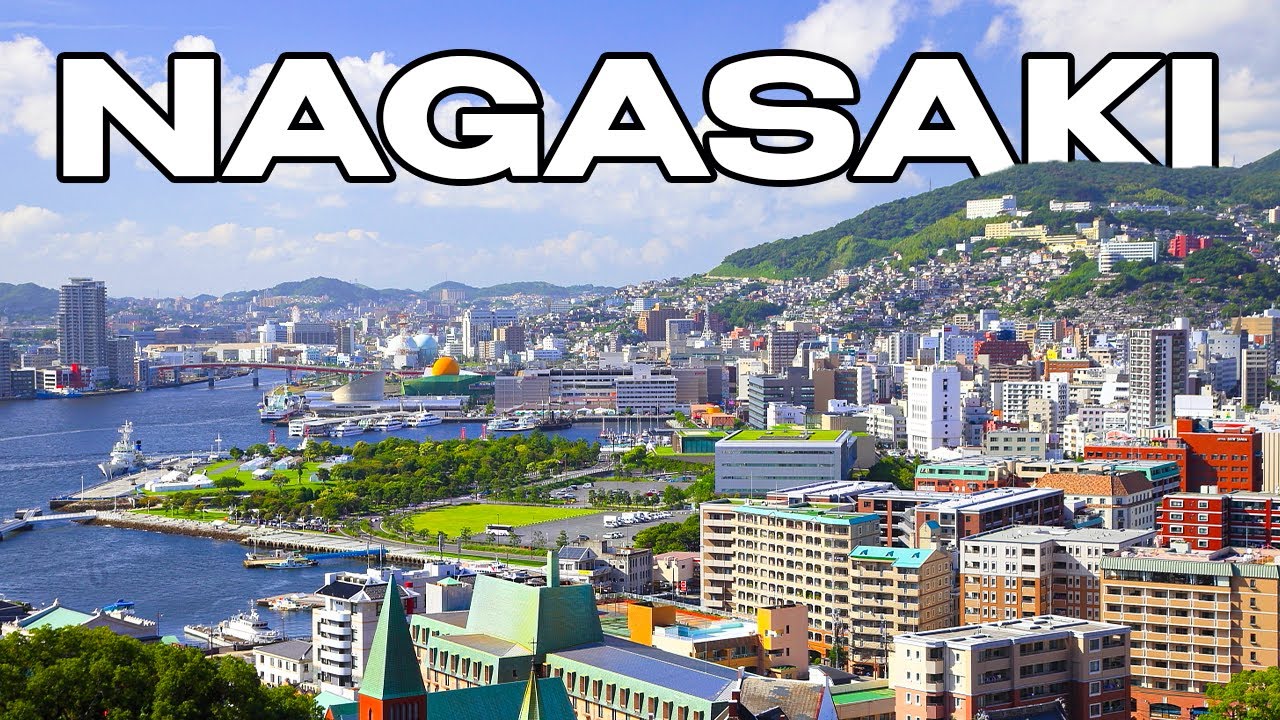
NAGASAKI | Destroyed by an Atomic Bomb in World War 2
Come on. Come on. This is Nagasaki in 2025. Times have changed. Happy Friday. Hi there. Good afternoon. Today is Saturday, November 29th, 2025. Currently 61° Fahrenheit. That is 16° C. I just toured the Nagasaki Atomic Bomb Museum. I highly recommend it. It doesn’t take too long, but is very informative and eye opening. This is not the site where the atomic bomb dropped. It is very close, though. I’m going to walk over there now as I share a bit of the uh history of World War II. By no means am I going to attempt to encapsulate it, but uh just to give the context of what most people will already know. But uh of course Nagasaki is one of only two places in the world where nuclear weapons were used during warfare. So, World War II did not end with the suicide of Adolf Hitler. And so, after the death of Hitler, Germany surrendered about a week later, but the fighting continued for many months after that. here in Asia. The Axis powers of course Germany, Italy, Japan being the major uh countries fighting against the allies, UK, France, United States, etc. And so the fighting raged and was showing no signs of there being a conclusion to the war and uh the atomic bomb was in development. President Roosevelt was hoping to end the war by dropping atomic bombs on Germany, but uh they hadn’t been developed yet, but it was fairly well known that they were getting very close within months. And so as it went into June and July of 1945, they started to much more seriously consider the possibility as it became clear that they were going to accomplish building a atomic bomb. And so, uh, as they were drawing up their war plans of a invasion of Japan in order to finally defeat them and end the war, then there were casualty estimates. How many people were going to be killed and injured in the course of an American invasion of Japan, both of American soldiers and the Japanese. And those numbers were very very big in the millions. And so there was of course much debate about whether it was the ethical thing to do to drop an atomic bomb that would undoubtedly kill many tens of thousands but would hopefully end the war. And so I’m not going to uh make a determination about whether that was or was not the right thing to do, but obviously they ultimately decided to go ahead with it. And so they threatened Japan and ordered them to uh surrender. They did not. And so on August 6th, 1945, they dropped Little Boy, the first atomic bomb on Hiroshima, Japan. But Japan did not surrender. And so they dropped the next one, Fat Man, on Nagasaki here, right here on August 9th, 1945 at 11:02 in the morning as a stopped clock showed there in the museum that was found here in Nagasaki, like a mile or so away from the bomb site, still intact, but stopped at 11:02. 2 in the morning. And so the number of casualties was not exactly known. I think around 80,000. I will put the estimate uh down below here. the uh little boy atomic bomb dropped on Hiroshima was the less powerful, but I believe that there were more casualties there. Maybe because it was a bigger city. In total, it was in the range of 200,000 or so killed between the two bombs. And so the uh blast zone was basically One kilometer in every direction from the blast site, nobody survived and very few buildings remain. There was a photo inside the museum of the valley from the other side looking back at that hill that the museum is on. And there is very very little left standing. And so that was of course just over 80 years ago. But the city has transformed tremendously. And so I decided to start this video at the bombing site so that now we can kind of symbolically move forwards away from that uh terrible moment in uh history and uh go see what Nagasaki is like now. It is a very lovely city with quite a lot to see. So, atomic bomb hypoenter. So, that is there and then the museum here. Fountain of peace. Okay, let’s uh go take a look at that and then start walking into the city. So, the peace statue was created by the sculptor So Kitamura. The right hand indicates the threat of nuclear weapons. His left symbolizes peace and his closed eyes express prayerfulness for those who are victims of war. The fountain of peace is a place to pray for those victims who passed away. While begging for water, the everchanging shape of the water evokes the beating wings of the dove of peace and the crane. The crane is representative of Nagasaki port, which is known as the crane port because of its shape. At 11:02 a.m. on the 9th August 1945, an atomic bomb exploded. Approximately 500 meters above this spot. In an instant, many irreplaceable lives were lost. After the bombing of Hiroshima, it was the second atomic bomb to be used in the history of mankind. Okay, let’s uh go take a look at the uh Peace Fountain. You can hear me. I love the old street cars. So, uh, Nagasaki now in 2025 is a fairly typical mediumsized Japanese city. There are a number of interesting looking things to see over near my hotel, which is a couple of miles away. Kind of a long walk. And so I want to get over there. I caught the taxi to the museum, but to get back there, I’d like to try one of the street cars. And specifically, I want one of the old ones. So, right up there is uh one of the stops. I don’t know how it works as far as paying for it, but I have lots of Japanese coins. I imagine those will work. So, uh let’s wait for one to come along. Okay, I’ve got the walk sign just in time here. Okay, I got to get on this side. No idea how much Okay, mission accomplished. Straight up there was the uh Nagasaki train station where I arrived yesterday coming from Yuin. And then out there you can not really see yet but uh the water is very close. So uh let’s go take a look at the harbor which uh Nagasaki is famous for. So Nagasaki has a lot of history that uh precedes the uh atomic bombing. It became a very important port that was established by the Dutch and Portuguese for trading and everything uh back in the I think 16th century and it was the only uh trading port for centuries up until the 1800s and so it was a very important city in this part of the world for a very long time. So there you can see the uh station where I will catch a train tomorrow back to Fukuoka about 2 and 1/2 hours train ride away and then I catch a flight out of Japan the day after tomorrow. So, this is likely my last video that I will film on this trip in Japan. And yes, I am going somewhere warmer. Looking forward to it. Not a new country, but a new place within that country that I wanted to go to for quite a while. And so the way that I figured out how to pay for the uh tram there is that I was standing there looking at the uh machine, not sure how much I should put in it. I had my uh coins in my hand. And so I asked a lady next to me, “Most people in Japan don’t speak English unless it is a hotel receptionist or some of the fancier or more touristy restaurants, etc., info booths at the airport and the train station. But uh I would say most Japanese don’t speak English, but uh you can manage to get points across in other ways. So, it was obvious to her that I was trying to figure out how to uh pay the uh toll. And so, uh I held out my hand with the coins in it. And then she picks out the right coins. So, it was 150 Japanese yen, which is about $1. And then I was about to put them in the uh machine, and she kind of stopped me, but then it was a little tricky trying to explain what I needed to do. And so she pulled out her phone and she did Google Translate or whatever translate app and uh then showed it to me and it said pay 150 when you leave the train. And so you don’t even pay at that machine there. Maybe I could have paid there when I left as well. Anyways, she seemed to say go to the front of the train and leave through that door and then you pay the fair there. So, uh, now I know you are here. So, Seaside Park, Art Museum, the former Hong Kong and Shanghai Bank, Nagasaki International Cruise Ship Terminal. So international. Where are they going to? Korea, Taiwan. Only so many countries they could be going to. Not a whole lot of other countries nearby. And so from here you get a nice perspective on the harbor and the city skyline. And then let’s take a quick look at the uh little park here. Okay, this is a happening scene here. And it looks like there is a uh little fair going on here. I guess these are benches. Wow, very nice scene. A Saturday market. Donald Donuts. Have a donut day. Sounds like a plan to me. And look at that massive cruise ship. Huge mongus. Really lovely park here. What a day. Not a cloud in the sky. It feels warm. Temperature is very relative. If I was in Bali right now and the temperature had dropped from 86° Fahrenheit to 61, I’d be freezing. But, uh, as it is, I’m overheating. just a very very pleasant uh temperature. Okay, let’s go explore some more sites out there. A really nice design of these canals and walkways and bridges here. And a really really bizarre statue here. Very surrealist. Let’s take a look at it from the other side. Very very strange indeed. No plaque here with an explanation. And look what we have here. It’s Nagasaki’s Chinatown. Looks like it might be fairly small. Good morning. I guess this is a restaurant. Yeah, maybe. It looks like they’re making wanttons. And I guess that is it. This is the eastern section of Dejima’s southern embankment wall. Excavations conducted in 199697 revealed four layers of rocks about 1.2 m in height since the stone pilings on the upper half of the wall were missing. These were restored using traditional methods in view of the need to preserve the Dejima tree. The section of this wall near the tree was not restored. I don’t know if this is the tree being referred to. Okay, I guess so. The Dejima tree is a species of the evergreen family common in Southeast Asia transplanted from Jakarta. It is a living testimony to the history of Japanese Dutch exchange. as I mentioned earlier. So I guess what it was also referencing there was ancient ruins or hundreds of years old ruins. Anyways, as you can see here, some pillars or something. And then I’m seeing more old walls over there, but I seem to be on the wrong side of the fence. It was a fan-shaped artificial island built in 1636. Okay, there we go. Under orders from the Tokugawa Shogunate to intern Portuguese residents of Nagasaki and thus to prevent the spread of Christianity, the Portuguese were expelled from Japan in 1639. leaving the island empty. Okay, so this was like after the Europeans had arrived and then weren’t very welcomed here by the sounds of it. Looks like that is a uh model of the town that took up this whole little island. Another Saturday market here. Okay, here we go into the old town, the old Portuguese town. All right, 520 yen entrance fee, about $3. Okay, so yeah, this is a fully uh constructed, I’m sure reconstructed town but uh very Japanese style looking room. So that is quite an interesting phase of history. Okay, we can go inside here. Various traditional methods were used to reclaim land from the harbor and to build the artificial island of Dejima. Introduced here are the structure of the island’s foundation and features of the embankment walls, Dejima bridge. Second story up there. Really, really interesting. a part of Japanese history you don’t uh necessarily hear much about. Okay. museum with uh art pieces and some amazing uh depictions of what it looked like. Wow. a map of the whole region. I think that’s got to be the Philippines. Borneo, New Guinea. Where’s Japan though? Is that Japan? It seems to be really out of uh proper scale. There it just says beach. Interesting. Timour Java, I’m guessing. So that’s probably Bali, maybe. Oh, there we go. Bali there. Look at that. Is it a clock or a calendar? Maybe both. Let’s see. Turret clock with two balance beams. Okay. The first traditional Japanese clocks had only one. By balance beam, do they mean the hand or they mean those things? Okay. Up there, I guess. Pretty fascinating. Rolling around Nakadori, crossing the stone bridges on the way to Terramaki, you will come across Nagasaki’s oldest shopping street, the Nakadori shopping street. Lining the streets are shops which have been around since the late 19th and early 20th centuries. and fashionable and fancy shops as well. So this is Meganashi spectacles bridge or meane bridge which is the oldest stone bridge in Japan. In 1982, a flood washed away six of 10 stone bridges along this canal here, including this one, but it was rebuilt using the original stones. I guess they managed to find the stones down the canal. Another one down there. So many phases to the history of Nagasaki and Japan in general encapsulated in uh the different layers of uh the city. Okay. Well, I think that is going to do it for my video of Nagasaki and my video series of Japan this visit. I look forward to coming back once again. Absolutely one of my favorite countries and so much more to see. One of those countries where you could truly spend a lifetime exploring. But more coming from another country in the next video. See you.
A tour of Nagasaki, Japan, one of only two cities in the world to be the target of an atomic bomb, which finally ended World War 2.
Support this channel on Patreon: https://www.patreon.com/gabrieltraveler
Leave a tip and get my ebooks for free (I will send them to your email address): https://www.paypal.com/paypalme/gabrielmorris198
Follow on Instagram: https://www.instagram.com/gabrieltraveler
Books written by Gabriel Morris: https://www.amazon.com/Gabriel-Morris/e/B001JS0KOS
Essays and stories: https://gabrieltraveler.medium.com/
Music during the video (in order):
“Kotojitoro” by Joseph Beg
&
“Blue Sky” by Quincas Moreira
&
“Asian Theme 3” by Jonatan Jarpehag
Need some good music for your Youtube videos? I use and recommend Epidemic Sound. To get a free 30-day trial click here: http://share.epidemicsound.com/sSvpV
Video created by Gabriel Morris, who is the owner of all video or photo content. Filmed with a DJI Osmo Action.
Gabriel is a budget traveler, outdoors enthusiast and travel writer who has been adventuring around the world since his first trip to Europe in the summer of 1990 when he was 18 years old. He is author of “Following My Thumb”, “Gabe’s Guide to Budget Travel” and several other books.
Disclaimer: Gabriel Morris is a participant in the Amazon Services LLC Associates Program, an affiliate advertising program designed to provide a means for sites to earn advertising fees by advertising and linking to www.amazon.com. As an Amazon Associate, Gabriel earns revenue from qualifying purchases.
32 Comments
and few decades later they used chemical weapons on Vietnam 🙁
Looks like a rather boring place unfortunately. South Vietnam next?
These are the type of videos that are great! Where we get to know more about events of such historical significance. It's a pity though he's heading back to yet another country he's been to before! He'll never change!
Hi from Portugal, cool video Gabe! Love Japan but i miss the cats😊
Like to see more museums in your travels
the sunny day also helps, but it seems like a really lovely port city. The first part of the video was quite moving. The area around Nagasaki is the richest of Japan in terms of hidden christian sites.
you should get an contactless IC card at one of the train stations. you can tap to pay for local public transport in the whole country!
A couple of weeks ago, I read "Nagasaki: Life After Nuclear War" by Susan Southard. Recommend.
You should have continued to read the info re Dejima. You’re wrong in saying Europeans weren’t welcome – the Dutch were happily accepted because they only came to trade. The Portuguese were expelled because they tried to evangelize and spread Roman Catholicism in Japan.
nagasaki – as far away from fukushima as it can get.
That is the Propaganda. Hitler Eva and many German nazis moved to Beriloche Argentina Under Juan Peron. & 6 of his top Generals.. Read the FBI's Hitler file. Every Argentinian knows this, The trail of evidence is also clear
That song the band is playing sounds like a jam.
How come this city didn't end up like Chernobyl which is still radioactive?
Dejima Island is fascinating as for 200 years it was the only place in Japan where foreigners were allowed. The Tokugawa shogunate won over the others and the Portuguese gave weapons to an opposing side, that's why they were first moved to Dejima and then expelled. But trade with the west continued and it was the Dutch who were allowed to trade, but only could bring their goods to Dejima. The main European language that some Japanese could speak before the coming of the 'Black ships' that forced Japan to open up in the mid 1800s was Dutch and there are still Dutch words for things used in Japanese. The Dutch traders were not allowed off the island of Dejima, the only bridge to the mainland was guarded.
👍
Get IC card such as Pasmo or Suica and precharge w money swipe to pay easy peasy 😂
Best video yet for this series. Love the music
On your way to Saigon?
Very cool city and video! Love that part where it opens up and you could see the big cruise ship and bridge
I'm guessing you're going to Vietnam
Bro I'm so bummed that you aren't staying longer in Nagasaki!😢
The strange statue probably symbolizes nuke aftermath ?
Nagasaki is also heavily influenced by western culture; two places recommended to check it out: Glover’s Park and Oura Chuch.
In addition you should consider heading to Hiroshima after Kyushu; Hiroshima is a fantasy city with more WWii memorial plus Miyajima island; one of the 3 Japanese most scenic spot
Nagasaki prefecture happens to have the highest concentration of Christians in Japan.
Thanks for sharing Gabriel. I will be visiting Japan at the end of January. Maybe I will see Nagasaki!
Hey fellow Canadian haven't seen your videos a long time you're looking older but still looking good
Great video, been to Hiroshima but not Nagasaki. Been following you for quite a while and it seems to me that you are not spending enough time in each country.
Gabriel, are you glowing? So radiant.😂
Nagasaki looks like a beautiful city to visit. Great to see it is now a thriving and diverse city after the horror of the bombing. Lots of layers of history. This Japan series has been fantastic. Thank you and safe travels.✌️❤️
That city is so clean! I haven't noticed any trash
Kokura was the target on August 9th, not Nagasaki, but due to poor visibility, the target changed. I've read that after WWII some Japanese would comment "the luck of Kokura" if they experienced life saving good fortune.
I appreciate the history lesson