

The Japanese Yen (JPY) remains on the back foot through the Asian session on Tuesday, though the downside remains cushioned amid a combination of supporting factors. A generally positive tone around the Asian equity markets is seen as a key factor undermining the JPY’s safe-haven status. The downside for the JPY, however, remains cushioned amid hawkish Bank of Japan (BoJ) expectations.
In fact, BoJ Governor Kazuo Ueda signaled on Monday that a December interest rate increase could be under consideration. This, along with intervention fears, helps limit deeper JPY losses. The US Dollar (USD), on the other hand, struggles to attract any meaningful buyers amid bets for another rate cut by the US Federal Reserve (Fed) this month, and contributes to capping gains for the USD/JPY pair.
Japanese Yen remains depressed as positive risk tone counters hawkish BoJ expectationsAsian stocks stage a modest recovery after the previous day’s selloff, undermining traditional safe-haven assets and prompting some selling around the Japanese Yen during the Asian session on Tuesday. This, along with a modest US Dollar (USD) uptick, assists the USD/JPY pair in building on the overnight bounce from the 154.65 region, or a two-week low.Bank of Japan Governor Kazuo Ueda offered the strongest signal yet toward further normalization and said on Monday that the likelihood of the central bank’s economic and price projections being met is rising. In fact, inflation in Japan has remained above the central bank’s 2% target for over three years, strengthening the case for policy tightening.Traders were quick to react and are pricing in a roughly 80% chance of a rate hike at the December 18-19 BoJ meeting, up from around 60% last week. The outlook pushed the rate-sensitive two-year Japanese government bond yield to 1% for the first time since June 2008 on Monday, and the 20-year yield to levels not seen since November 2020.Moreover, the 30-year government bond yields climbed to a record peak on Tuesday, and the 10-year yield reached a 17-year high, which, in turn, backs the case for the emergence of some dip-buying around the JPY.Japan’s Finance Minister Satsuki Katayama said on Sunday that recent erratic swings in the foreign exchange market and rapid JPY weakening are clearly not driven by fundamentals. It’s our position to issue warnings against such matters, Katayama added further, fueling speculations about the government intervention to stem any further JPY weakness.The US Dollar dived to a two-week low on Monday after the Institute for Supply Management’s (ISM) Manufacturing PMI fell to 48.2 in November, down from 48.7 in the previous month. The reading missed consensus estimates and comes on top of the recent tepid US economic data, suggesting that growth in the world’s largest economy is cooling.Moreover, dovish signals from Federal Reserve officials fueled speculation for another rate reduction this month. In fact, the CME Group’s FedWatch Tool indicates a nearly 88% chance of a quarter-point rate cut at the Fed’s December 9–10 meeting. This marks a big divergence in comparison to the BoJ’s hawkish outlook and should cap the USD/JPY pair.Heading into next week’s Fed rate decision, investors will confront the release of the US Personal Consumption Expenditure (PCE) Price Index – the central bank’s preferred inflation gauge – for more cues about the future rate-cut path. The uncertainty, however, remains in the absence of the official jobs report because of the recent federal government shutdown.USD/JPY might struggle to build on the recovery momentum beyond the 156.00 mark
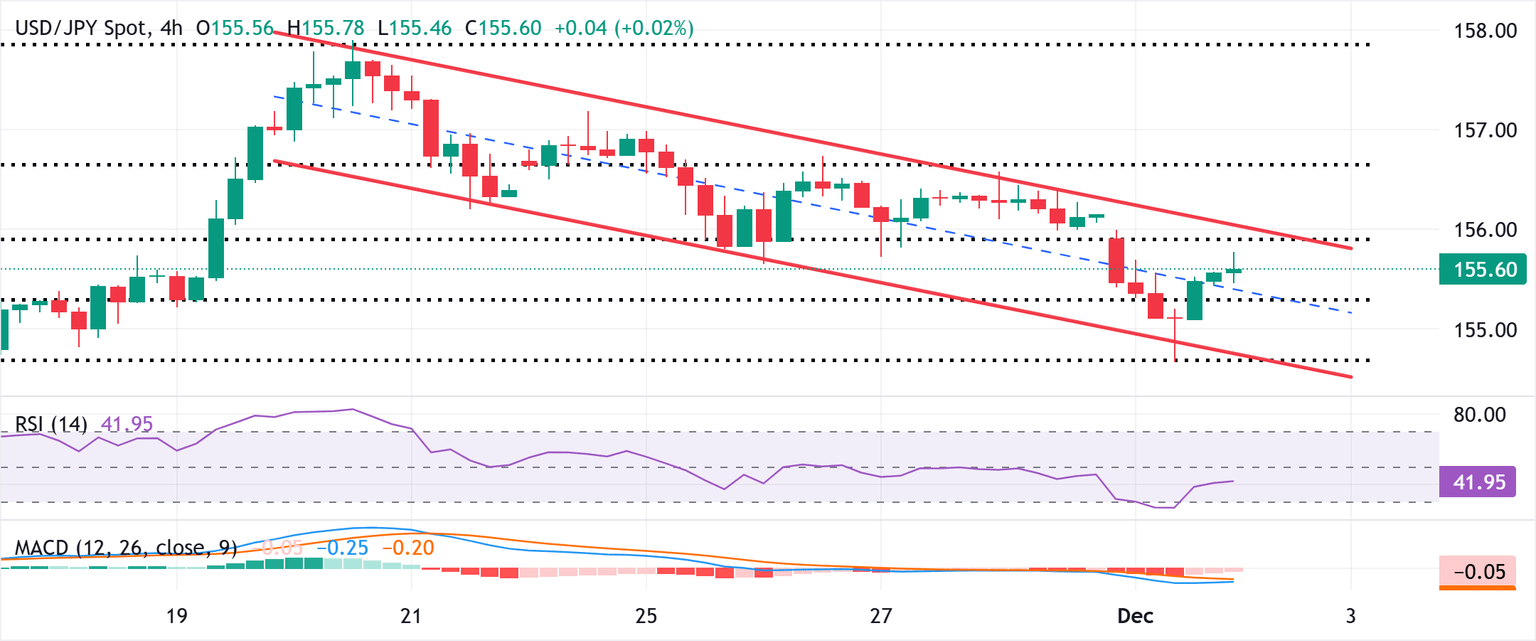
The USD/JPY pair’s corrective slide from the 158.00 neighborhood, or the highest level since mid-January, touched last month, has been along a downward-sloping channel. The overnight bounce validates the trend-channel support, which coincides with the 61.8% Fibonacci retracement level of the November upswing and should now act as a key pivotal point. A convincing break below will be seen as a fresh trigger for bearish traders and pave the way for an extension of the pair’s two-week-old downtrend. In the meantime, the 155.00 psychological mark could protect the immediate downside.
On the flip side, any subsequent move up is likely to confront stiff resistance around the 156.00 neighborhood, representing the top boundary of the aforementioned trend-channel. A sustained strength beyond could trigger a short-covering rally and lift the USD/JPY pair to the 156.60-156.65 intermediate hurdle en route to the 157.00 round figure. The momentum could extend further towards mid-157.00s before spot prices make a fresh attempt to reclaim the 158.00 mark.
Japanese Yen FAQs
The Japanese Yen (JPY) is one of the world’s most traded currencies. Its value is broadly determined by the performance of the Japanese economy, but more specifically by the Bank of Japan’s policy, the differential between Japanese and US bond yields, or risk sentiment among traders, among other factors.
One of the Bank of Japan’s mandates is currency control, so its moves are key for the Yen. The BoJ has directly intervened in currency markets sometimes, generally to lower the value of the Yen, although it refrains from doing it often due to political concerns of its main trading partners. The BoJ ultra-loose monetary policy between 2013 and 2024 caused the Yen to depreciate against its main currency peers due to an increasing policy divergence between the Bank of Japan and other main central banks. More recently, the gradually unwinding of this ultra-loose policy has given some support to the Yen.
Over the last decade, the BoJ’s stance of sticking to ultra-loose monetary policy has led to a widening policy divergence with other central banks, particularly with the US Federal Reserve. This supported a widening of the differential between the 10-year US and Japanese bonds, which favored the US Dollar against the Japanese Yen. The BoJ decision in 2024 to gradually abandon the ultra-loose policy, coupled with interest-rate cuts in other major central banks, is narrowing this differential.
The Japanese Yen is often seen as a safe-haven investment. This means that in times of market stress, investors are more likely to put their money in the Japanese currency due to its supposed reliability and stability. Turbulent times are likely to strengthen the Yen’s value against other currencies seen as more risky to invest in.
AloJapan.com