
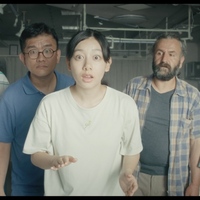
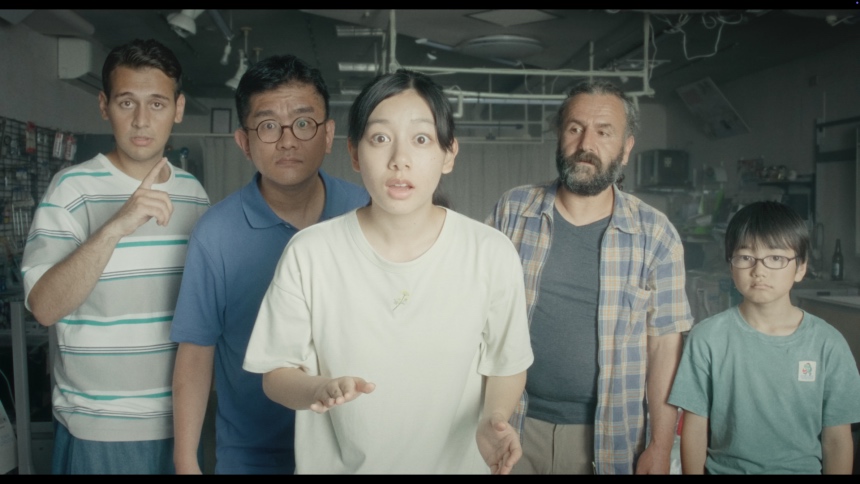
A quiet shopping street. The Koga family runs a store that serves their local community. The shop-owner father and his son are deaf, and signage in the store indicates this to the customers.
The daughter, Natsumi, is a hearing person. Their lives are peaceful, and agents have come to regard this street as the perfect living location for minorities moving to the area.
So it is that the Kogas are disrupted by the arrival of a Kurdish family across the street – a brasher (if well-meaning) group who do not understand Japanese – or sign language. A series of misunderstandings escalate, and the hearing adult children of the two families are called upon to mediate. But the intimacy of their communication gives way to another kind of intimacy, and tensions escalate further.
Ken Kawai’s third feature, following 2012’s From Here To Nowhere and 2015’s The Sheep Story, Tokyo International Film Festival premiere The Chatterboxes is a warm-hearted riot – the rarest kind of dramedy which embraces our diversity whilst unapologetically ribbing all and sundry in equal measure (think Four Lions).
Keen to represent reality, Kawai cast actors whose first language matched that of their characters. Aided by an interpreter, we too explored our cultural common ground, and where his film diverges from its contemporaries.
ScreenAnarchy: This film finds warm humour in the absurdity and frustration of translation and language barriers, so it feels amusing and appropriate to be conducting this interview with you with a language barrier ourselves.
Ken Kawai: I am a CODA myself – a child of deaf adults, so I grew up as a majority amid a minority. I have faced and come across various barriers. But when these kinds of situations are depicted on film, they’re typically given a sad tone.
I wanted this film to be cheerful. There’s a comedic streak to this film, and we derive that from the absurdity of these situations.
There’s been an explosion of films about the experiences of deaf and CODA individuals out of East Asia over the past year or so: Mipo O’s film LIVING IN TWO WORLDS, Korean film HEAR ME: OUR SUMMER, and Hong Kong film THE WAY WE TALK, to give a few examples. In making this film, were you conscious that you were adding to a curious cultural moment – much as your film is pushing in different directions stylistically?
The films related to this theme that I’ve watched is the original French-Belgian film that the American film CODA was based on, La Famille Bélier. And, indeed, Living in Two Worlds. I wasn’t aware of other films.
But I must say, it wasn’t the primary thing on my mind. The lead characters are CODA, yes, but that’s not what I wanted to focus on – it was more my perspective as a CODA filmmaker that I wanted to reflect upon with this film.
What interests you more broadly about language as a subject for a film, as a site for observational comedy?
I don’t want to sound preachy, but what I wanted to achieve with my film is that I would like my audience to be multilingual – meaning that I’m not just targeting those who are deaf. Because I am a CODA, I must include those who understand and communicate with Japanese sign language, but with different languages, different information is transmitted.
People have different feedback and understanding. That difference is something I really wanted to highlight.
What I really love about this film is that it’s not the typical tried-and-tested narrative feature film logline about deaf individuals and marginalized communities. You’re willing to make a fool out of everyone and empower everyone at the same time. Were you keen and conscious to shift the onscreen narratives about these different communities?
So-called minorities, whether – say, in Japan, those who speak languages other than Japanese and those who are deaf – face preconceived stereotypes that I would like to correct. For example, it’s often said that all deaf people are isolated – but in fact, it’s a really tight-knit community. They have many friends, and they’re really fooling around, having fun.
And when it comes to Kurdish people, they tend to be quite jolly by nature. But if you put them under this one category of ‘Kurds in Japan’, the situation is currently not positive for them – the way they are depicted and the predicament they’re in.
In the film, I’m not portraying them from society’s perspective, so to speak. I wanted to depict them from within, from the community perspective. Then you see a whole different picture. Depicting them from this alternative perspective, these characters are, in a way, as you described – fools. I am depicting them just the way they are, and it turned out to be quite different from what narrative film audiences are familiar with.
What first sparked the idea for this film?
Of course, it somewhat stemmed from the fact that I am a CODA myself, but it’s also the fact that the way we perceive and receive information is changing in the 21st century as a result of digitization. I fear that, rather than actively seeking information, we are becoming very passive.
People tend to prioritize not what is spoken by someone right in front of them, but information from the internet – they seem to trust that information more, and that’s scary. Film, I thought, is the best form of expression to tell this story. Because, in film, communication in multiple languages is possible.
As I mentioned earlier, I would like the audience to be multilingual as well, perceiving different messages, having different feedback. That’s both the genesis and the goal of my film.
Speaking of that multilingual element, could you tell me about the decision to subtitle the Kurdish speakers in their native language, and not in English or Japanese?
This was a decision made from the eyes or standpoint of those who are deaf – because if one is able to hear, then even if the person doesn’t understand that language, at least this person knows that it is a foreign language. Whereas there are subtitles for those who have difficulties.
The subtitle could simply say that this is some kind of foreign language. But that is mere information – it doesn’t tell anything.
That’s why I made a point of having Kurdish subtitles. Unless you understand Kurd, you don’t understand it – so hearing spectators are in the same standpoint as deaf spectators.
It’s rare to find a film that manages to find humor in the communication differences between deaf people and hearing individuals like this film does. I imagine that acuity and awareness stems from your own experiences as a CODA. Could you tell me about how you went about striking that tone successfully?
It was such hard work to finish the script. I struggled to balance the perspectives of the deaf and hearing characters. But that humor and light-heartedness just naturally leaked out without intending it.
When you listen to deaf people’s communication, you find it tends to get quite self-loathing, but it’s quite fun with humour. I didn’t want this film to be gloomy, but I didn’t struggle to make it lighthearted.
The handheld camera and the anarchic humour derived from discomfort in this film reminded me of Lars von Trier’s film THE IDIOTS. Was this film an influence, and what other films were?
I have seen The Idiots, and Lars von Trier is a filmmaker who I was very much following in my teenage years. But the similarity didn’t really occur to me until you mentioned it just now. I received feedback that this film is somewhat ‘classic’ in its comedy style, reminiscent of the old Shochiku films.
This is a long film. Two hours and 25 minutes is a runtime where you run the risk of losing an audience, especially in the case of a comedy. What attracted you to this runtime? Did you have faith that your film would draw audiences in and successfully keep them there?
I thought about this a lot. I’m dealing with different languages here, and so it requires a certain tempo. We go through this sort of communication breakdown, and I didn’t want to treat that subject lightly. I didn’t really set out to make a comedy film per se.
When you deal with other people, it takes time. It’s quite painstaking to understand one another. I didn’t think it would be appropriate if I made a light, feel-good film where everything goes smoothly towards a happy ending. I thought I should fatigue the audience a bit. Their bums might start hurting, but that’s the way it should be.
In style, this film feels equally reminiscent of domestic Japanese cinema and European arthouse cinema, which feels fitting considering the convergence of cultures and communications in this film.
When making the film, I didn’t have any particular audience in mind. But I grew up on European cinema – Rossellini, Bertolucci, these are the directors I grew up with. In the way that emotion drives my filmmaking, I think I’m very much influenced by Italian cinema tradition.
What would you like your audiences to take away from this film and bring back into their own lives?
What one knows or sees in their everyday – I want people to see and reach way beyond it. The unknown is there – I want people to realise that it is there.
What people who can hear or see take for granted is completely different to those who cannot. If there’s at least a little realisation, if this film can be a trigger for that, it would make me happy.
The Chatterboxes premiered at the 38th Tokyo International Film Festival in the Asian Future section. With thanks to Yumi Matsushita for translating. All images ©2025 “The Chatterboxes” Production Committee
AloJapan.com