
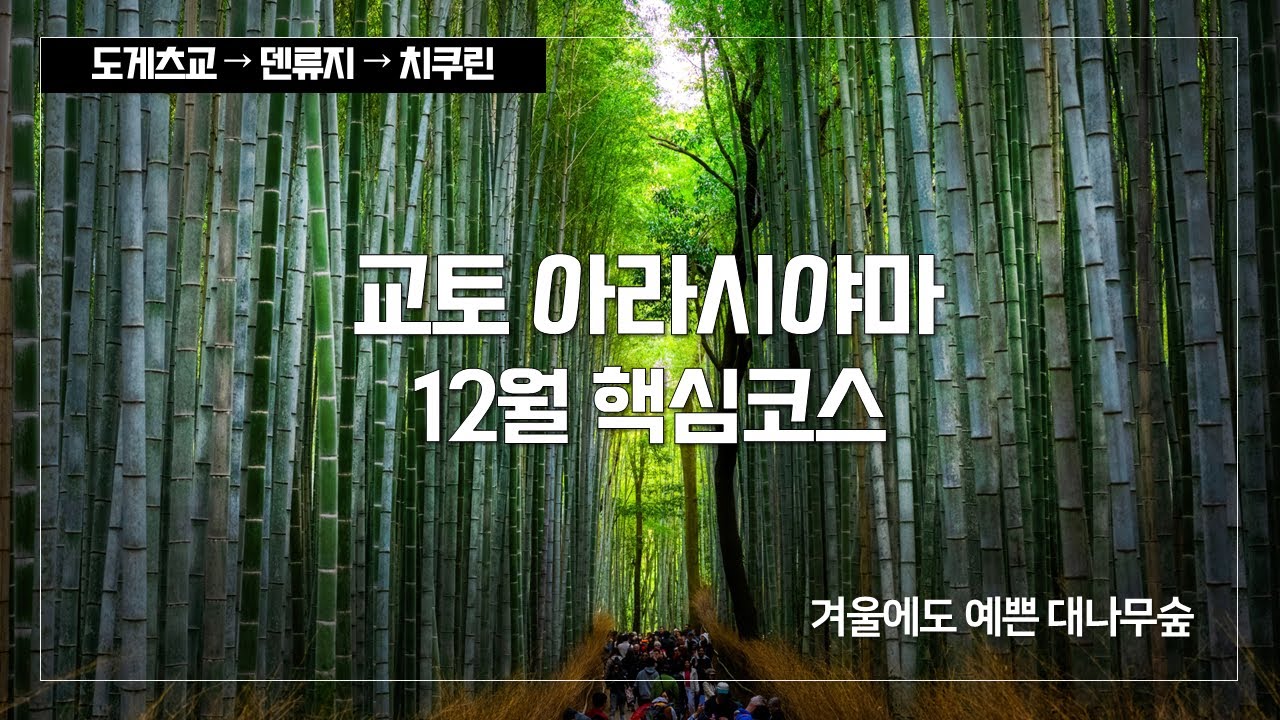
교토 아라시야마 가는법 & 대나무숲 치쿠린·도게츠교·덴류지 단풍 & 겨울 여행 코스
Hello, I’m a travel writer – INSTAGRAM @jeymin.ny Today I’ve prepared a trip to Arashiyama, one of Kyoto’s classic healing getaways, which also means it’s a place that attracts a lot of people. Details on how to get to Arashiyama are organized in the Q&A at the end of the video. For now, let’s start with Arashiyama’s three major highlights and how to enjoy its best views a little more efficiently. I’ll also show you some dazzling moments in Arashiyama, whose name means “Storm Mountain.” Arashiyama has been a scenic spot where people in Kyoto came to enjoy nature for about 1,200 years. Over time, a variety of ways to enjoy the mountains and river developed along the landscape. There’s the foliage train that runs through the gorge, and boat rides that take you down the river. The river even changes names between its upper and lower reaches. Here, this river is called Hozugawa. Near Togetsukyo it’s called Oigawa, and downstream from the bridge it becomes Katsuragawa – one river, one flow, with several names. Togetsukyo means “the bridge where the moon crosses.” This is exactly the Arashiyama most travelers think of when they say they want to visit. You can take a boat and enjoy the view, sit down for a coffee, and if you think of Togetsukyo as your reference point and make a loop around it, the area becomes much easier to grasp. This is why you see a constant stream of people crossing the bridge. The station name may sound the same, but depending on the train line, the actual location can be completely different. For this trip, the key station to remember is Randen Arashiyama Station. “Randen” is a tram line built to connect Arashiyama with central Kyoto. It’s only about a one-minute walk from here to Tenryuji, the main temple of Arashiyama. If you simply walk straight along the shopping street toward the river, you’ll reach Togetsukyo, so the route is very straightforward. Most souvenir shops, restaurants, and cafés are clustered in this area. But as you probably know, Arashiyama gets extremely crowded. In the daytime it can be so busy that it’s hard to walk. So if you arrive early in the morning, start with Tenryuji and the bamboo grove first. Plan to have an early lunch around 11 a.m., either with a reservation or as soon as places open, and then move to other spots naturally once the crowds really start to build. Now, let’s walk from Randen Arashiyama Station to Tenryuji. Tenryuji was founded in 1339 and is the central temple of Arashiyama. Together with Kiyomizudera from the previous video, it’s one of Kyoto’s representative UNESCO World Heritage sites. There are three entrances to Tenryuji, and from Randen Station the closest one is the ticket office by the garden side. The Hojo (Abbot’s Quarters) is where the head priest lives and where practice and receiving guests are centered. Here you can see the seated statue of Shakyamuni Buddha and sliding doors painted with cloud-dragon motifs. Also look out for the two paintings of Bodhidharma, a key figure in Zen Buddhism. From the main hall your gaze naturally flows outward into the garden, and the distant ridgeline of the mountains is incorporated as part of the scenery using a “borrowed landscape” technique. It’s said that the design, created about 700 years ago, has been preserved almost in its original form. The garden is laid out as a circular walking garden, where you stroll around the pond to appreciate the view from different angles. How to get from Tenryuji to the Bamboo Forest Instead of exiting the temple, follow the path deeper into the garden. If you walk for another five minutes or so while enjoying the scenery, you’ll suddenly start to feel the cool, green atmosphere of the bamboo grove. The path connects directly to the bamboo grove through Tenryuji’s north gate. While others are approaching from outside, you’ll effectively be starting your walk from the middle of the forest. This narrow path lined with tall bamboo on both sides is known as the Bamboo Grove Path (Chikurin-no-Komichi). The entire area is covered in bamboo, and there isn’t a single fixed route, so detailed directions are hard to find online. But if you enter via Randen Arashiyama Station and walk through Tenryuji, it becomes much easier to find your way. From there, you can either circle back down to the riverside or extend your walk to include other nearby temples. Because I write books and take photos for a living, I often end up visiting when the scenery is at its best — and the crowds are at their heaviest. Even so, I can still find quiet moments like this by arriving a bit earlier than others and planning the order of my visit. It may sound odd to talk about “strategy” in a place meant for healing, but this is how you conserve your energy and increase your satisfaction when traveling in Kyoto. Of course, there will still be times when you can’t avoid bumping into people. In those moments, just look up — the bamboo stretching all the way toward the sky will help calm your mind. Arashiyama is about 10 kilometers from Kyoto Station, where the Kyoto Tower stands. It’s a bit ambiguous to call it a “day-trip suburb,” but from Kyoto Station or the Gion-Shijo area it still takes more than 30 minutes to get there. Including travel time, I recommend setting aside at least three to four hours — more if you can. From Osaka Umeda, if you take JR you’ll need to change trains once at Kyoto Station. The Hankyu Line costs about half as much and takes slightly less time. If you’re going directly from Kyoto Station, JR is the faster option. Buses take more than twice as long, so I don’t recommend them. From JR Kyoto Station, go through the ticket gates and look for platforms 31 to 33. These platforms are on the ground floor — the same level as the Central Gate. Take whichever train on platforms 31, 32, or 33 best matches your timing. It can get very crowded during rush hours. It feels like you’re heading far out of central Kyoto for a little getaway. Get off at JR Saga-Arashiyama Station, then walk about 10 minutes to Randen Arashiyama Station. The Hankyu Line is especially convenient if you’re starting from Osaka Umeda or central Kyoto. Change between the Hankyu Kyoto Line and the Hankyu Arashiyama Line at Katsura Station. From Hankyu Arashiyama Station it’s about a 12-minute walk to Togetsukyo and then to Randen Arashiyama Station. I thought you might be curious about Arashiyama in winter as well, so I prepared these scenes. Even in midwinter, the bamboo grove stays green. This was one of the most striking days I’ve ever seen in Arashiyama. I never imagined that a “mountain where storms blow in” could look this beautiful. Just like the cherry blossoms in spring and the foliage in autumn, I ended up falling in love with the quiet, profound winter side of Arashiyama. Of course, this was a special day with both雪 and sunshine. If it had been a true blizzard, a walk like this wouldn’t have been possible. If you’d like to join me on my next trip, please consider subscribing and liking this video. Thanks for watching! If anything doesn’t come through clearly in translation, feel free to leave a comment.
교토 아라시야마 3대 명소 도게츠교→덴류지→치쿠린으로 이어지는 효율적인 여행코스와
가을 단풍의 짙은 색감부터 🍁눈 내리는 한겨울 ☃️교토의 맑은 풍경까지 담아왔어요!
오사카 또는 교토역에서(JR vs 한큐) 아라시야마 가는방법도 자세하게 안내합니다.
00:00 인트로
00:43 1️⃣아라시야마 이해하기
01:41 2️⃣여행의 기준점 – 도게츠교
02:22 3️⃣란덴 아라시야마역
03:15 4️⃣하루 동선 설계하기
03:40 5️⃣세계유산 덴류지 탐방
05:156️⃣덴류지에서 치쿠린 찾아가기
06:09 7️⃣치쿠린 약도 & 공략법
07:26 8️⃣교통편 Q&A (위치·소요시간)
07:58 🚈오사카에서 아라시야마 가는법
08:18 🚆교토역에서 가는법(JR 플랫폼 찾기)
09:57 🚉한큐선 타고 아라시야마역 가는법
10:31 9️⃣ 치쿠린, 겨울에 가도 괜찮을까?
📷 기요미즈데라 동선도 확인 👉🏻 https://youtu.be/l1lKf_tW0J0
#교토 #아라시야마 #도게츠교 #덴류지 #치쿠린 #아라시야마가는법
#교토여행 #교토브이로그 #여행브이로그 #嵐山 #京都旅行 #KyotoTravel #vlog
AloJapan.com