
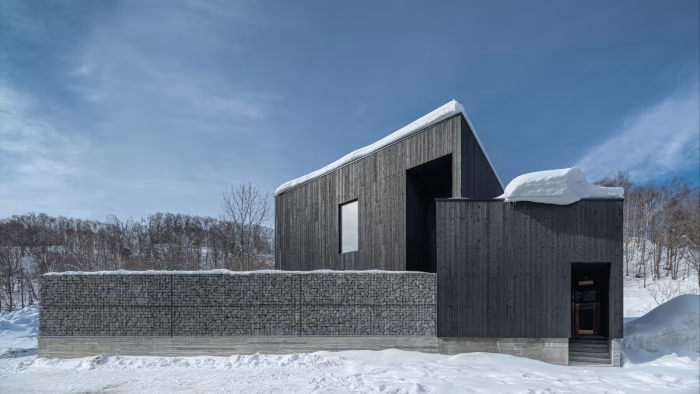
The term globalisation may be out of fashion, but Niseko, Japan’s most international ski resort and one of the snowiest on earth, is a global melting pot when it comes to the architecture of its ski homes. From a 1990s cluster of rustic lodges and unimaginative concrete buildings, it has become a showcase of cross-cultural design: a patchwork of the pared-back geometry and strength of modern Japanese houses; the soft, timbered intimacy of Scandinavian interiors; the steep-roofed chic of Alpine chalets and the rugged scale of the American mountain lodge.
“I don’t think there is a [contemporary] Japanese ski aesthetic,” asserts Vincent McIlduff of ALT Design and Construction, the Hong-Kong based company that built its first Niseko home in 2014. “It has evolved as a hotchpotch of styles.” Hotchpotch may be, but elegantly so.
 The Odin M2 home near Niseko town, by ALT Design and Construction, nods to Kyoto’s ‘machiya’ town houses with its windowless side (render)
ALT’s recently completed Odin M2 home on a wooded plot roughly 20 minutes’ drive from Niseko town is a case in point. The long, low two-storey building presents an almost windowless side to the road, a nod to Kyoto’s narrow machiya town houses that once minimised street-front taxes and protected privacy. Its deep-eaved gable roof and horizontal lines echo the homes in old mountain villages such as Nozawa Onsen in Nagano prefecture, designed to shed heavy snow and blend into wooded slopes.
 Glass-walled sitting room and dining space bring the forest almost indoors
At the end of a long entrance hall, a glass-walled sitting room juts out to one side, providing the first view of Mount Yōtei (often called the Mount Fuji of Hokkaidō prefecture). Upstairs, an open kitchen-dining-living space runs the width of the house and half the length, its three glazed sides bringing the forest almost indoors. It’s expansive, recalling Kyoto courtyards while catering to the demand for social spaces. “Entertaining at home is central here. Often people hire private chefs — restaurants get booked solid and taxis are scarce in deep winter,” says McIlduff.
Exposed internal timber trusses nod to Alpine chalet heft; outside, the walls are wrapped in charred cedar (yakisugi), a centuries-old Japanese technique that burns wood to resist insects, rot and fire; a rustic wrap for the home’s sharp-edged modernism.
 Mount Yōtei as seen from Niseko Grand Hirafu ski resort © Noriko Hayashi/Bloomberg
Niseko — today four interlinked resorts that cluster around Mount Niseko-Annupuri — began life as a modest town of basic lodges, ryokans (traditional Japanese inns) and a scattering of Alpine-style bed and breakfasts. When Australians began buying in the 1990s, drawn by cheap land and deep powder, they built simple log houses using local contractors. As the resort’s fame spread to European, American and, later, Asian buyers, expectations and budgets rose. By the late 2010s, leading Japanese architects such as RIBA National Award-shortlisted Kengo Kuma and Pritzker Prize-winning Shigeru Ban began designing individual houses and setting design plans for new estates — adding kudos and injecting traditional Japanese principles back into the mix.
 An Odin Hills home by Shigeru Ban, enlisted for his preference for. . . © Hiroyuki Hirai
 . . . ‘barefoot living on timber floors, big windows, minimal clutter, everything about light and nature’ © Hiroyuki Hirai
Estates are the main platform for Niseko’s larger homes; a cluster of houses and plots often anchored by a clubhouse, with spas, pools and dining facilities. When Nicolas Gontard and his partners developed Odin Hills, an 89-plot estate that includes the M2 home, they enlisted Shigeru Ban, seeking his “Nordic sensibility — barefoot living on timber floors, big windows, minimal clutter, everything about light and nature”. Ban’s four rectancular designs are built with dowel-laminated timber (in place of conventional timber framing). “Wood is central inside and out; this quality of warmth and humbleness — using simple materials with beautiful simple design — can be luxury,” says Grant Suzuki, a partner at Shigeru Ban Architects in Tokyo.
 On this render of another Shigeru Ban home deep eaves shield the facade from rain and snow
Tokyo-based architect Keiji Ashizawa was called upon to build Odin Hills’ central clubhouse. On the side facing Mount Yōtei a glass wall spans the facade, “allowing the interior to remain closely connected to the changing seasons and the richness of the surrounding landscape”, he says. Deep eaves extend from the building’s exterior, shielding the facade from rain and snow, providing summer shade for those lounging outdoors, and reducing the costs associated with heating and cooling. To soften the heavy look that can come from thick mountain roofs, the eaves are engineered to appear light and slender. “Lightness plays a crucial role in harmonising the architecture with the landscape,” says Ashizawa.
Niseko’s most interesting architecture is away from the main ski hills, says Suzuki; resorts such as Zaborin and Shiguchi sit in secluded forest and give homes, hotels and other buildings space to breathe. “The sense of place is more like that of a ryokan than a hotel [complex]; that can only be achieved with the right location,” he says.
Wood is central inside and out; this quality of warmth and humbleness — using simple materials with beautiful simple design — can be luxury
Grant Suzuki, a partner at Shigeru Ban Architects
Niseko clients favour homes of around 400 sq metres, says McIlduff. “It’s enough for four or five bedrooms and staff space — and below the 500 sq metre threshold where Japan’s hotel-grade fire regulations make costs jump.” Current clients are from Hong Kong, China, Singapore, Indonesia, Switzerland and the UK, he adds.
Onsen-style hot baths are standard, but only a portion will be the genuine article: drilling down often a kilometre underground to a natural hot spring will add roughly $1mn to a project. “Then there is the challenge of preventing the sulphurous smell from spreading through the house,” he says. Photos of a just-completed villa reveal three sealed doors between the onsen and master suite.
 An Awayuki villa: European design with Japanese flair by ALT Design and Construction — on the market with Christie’s International Real Estate for $2.66mn © Aaron Jamieson
Niseko’s patchwork of architectural styles stems in part from the realities of engineering in one of the world’s snowiest resorts. Annual levels can breach 15 metres, compared with the 7 to 10 typical in Alpine resorts. “You think local building [codes] are too cautious — then you go there and see 3 metres of snow piled on a roof,” says structural engineer Alan Burden, founder of Structured Environment, a London-based practice that has built 15 homes in and around Niseko, working with Japanese architects Kengo Kuma and Tomoyuki Sudo.
Concrete bases are dense, able to bear snow loads while anchoring houses into the slope. Moulds are often formed with timber boards, planks or strips that leave imprints of their rich textural details. “It gives a more tactile surface,” says Wei Kwong, a one-time corporate financier working in Singapore who became a full-time developer in Niseko after building a home for himself there in 2010. The wood-imprinted-concrete style has become ubiquitous; he is now experimenting with “random rectangular patterns on concrete for a more original look”.
Upper floors are often timber-framed, and feature swaths of glazing designed to blur the boundary between shelter and landscape; rough concrete and charred cedar ground the lighter interior tones of local pine, cyprus and cedar. “The architecture gradually assimilates into the surrounding landscape,” says Ashizawa.
Recommended

Engineers hide a great deal in order to keep the clean lines of interiors. In one house overlooking Mt Yōtei at Elevation Estate in Hirafu (whose design guidelines were set by Kuma), Burden used steel columns disguised as slim window mullions; on another home he tucked thick steel beams between timber rafters to maintain a lightweight wooden look. Below, stick-thin steel posts hold up the roof of the forecourt. “Architects always want it thinner,” Burden jokes. On Kwong’s buildings, vertical slats over facades contain steel reinforcements to stop their timber warping.
Suzuki may fear the slide towards the high-rise luxury of Niseko’s ski-in ski-out apartment blocks, but demand for roomier, more peaceful homes should secure the current direction of innovative design. As the huge snowfalls pile up, Niseko’s position as an architectural cultural exchange looks set to weather beautifully.
Find out about our latest stories first — follow @ft_houseandhome on Instagram
AloJapan.com