
WASHINGTON — U.S. automakers said Wednesday that they are concerned about President Donald Trump’s agreement to tariff Japanese vehicles at 15%, saying they will face steeper import taxes on steel, aluminum and parts than their competitors.
Trump announced a trade deal with Japan on Tuesday night, placing a 15% tax on goods imported from that nation.
“This Deal will create Hundreds of Thousands of Jobs — There has never been anything like it,” Trump posted on Truth Social, adding that the United States “will continue to always have a great relationship with the Country of Japan.”
The framework of the Japan deal fits a pattern for Trump, who is eager to portray the tariffs as win for the U.S. His administration says the revenues will help reduce the budget deficit and more factories will relocate to America to avoid the import taxes and cause trade imbalances to disappear.
“We need to review all the details of the agreement, but this is a deal that will charge lower tariffs on Japanese autos with no U.S. content,” said Matt Blunt, president of the American Automotive Policy Council, which represents the Big 3 American automakers, General Motors, Ford and Jeep-maker Stellantis.
Blunt said in an interview the U.S. companies and workers “definitely are at a disadvantage” because they face a 50% tariff on steel and aluminum and a 25% tariff on parts and finished vehicles, with some exceptions for products covered under the United States-Mexico-Canada Agreement that went into effect in 2020.
The domestic automaker reaction reveals the challenge of enforcing policies across the world economy, showing that for all of Trump’s promises there can be genuine tradeoffs from policy choices that risk serious blowback in politically important states such as Michigan and Wisconsin, where automaking is both a source of income and of identity.
Trump portrayed the trade framework with Japan as a major win, saying it would add hundreds of thousands of jobs to the U.S. economy and open the Japanese economy in ways that could close a persistent trade imbalance. The agreement includes a 15% tariff that replaces the 25% import tax the Republican president had threatened to charge starting on Aug. 1. Japan would also put together $550 billion to invest in U.S. projects at the “direction” of the president, the White House said.
Japanese Prime Minister Shigeru Ishiba told reporters in Tokyo on Wednesday morning that he had received an initial report about the agreement from Ryosei Akazawa, Japan’s chief trade negotiator, who is in Washington. “I will receive a report on the details in the future and examine them carefully,” Ishiba said.
In a social media post, Akazawa said: “Mission accomplished.”
An agreement with Japan stands to be the most significant of the preliminary trade agreements that the Trump administration has announced thus far.
Japan was one of the United States’ largest sources of imports in 2024, trailing only Mexico, Canada, China and Germany. It’s also a major export market for the United States. The United States ran a $63 billion trade deficit with Japan last year, which Trump has viewed as a sign of economic weakness.
The framework of the trade deal with Japan will remove regulations that prevent American vehicles from being sold in that country, the White House has said, adding that it would be possible for vehicles built in Detroit to be shipped directly to Japan and ready to be sold.
But Blunt said that foreign auto producers, including the U.S., Europe and South Korea, have just a 6% share in Japan, raising skepticism that simply having the open market that the Trump administration says will exist in that country will be sufficient.
“Tough nut to crack, and I’d be very surprised if we see any meaningful market penetration in Japan,” Blunt said.
Major Japanese automakers Toyota, Honda and Nissan did not immediately respond to a request for comment on the trade framework, nor did Autos Drive America or the Alliance for Automotive Innovation, organizations that also represent the industry.
There is the possibility that the Japanese framework would give automakers and other countries grounds for pushing for changes in the Trump administration’s tariffs regime. The president has previously said that flexibility in import tax negotiations is something he values. The United States-Mexico-Canada Agreement is up for review next year.
Ford, GM and Stellantis do “have every right to be upset,” said Sam Fiorani, vice president at consultancy AutoForecast Solutions. But “Honda, Toyota, and Nissan still import vehicles from Mexico and Canada, where the current levels of tariffs can be higher than those applied to Japanese imports. Most of the high-volume models from Japanese brands are already produced in North America.”
Fiorani noted that among the few exceptions are the Toyota 4Runner, the Mazda CX-5 and the Subaru Forester, but most of the other imports fill niches that are too small to warrant production in the U.S.
“There will be negotiations between the U.S. and Canada and Mexico, and it will probably result in tariffs no higher than 15%,” Fiorani added, “but nobody seems to be in a hurry to negotiate around the last Trump administration’s free trade agreement.”
EU PREPS TARIFF PLAN
The European Union plans to quickly hit the U.S. with 30% tariffs on some $117 billion worth of goods in the event of no deal and if Trump carries through with his threat to impose that rate on most of the bloc’s exports after Aug. 1.
As a part of a first wave of countermeasures, the EU would combine an already approved list of tariffs on $24.7 billion of U.S. goods and a previously proposed list on an additional $84.7 billion of American products into one package, a European Commission spokesman said Wednesday.
The U.S. exports, which include industrial goods such as Boeing Co. aircraft, U.S.-made cars and bourbon, would face a levy that matches Trump’s 30% threat, according to people familiar with the matter.
The threatened retaliation from Brussels would hit about one-third of American exports to the EU, based on the $412 billion worth of U.S. goods shipped to the bloc last year.
The tariffs would be prepared to come into force next month but only if there is no deal and the U.S. implements its levies after the August deadline, said the people who spoke on condition of anonymity to discuss private deliberations.
The plans come as EU member states, including Germany, have hardened their positions in response to the U.S. stiffening its negotiating stance.
Information for this article was contributed by Josh Boak, Alexa St. John and Mari Yamaguchi of The Associated Press, Ana Swanson and River Akira Davis of The New York Times and Arne Delfs, Alberto Nardelli and Jorge Valero of Bloomberg News (WPNS).
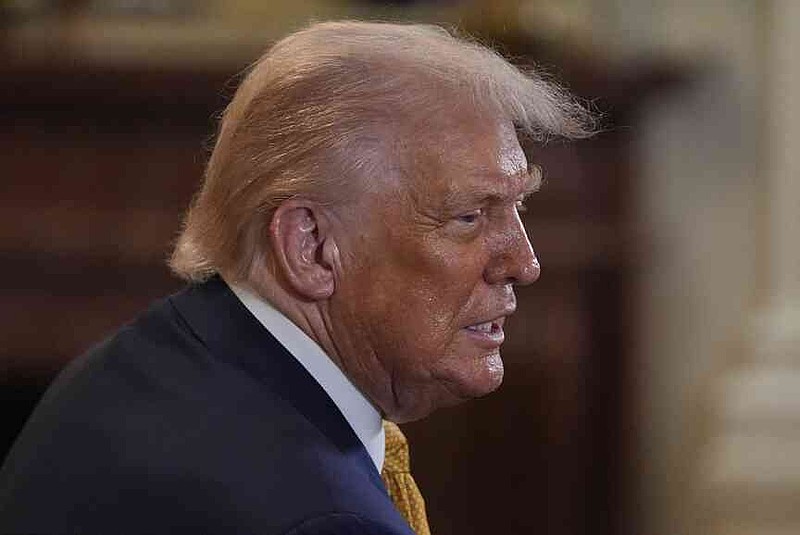 President Donald Trump greets people during a reception for Republican members of Congress in the East Room of the White House, Tuesday, July 22, 2025, in Washington. (AP Photo/Julia Demaree Nikhinson)
 President Donald Trump greets people during a reception for Republican members of Congress in the East Room of the White House, Tuesday, July 22, 2025, in Washington. (AP Photo/Julia Demaree Nikhinson)
AloJapan.com