

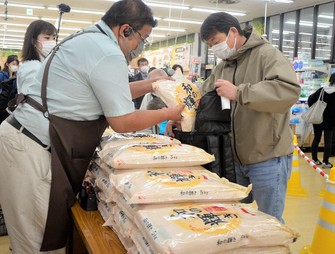
A shopper, right, purchases a bag of government reserve rice at a home improvement center in Sendai’s Miyagino Ward, May 31, 2025 (Mainichi/Hiroyuki Yamanaka)
TOKYO — As the campaign period for the House of Councillors election has officially kicked off, recent issues surrounding rice — Japan’s staple food which directly affects household budgets — are expected to become a key topic. While countermeasures against surging prices have risen to the fore, measures to ensure a stable supply going forward are also under scrutiny.
Rice prices surge despite government prediction
Since the summer of 2024, rice prices have significantly increased following shortages at some retail stores. The Ministry of Agriculture, Forestry and Fisheries initially suggested that prices would stabilize following the release of the new crop produced in 2024.

Prime Minister Shigeru Ishiba, left, speaks during a ministerial meeting regarding a stable supply of rice at his office in Tokyo on July 1, 2025. To the right is farm minister Shinjiro Koizumi. (Mainichi/Akihiro Hirata)
As prices remained high, however, the government revised its management of reserve rice in January this year, and began selling stockpiled rice through public auctions. Despite these efforts, the price surges persisted.
In late May, Shinjiro Koizumi was appointed agriculture minister and decided to release reserve rice through negotiated contracts instead of auctions. This move resulted in an accelerated supply of affordable rice in store shelves, reducing the national average price of supermarket rice from over 4,000 yen (about $28) to the 3,000-yen range for 5 kilograms, according to the farm ministry.
Farmers confused over appropriate rice price levels
So what is the appropriate price level for rice? Although prices have slightly decreased from their peak, they are still about 1.7 times higher than the previous year. Some consumers say they feel rice is still too expensive. “Children’s cafeterias,” which offer free or cheap meals to children and their families and rely on donations, are starting to face difficulties procuring rice.
Some experts suggest that rice prices before 2024 were too low. At a June press conference, Toru Yamano, chairperson of the Central Union of Agricultural Cooperatives (JA Zenchu), emphasized the importance of achieving a price satisfactory to both producers and consumers. He showed to a certain extent understanding toward Prime Minister Shigeru Ishiba’s target of “the 3,000-yen range for 5 kg.”
Most rice farmers argue that the negotiated contract prices of around 2,000 yen for 5 kg of reserve rice will not pay off. With an aging farming population and a lack of successors, ensuring adequate income for younger generations is essential to sustain rice production.
Gov’t wants to boost rice production. What about opposition parties?

Constitutional Democratic Party of Japan leader Yoshihiko Noda delivers a speech in Kunitomi, Miyazaki Prefecture, to kick off the official campaign for the House of Councillors election, July 3, 2025. (Mainichi/Minoru Kanazawa)
On July 1, the government held its second ministerial meeting on stable rice supply. Prime Minister Ishiba stated, “We are going to shift to a new rice policy ensuring that motivated producers can secure income and increase production without worry,” indicating plans to boost production from the 2025 crop.
Meanwhile, Yoshihiko Noda, leader of the main opposition Constitutional Democratic Party of Japan, emphasized in Miyazaki Prefecture on July 3, when the official upper house election campaign kicked off, “If (rice) producers abandon farming, Japan’s food security surely cannot be achieved.” He stressed the need for a system of direct subsidies to farmers to secure food and maintain farmland.
The upper house election is expected to bring into focus each party’s policies for rice price management, production adjustments to match demand, as well as farmer support and sustainable agricultural policies for the future.
(Japanese original by Hajime Nakatsugawa and Toru Watanabe, Business News Department)
AloJapan.com