
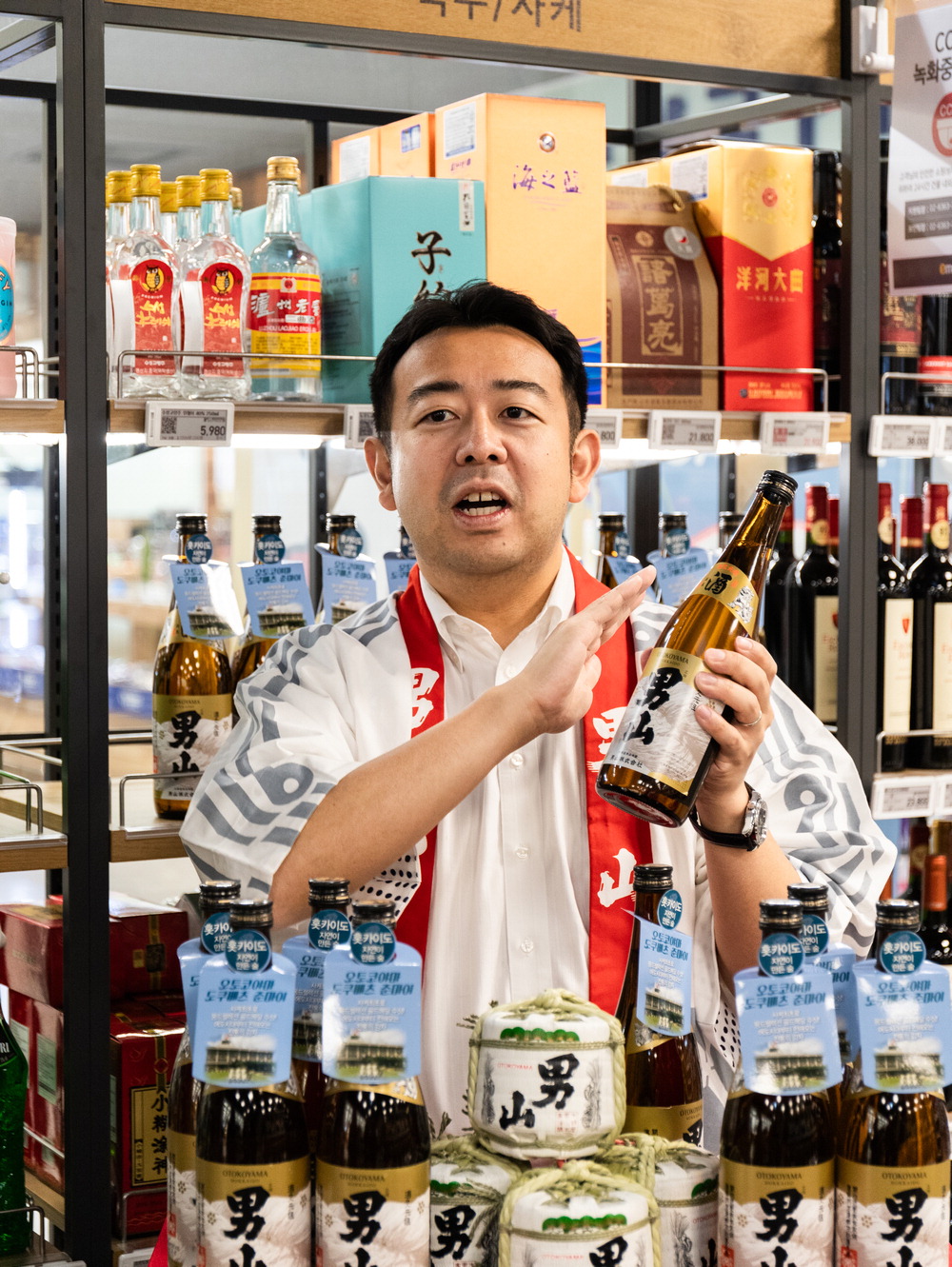
 사진 확대 President Yamazaki Goro Otokoyama, who met with Mail Business, is taking a commemorative photo at E-Mart’s Yongsan branch.
There’s a sake that kept its name for 364 years. It started in Kyoto, Japan, and moved to Hokkaido, where the Yamazaki family’s touch reached for five generations. It was the world’s first sake to win the gold prize at the World Liquor Fair “Monde Selection,” and became the top local liquor in sales in Hokkaido. Despite the slump in the liquor market, Japan alone posted annual sales of 1.131 billion yen (about 11 billion won). This is the story of “男 (Otokoyama),” which has been directly targeting the Korean distribution industry since the end of last year.
“An altitude of more than 5 degrees is not running well in Japan,” said CEO Goro Yamazaki (41), who recently met with a Mail Business at a hotel in Yongsan-gu, Seoul, adding, “I wanted to find a new way out of Korea.” At the end of last year, Otokoyama launched “Tokubetsu Junmai (特別純米)” in E-Mart and Traders. It is also sold in convenience store GS25. Sake imports reached an all-time high for two consecutive years (2023-2024).
Tokubetsu Junmai is the representative product of the Otokoyama foundry, which represents the Hokkaido region. With its rich umami and clean throat while drying with subtle greenhouses and fragrances, it exports most of its production not only in Japan but also in the global market. The alcohol content is 16 percent. Miyamanishiki rice was used and the rice rate is 55%.
Otokoyama started in Kyoto in 1661, and was succeeded by the Yamazaki family in Hokkaido from 1968.
It started during the Edo period and was old enough to appear in Kabuki, Zoruri, a traditional Japanese performing art, and in ukiyoe, a traditional painting format. It is also famous for tasting gold as sake at the 1997 Monde Selection.
Since then, Sake has not won a gold medal, so it is still a valid record. He also won numerous gold medals at his country’s liquor exhibition and the National Brewery Institute.
In Korea, it is also known as ‘Namsan sake’ because of the ‘男 Mountain’ mark on the label. It means ‘man’s mountain’.
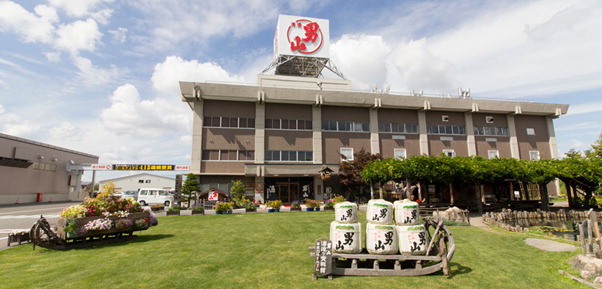 사진 확대 Otokoyama Brewery Museum in Asahikawa City, Hokkaido, Japan. Ayoung FBC
When asked about the special way to make traditional sake for more than 360 years, Yamazaki dismissed it, saying, “Hokkaido sake is just a gift from Mother Nature.” Hokkaido has an ideal climate and soil for sake brewing in the northernmost part of Japan. The cold climate helps slow fermentation during sake brewing, forming more complex and deeper flavors. Mineral-rich soil is suitable for rice cultivation and plays an important role in making high-quality sake. He emphasized, “The clean water from the ice cap of Daisetsu Mountain in Hokkaido, where the foundry is located, is the lifeline of Otokoyama Sake.”
Of course, CEO Yamazaki refused to give the gift from Mother Nature. He graduated from the Hitotsuba-era Department of Commerce, Japan’s top national university, and did not want to continue his family business, so he worked. He joined Marubeni, a general trading company, and worked in the beverage raw materials department of the food department. However, he confessed that he could not avoid providence. The guilt that he might commit a crime of breaking the 360-year tradition and his father’s persistent persuasion pushed him to the Hokkaido foundry.
It was a pushover, but he had a strong commitment to work. In 2013, he decided to take over the Otokoyama foundry and trained for a year at a foundry in Kunisaki Peninsula, Oita Prefecture. He joined the Autokoyama Foundation as a director in 2014 and is now the fifth-generation operator of the Autokoyama Foundation. He is leading the overseas expansion and various business expansion. The Autokoyama foundry has grown to the top 40 of Japan’s 1,200 foundry. It exports autokoyama to 20 countries, including Korea, the United States, Taiwan, Hong Kong, and China.
Yamazaki hinted at one, saying it was a way to enjoy Autokoyama. He said, “It’s better not to cool or heat it, but to drink it at room temperature. That’s how you can feel the original taste.” Sometimes, some people add that the temperature is raised or lowered to hide the miscellaneousness of alcohol, blurring the taste.
However, they recommended the best combination. Along with salmon and fur crabs, try lamb such as Genghis Khan (Japanese lamb roast), one of Hokkaido’s representative foods. “You can feel the atmosphere of Hokkaido in Korea,” he said with a smile.
Meanwhile, countless fans from all over the world visit the museum next to the Otokoyama foundry in Asahikawa City every year. The museum offers an opportunity to learn the history and production process of sake, and visitors can also taste sake. Otokoyama Park offers breathtaking views of Mount Daisetsu and the Tokachi Mountains, and is a place where you can enjoy the beauty of nature.
[Reporter Lee Hyoseok]
AloJapan.com