
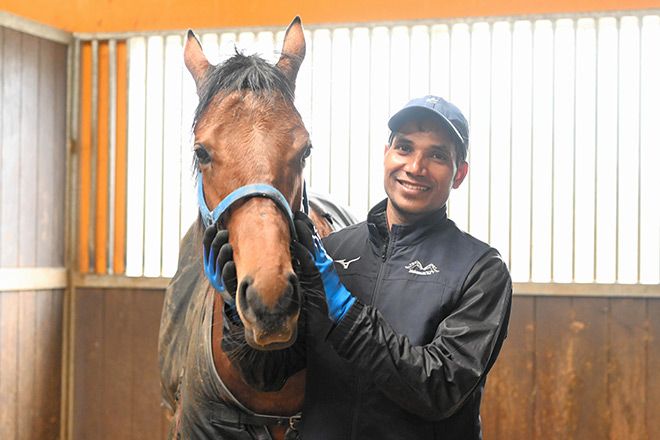
URAKAWA, Hokkaido–India native Rizwan Alam rises at 4 a.m. as an employee of Mishima Stud here to begin his work.
Cleaning a stable, Alam, 32, brushes and feeds horses. He then rides on the back of a yearling that he is responsible for. Alam is tasked with training horses to ride with humans.
At lunchtime, he returns to a dormitory near the stable to eat lunch with his family. As many compatriots work with Alam, they play cricket, which is said to be India’s national sport, on their days off.
Alam communicates with Japanese in broken English. At times, Indian colleagues interpret for him to provide explanations in his native tongue.
“He is firmly determined to take care of his entire family,” said Kenta Fujii, training manager at Mishima Stud, about Alam. “He is diligent and respects his superiors–a feature that may be common among Indians. They have strong ties and care for each other while on duty.”
One of every 30 residents is now Indian in Urakawa, which is Japan’s most renowned thoroughbred-producing area.
A staggering 80 percent of racehorses are produced in the Hidaka region of Hokkaido. Urakawa is particularly famous as a leading production area in Hidaka.
A national breeding farm was installed in Urakawa during the Meiji Era (1868-1912). Foaled in Urakawa, the five-time champion Shinzan is especially noted as the superstar of the Showa Era (1926-1989).
However, the shortage of labor in the horseracing industry has accelerated over the last 10 years or so. Urakawa thus started inviting and hiring skilled trainers from Southeast Asia and Africa.
A rapidly growing number of farms reportedly began employing Indian trainers, after word spread that their work styles and personalities are ideal for positions in Urakawa.
Starting from 2014 when there were no Indian workers in Urakawa, their number reached 371 by the end of October 2024.
SHOWING OFF HIS SKILLS
Alam hails from Bihar state in northern India, one of the poorest regions across the nation. Polo, the sport of riding horses and hitting a ball with sticks, is popular in the northern region, so a lot of people there work with horses.
At age 15, Alam entered the equine industry. He served as a trainer for nine years in Qatar.
Hearing from a friend in Urakawa that his “salary can go up 20,000 yen ($128) to 30,000 yen” more than what he was making, Alam came to Japan in 2022 to show off his skills in the “slightly cold but pleasant destination.”
Locally, Alam found many of the comforts of home and a supportive community for Indian immigrants.
A grocery store offers a range of spices in Urakawa. Maternal and child-health handbooks, which are distributed by local governments to expectant mothers, are available in Hindi.
In response, Urakawa town released a maternal and child-health handbook in Hindi. A local supermarket is expanding its lineup of milk, yogurt and other items Indians typically buy in bulk.
Other similar stores, such as Bharat Restaurant, situated in front of Mishima Stud, handle spices, Indica rice and other Indian foodstuffs.
Bharat Restaurant is characterized by a noticeable yellow sign among horse farms. Its chef, Kirpal Singh, 48, recommends curries with a spice level of 2 or 3 for Japanese guests, while Indian patrons often prefer level 10.
Finding Indian features in every corner of the town, Alam invited his family to Urakawa a year earlier.
A remaining challenge is the language barrier. Mothers from India often return to their homeland for educational purposes when their children turn 5 years old.
Alam, who has a 2-year-old son named Shifan, said he is worried about the future of his offspring as well.
“I want him to study in Urakawa but feel at the same time that an English school is necessary,” said Alam. “English education is important in particular in India.”
HELP WITH THE LANGUAGE
People from the major South Asian country with the world’s largest population of more than 1.4 billion speak not only the official language of Hindi but also Marwari and other minor languages.
As many as 21 languages are officially recognized as state tongues in the Constitution to reflect the nation’s diverse ethnic groups and religions.
To help Indians in Urakawa, Minakshi Soni arrived in the town last August under the Japan Exchange and Teaching (JET) Program, aiming to promote foreign language education and global interactions in the local municipality.
Soni, 46, came from a town in Rajasthan state in India. As she was raised by her Marwari-speaking father who was a goldwork artisan, Soni became enchanted by the beauty of a Japan-made light green vase treated with gold during her childhood.
After raising two sons, Soni started attending a weekly Japanese language class. She spent six years passing the advanced level of a Japanese language test, securing a Japanese teacher post at a junior high school in India.
One day, a friend informed Soni about a “job offer that best suits you.” Soni therefore decided to head for Urakawa.
Soni currently serves as an interpreter for Indians who show up at the town office for tax consultations. She likewise translates the municipality’s notices.
“I am happy to be able to support Indians in Japan, as I had longed to work in the country for many years,” said Soni.
Another mission of Soni is assisting in Indian kids’ learning. She goes to an elementary school in Urakawa twice a week where two Indian children are enrolled.
Though a first-grade boy who came to Japan last spring has gradually become able to understand the Japanese spoken by his teacher at the primary school, Soni stressed that further support is essential.
Her reasoning is that Indian parents frequently do not use Japanese, making it difficult for children to receive help with their assignments at home.
“My hope is teaching Japanese for adults as well as children,” said Soni.
Soni’s latest endeavor is offering a weekly Hindi lesson for Japanese.
“I would like both Japanese and Indians to learn from one another to further deepen friendship,” she said.
Her journey as a liaison between India and Urakawa has just started, as the JET program lasts for up to five years.
AloJapan.com