
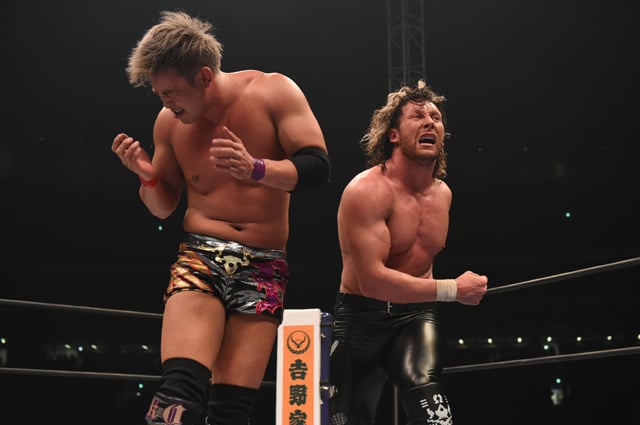
Kenny Omega became the first foreign wrestler to main event for NJPW at the Tokyo Dome in 2017, and he recently looked back at that iconic match in a new interview. Omega battled Kazuchika Okada in a critically acclaimed match at Wrestle Kingdom 11 for the IWGP Heavyweight Title. It was the first time a foreigner had won the G1 Climax and earned the main event at the Tokyo Dome and while Omega didn’t win the match, it earned raves across the wrestling world.
Omega reflected on that experience in an interview with the Battleground Podcast. He spoke about how he didn’t know how it would go and that he doesn’t know to this day how he came into the match with the confidence that he did. He also recalled how his mother was in the crowd and that it helped convince her that he was going to be okay in the wrestling business. You can see the highlights below:
On His Mindset Going Into the Match:
“So interesting story with that was that I was very unsure how things would go. And all I knew was that I was very fortunate and lucky to have the position of being in the Tokyo main event. We had seen years previous where there maybe had been an opportunity for a foreigner to be in a main event and the company had always decided, ‘We’re not going to take that direction. We’re not going to go in this direction this time. We’re going to stay the course and keep it at home, close to the vest.’
“And I remember, even when we had AJ Styles who was primed and ready to go as a main eventer, it didn’t work out for him. Because they had done something where they wanted to run a vote as to who would be the main event. And there was some title switches and a bunch of chicanery, and it just didn’t work out. But when I had seen that AJ was on the precipice of doing something incredible — which at the time to me, I didn’t think I’d be alive or active in a world where I could be close to a Tokyo Dome main event, even tied to it. Because for me there’s a huge sense of pride even just being a second to AJ, like being at ringside at cheer him on for his Heavyweight Title bouts. Just being a part of Bullet Club and to be an integral part of New Japan’s business, knowing that we were selling a lot of merchandise and all that, I felt real special just for that.”
On the Pressure to Deliver:
“But to then have the responsibility of being a Tokyo main event, making sure that that was a home run. Maybe not even — a grand slam, like it had to be. I knew that I had to pour everything into that match, not only to prove to the company and to the world that us as foreigners could do something incredible for this company. And that even though maybe we didn’t speak the same native language, that I could communicate in a way where you could feel what I’m feeling. And I could make you feel what I wanted you to feel in that moment as well. Those are important to prove on that night.
“And also — and this is just more important to me than anybody else, but that was the one of the first times that uh my mother had come to watch a show. And I think, I’m pretty convinced to this day that I’m sure she had thought up until that point I was paying my way out to Japan every trip, that I was just going out there to hang out. I was losing all my money, probably involved in loan sharks to pay for these plane tickets, wasn’t getting paid anything. For her to be able to be there and see that and to feel like, ‘Oh, my son’s actually okay. The thing that he said he was doing as a job actually is a real job, and he actually is employed by this place and he’s doing a pretty good job at doing it,’ even though I lost that match. It was good to put their minds at ease, right? And so yeah, it was a really big weight to bear for that match especially.”
On the Matches That Followed:
“But then when it became a thing, every match that happened there on after exponentially became more and more difficult. And I always wonder going back like, how did I do it? Not just the actual execution of it, but how did I handle that pressure? I don’t know. Because I mean, I’m no stranger — maybe because of the way that I conduct myself or just the fact that I wasn’t someone that was manufactured by a machine for whatever reason that by default, causes a lot of people to hope for my downfall. And they like to see me fail.
“And to have so many people all around you hoping for you to flounder, hoping for you to screw up, hoping for you to be out in the streets. Those are situations where you either rise up and become something that you didn’t even see yourself capable of, or you just fall to the pressure. You succumb to the pressure. And I wasn’t sure — in sports leading up to that point, I’d always saw myself as someone who did well in the face of pressure. But wrestling is — there’s so much more that goes into a performance. Like I said before, it’s there’s a matter of, if a match is good, great, that’s fantastic. But did we sell tickets? How was the merchandise? Do we have something that we can move forward with that can bear fruit? There’s so many other factors that go into play, and you have to sort of hit a home run across the board. That was kind of why I was saying it has to be a grand slam. It can’t just be a home run on all across all fronts, you have to have seen as a success. And yeah, how I was able to pull that off, I don’t know.”
On Not Recognizing the Person He Was Then:
“That’s why I say — and it comes from a place of earnest. I don’t recognize that person when I see footage back. Just that confidence and that — I don’t know what I was on, man. But yeah, I guess I had something to prove. And thankfully that the focus was primarily and possibly only solely on that. And there was never a fear of failure, I don’t think if I — remembering back, I know everyone wanted me to fail. But I never feared it for myself. And maybe that even speaks to Okada’s talents as well. Because it’s like — man, it’s Okada. And you know, he was just the guy that was having incredible matches with everyone up and down the card. So I felt like even at its worst, it’s probably still going to be a pretty good match.
“Did I think it would make history? Did I think people would talk about it outside of New Japan? Or did I think that somehow, there would be ties to the current AEW with that? No, I didn’t know. I didn’t know anything. I was just — for me, it was just, I wanted to do everything that I could for the state of global professional wrestling. I wanted to show the beauty of multicultural professional wrestling, as odd as that may sound.”
If you use any of the quotes in this article, please credit the battleground Podcast with a h/t to 411mania.com for the transcription.
AloJapan.com