
Japan approved ¥631.5 billion (US$3.97 billion) in additional subsidies to hasten Rapidus Corp’s entry into the high-stakes artificial intelligence (AI) chipmaking arena, ramping up support for a project widely regarded as a long shot.
The capital is intended to bankroll Rapidus’ work for information technology firm Fujitsu Ltd, one of the initial customers that Tokyo hopes would get the signature endeavor off the ground.
The new money raises the fees and investments that the government is injecting into the start-up to ¥2.6 trillion by the end of the current fiscal year to March next year, the Japanese Ministry of Economy, Trade and Industry said in a statement.
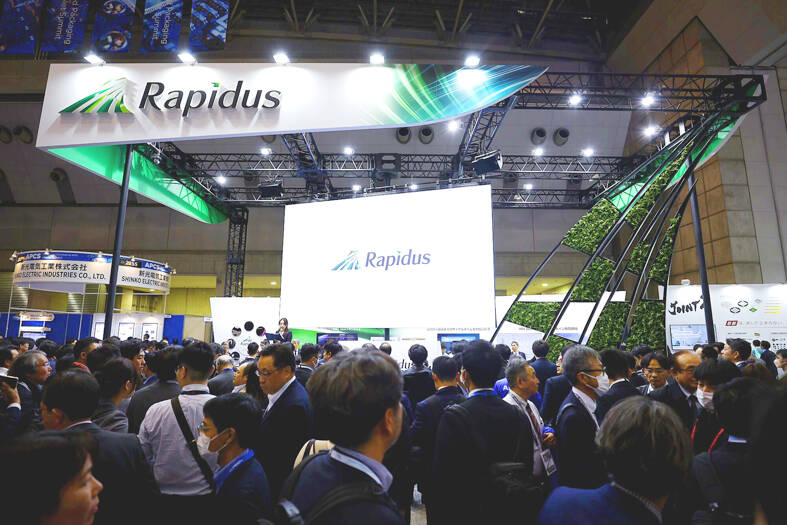
Photo: Bloomberg
An external committee inspected Rapidus’ foundry in Hokkaido in northern Japan, and signed off on its technological progress, the ministry said on Saturday.
Tokyo is offering financial support to Rapidus to help it secure customers, Japanese Minister of Economy, Trade and Industry Ryosei Akazawa told reporters at a Rapidus event in Hokkaido on Saturday.
The fledgling company aims to make cutting-edge 2-nanometer chips by next year, a schedule Akazawa reaffirmed, and help Japan lower its reliance on industry leader Taiwan Semiconductor Manufacturing Co (TSMC, 台積電).
Policymakers see Rapidus’ success and technological independence in AI, robotics and quantum computing as critical to the country’s security.
Rapidus, which targets an initial public offering around fiscal 2031, aims to secure about ¥3 trillion in private-sector financing partly with the help of government loan guarantees, the ministry said.
It has set up an analysis facility in Chitose, Hokkaido, to test and diagnose Rapidus’ chips in an attempt to lift yields, and has also begun operations of a backend processes development center.
The Japanese state-backed venture, founded in 2022, faces additional competition for chip expertise from an unlikely quarter: Elon Musk is entering the white-hot arena, partnering with Intel Corp on the so-called Terafab project to make semiconductors for his companies including Tesla Inc, Space Exploration Technologies Corp and xAI.
Despite its latest strides forward, Rapidus remains far behind TSMC, which began 2-nanometer volume production last year and is the go-to chipmaker for Nvidia Corp and Apple Inc. In addition to technological hurdles, Rapidus — like other manufacturers in resource-poor Japan — are getting hit by rising costs for energy and material input during the conflict in the Middle East.
Rapidus chief executive officer Atsuyoshi Koike has himself acknowledged the mammoth task ahead.
Production of cutting-edge semiconductors is technically challenging and expensive. TSMC this year is planning to allocate more than US$50 billion in capital expenditures, with no other competitors coming close to winning as many AI accelerator orders.
AloJapan.com