
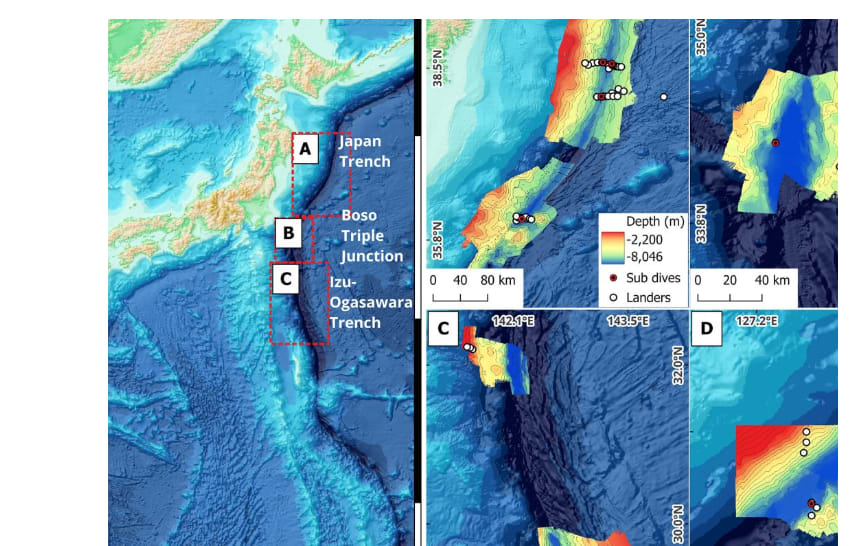
The deepest trenches of the ocean have long been regarded as the last frontier on Earth because they are isolated, harsh, and mostly unexplored. However, a fresh video from Japan’s hadal depths is beginning to complete that picture, showing an unexpectedly diverse ecosystem moulded by food, pressure, and changing seafloor conditions.
Along the way, scientists recorded over 100 different types of life in ocean trenches, including the deepest fish ever seen on camera and an enigmatic drifting creature that is currently unclassified.
What researchers observed far below
In almost 460 hours of video from three trenches, the deepest bottom was not a sparse area but rather a crowded and diverse population. Professor Alan Jamieson of the Minderoo-UWA Deep-Sea Research Centre at the University of Western Australia documented the entire spectrum of creatures found at these depths by creating that visual record.
A significant amount of this biodiversity still requires accurate identification, as evidenced by the fact that many of those forms could only be categorised based on appearance and behaviour. This ambiguity highlights the necessity for more thorough classification and establishes a clear limit on what can be inferred from observation alone.
The deepest fish ever captured on camera
A snailfish was seen feeding at a depth of 27,349 feet (8,336 meters), which is deeper than any fish has ever been seen on video while alive. Because snailfish bodies rely more on soft tissues that can withstand high pressure than on stiff bones, that depth probably works.
In contrast, grenadiers in the same area topped out far shallower, corresponding to the point at which swim bladders packed with gas cease to function. A hard biological edge is marked by the record, which demonstrates how one fish design fails while another is still able to hunt.
Not everything at these depths, however, simply fits into assumptions. Some significant animal groupings only made one appearance during the expedition, indicating actual rarity rather than just bad luck. The video did not rule out injury or concealment, but two snailfish in the Japan Trench similarly seemed to be eyeless.
Snailfish usually have dark, clear eyes at these hadal depths, which are deeper than roughly 19,700 feet (6,004 meters). The abnormality is still only a hint rather than proof of a new blind lineage because researchers watched the animals instead of gathering them.
Scientists are unable to identify the mystery animal.
On two occasions, a slow-moving animal was captured by cameras sinking to the seafloor from dark water, once at a depth of about 5.7 miles (9.2 km). Despite having paired projections and lobes resembling sea slugs on its body, specialists were still unable to classify it under any recognised category of animal life.
Animalia incerta sedis, a Latin placeholder for animals whose broader family ties are unknown, was the name given by researchers. The deepest strangeness in the survey remains frustratingly unsolved until someone gathers a specimen without destroying it.
Trench life at the bottom of the ocean
The submersible passed 1,500 stalked crinoids, which are sea star relatives, on rock terraces at the Boso Triple Junction, off the coast of central Japan. These animals probably preferred hard ledges and flowing water because elevated perches allowed their feathery arms to catch falling food.
Carnivorous sponges were seen farther south between 31,391 and 31,969 feet (9,568 and 9,745 meters), which is the deepest live sighting for that group to date. The idea that trench floors are biological deserts is disproved by such dense patches, which also suggest that minute habitat variations have a significant impact.
How cameras reshaped the search
Cameras altered what scientists could see and what they could miss since fragile trench animals frequently shred apart in trawls. Fast scavengers were attracted to baited landers, and crewed submersibles showed animals adhered to rocks or floating slightly above the seafloor.
Scavenging amphipods, which are tiny crustaceans that resemble prawns, crowded the bait in a matter of minutes, but the same dives rarely drove those groups away from food. However, because cameras seldom catch buried species that nets occasionally remove from mud, the image remained inadequate.
Ocean trenches tell tales.
From trench to trench, local patterns varied dramatically, with the Japan Trench exhibiting the highest number of observed groups. Lead is partially explained by sampling effort, but since each trench funnels sediment differently, geology and food supply also play a role.
The seabed can be abruptly redrawn by earthquakes, fault scarps, and new debris where two tectonic plates collide. These fluctuating circumstances contribute to the explanation of how neighbouring trenches can have distinct communities despite sharing a large number of animals.
Even the deepest ocean is reached by rubbish.
The scientists noted, “Our findings also showed evidence of human-derived debris, likely transported by downslope processes, even though it’s easy to think of deep-sea trenches as untouched wilderness.”
Because some huge single-celled forms congregate around metal canisters and other hard objects, they may even alter the local population. Even though the deepest ocean is still far away, it is no longer shielded from debris that is carried down from above.
What follows this finding
Future expeditions will have a higher chance of identifying what they are viewing in real time because each image now functions as a field guide entry. This is important because, instead of upsetting everything within reach, meticulous visual matches can direct researchers toward the uncommon species that are most valuable to gather intact.
The scientists concluded, “This study was not just about observing deep-sea organisms, but also aimed to establish a foundation for future research at these depths.” Later dives should proceed more quickly, cause less disturbance, and transform more of that odd footage into species that scientists can really identify with the help of better guides.
Concurrently, Japan’s trenches are beginning to resemble undulating terrain rather than sparse edges. Rock structure, disturbance, food supply, and depth all influence life systems.
This change sets up the next challenge, which is easy to explain but challenging to execute: go back to these ocean tunnels, gather what is still unknown, and discover the life that even the cameras are missing.
AloJapan.com