
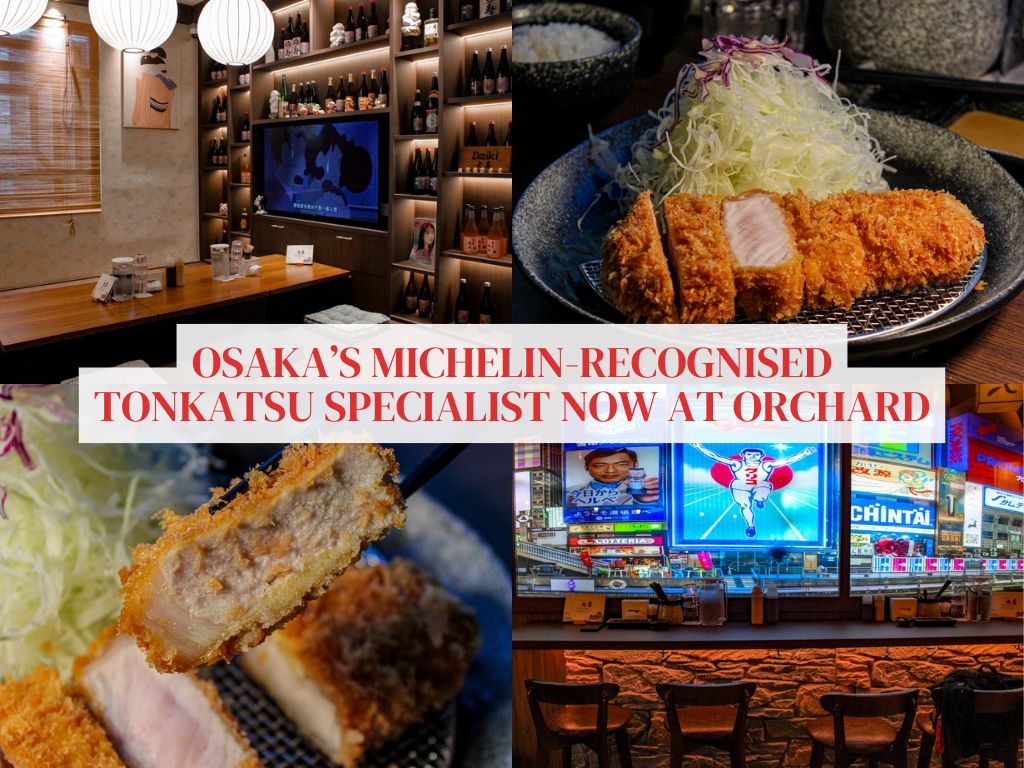
Each cutlet goes through a meticulous process, from breading to frying, resting, and slicing. It’s coated in fine Japanese panko, then cooked with exacting temperature control to achieve its signature crust: Light, airy, and shatteringly crisp — all without the grease.
The brand calls it the “perfect fry”.
We tried the classic rosu (pork loin, from S$29 for 150g) and classic hire (pork tenderloin, from S$29 for 120g) tonkatsu sets — the former richer and juicier with its strip of fat, and the latter leaner, and more delicate in texture.
It’s also recommended to start with the end-cap on the right — the juiciest, most tender cut — before working your way through the rest of the katsu.
You can immediately see the contrast of the crunchy exterior and tender, juicy centre with a blush of pink. It might catch you off guard, but this comes from precise temperature control — fully cooked, safe, and designed to retain as much moisture as possible.
Interestingly, the katsu is not seasoned. Instead, the focus is on drawing out the natural flavour of the pork itself — specifically the Hokkaido Yume no Daichi four-cross breed, a “super hybrid” pig that’s prized for its richness and tenderness.
The kitchen pays more mind to technique than seasoning to allow those qualities come through.
With each set, you’re given a small tray of condiments — Himalayan salt, a house mustard blend from Tonkatsu Daiki, and tonkatsu sauce — to tweak each bite to your liking.
It’s worth experimenting around with these, as each one brings out a slightly different side of the pork, from its natural sweetness, to its richer, fattier notes.
Each set also comes complete with Japanese rice, shredded cabbage, miso soup, and house pickles — with the rice and cabbage available for refills.
If you’re not just here for pork, there’s also a premium ebi katsu set ($32 for four pieces) — bouncy prawns wrapped in that same crisp coating.
There’s also the in-house Japanese curry sauce (S$5) that is well worth adding on. It’s deep, slightly sweet, and comforting, pairing especially really well with both the rice and the katsu.
Apart from the in-house Japanese curry sauce, there are other add-ons — such as the white fish katsu (S$6 per piece) and kaki (oyster) katsu (S$6 per piece).
For drinks, the menu leans into Japanese classics — from sake options such as the Enman Seishu (S$14) and Ume no Kotobuki (100ml, S$16), to familiar pours such as Asahi Super Dry draft (500ml, S$15) and Suntory highball (S$14). Sodas and tea, too, are available.
Tonkatsu Daiki’s does lean a little pricey for the everyday meal. If you’re after quality tonkatsu, one that is focused on technique and ingredients, this might just be worth it.
AloJapan.com