
The capital’s Kichijoji suburban district regularly appears in the rankings among the most desirable neighborhoods to live in the greater Tokyo area.
An Asahi Shimbun reporter strolled around the Kichijoji area, located in the western part of Tokyo, to check out its long history and attractions.
She was told that Inokashira Park, a green oasis in the busy commercial district in the middle of a vast residential sprawl, was well-liked by people during the Old Stone Age and the Jomon Pottery Culture Period (c. 14500 B.C.-1000 B.C.).
The reporter strolled around the park, which is administered by the metropolitan government, thinking about the area’s history along the way.
The entrance to the park is about a five-minute walk from the south exit of Kichijoji Station.
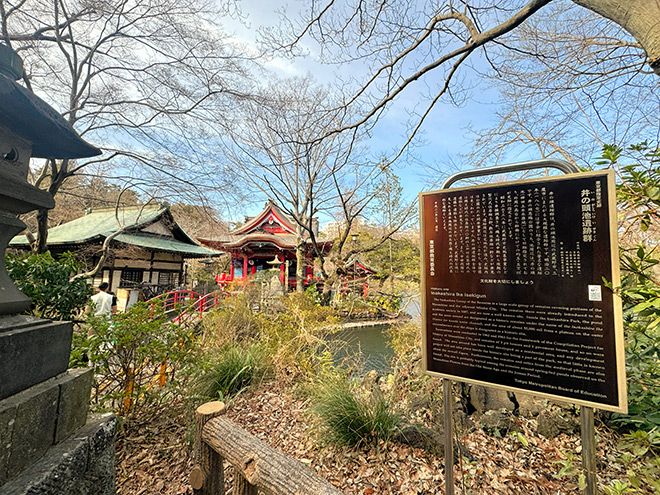
The grounds of the park contain a “historic site” complex designated by the metropolitan government, as it has produced the remains of more than 60 habitation sites from the Jomon Period as well as artifacts from the Paleolithic age.
The Inokashira Pond archeological site group, as the complex is called, is marked on a signboard by the side of Inokashira Benzaiten, a Buddhist temple with origins in the Heian Period (794-1185), which has been worshipped as a shrine to the goddess of water.
Hiroshi Shimohara, a curator with the Mitaka city government who is well-versed in the history of the Inokashira area, answered questions from the reporter as she walked around the park.
STABLE SUPPLY OF SPRING WATER A DRAW
Why has the Inokashira area been popular since olden times? the reporter asked.
“That’s because the source of spring water here is more stable than most of the others,” said Shimohara, 61.
People migrated over broad areas in search of food, without settling at a single site, during the Old Stone Age some 40,000 years ago.
The Inokashira area, where water was available, likely served as a base camp of sorts that people dropped by midway in their nomad lives.
The Inokashira Pond archaeological site complex has produced arrowheads and knives made of stone.
Asked to describe the Paleolithic people, Shimohara said: “They were modern humans with the same abilities that we have. If they were to live in contemporary age, it would take them only several months to master good command of an iPad.”
He added, laughing: “They could even begin going to Tully’s (Coffee) and Starbucks (Coffee) and start saying things like, ‘Well, espresso is sort of better at Tully’s.’”
A village was formed around Inokashira Pond during the Jomon Period that followed, he said, even though, unfortunately, no remnants of Jomon Period habitation sites have been preserved in a visible form.
“People of the mid-Jomon Period may have built a sustainable society, without using up resources, with no war over approximately 1,000 years,” Shimohara said.
‘POND OF 7 WELLS’
It is believed that Inokashira Pond’s water gushed out of seven springheads during the Edo Period (1603-1867).
The basin has the byname of “Nanai no Ike,” which means the “pond of seven wells,” and one of the bridges over the pond is called “Nanai-bashi,” or the “bridge of seven wells.”
The pond supplied a source of drinking water for residents of Edo, present-day Tokyo, via the Kandagawa river before the Tamagawa Josui canal was developed in the 17th century.
The area was therefore designated a “shogunal demesne” under direct administration of the Tokugawa Shogunate.
The springheads have since dried up, so groundwater is now being pumped up mechanically.
Some hypothesize, Shimohara said, that Inokashira Pond was created to serve as a sightseeing spot during the Edo Period, arguing that it is questionable that a pond of this immensity was formed through the natural workings of spring water.
Officials studied the source of water when the pond was drained temporarily to restore the water quality, but no conclusion has been reached, Shimohara said.
PLACE NAME SHOGUN’S BRAINCHILD?
Inokashira and its surrounding areas were previously a wilderness that went by the name of Mure-no.
Ancient documents contain records of several visits by Tokugawa Ieyasu (1542-1616), founder of the Edo Shogunate, and Tokugawa Iemitsu (1604-1651), Ieyasu’s grandson and third shogun, both of whom came here for falconry.
Tradition has it that Iemitsu named this area Inokashira, which means the “best of all wells.”
Close to Benzaiten temple stands a stone monument to the “old site of a sword cut by Tokugawa Iemitsu.”
It refers to folklore saying that Iemitsu used a sword to engrave a nearby Magnolia kobus tree with the three letters for “Inokashira.”
As the reporter walked north with her back to Benzaiten, she sensed a fragrance coming from an ume (Japanese apricot) orchard on her right.
Opposite to the ume grove is a monument to the Gotenyama Ruins, which is a component of the Inokashira Pond archaeological site group, and has produced the remains of the Jomon Period village.
The spot was named Gotenyama, or “palace mountain,” because it was home to a palace where Shogun Iemitsu stopped to rest when he came here for hawking.
That is enough proof that the site of today’s Inokashira Park was the spot of people’s choice not just during the Jomon Period but also in the Edo Period.
Inokashira Park also straddles the cities of Mitaka and Musashino. The reporter has never really known what parts of the park grounds are under the jurisdiction of which city.
Shimohara took her question and answered that the pond, its shores and the top of the uplands to the south are part of Mitaka, whereas the top of the tablelands to the north is administered by Musashino.
POPULAR HAUNT IN EDO PERIOD
A black torii, called the “black gate,” stands to the south of Benzaiten.
It marked the entrance to the main approach to Benzaiten, which was a famous tourist spot during the Edo Period.
A guidepost built in the mid-Edo Period is preserved near the black gate. Engraved on it are the names of donors including the Nakamura-za, a kabuki theater that was run at the time by a family of actors that continues to this day.
Also on the guidepost are the names of the Hizen-za and Satsuma-za playhouses of the “joruri” puppet theater. Benzaiten likely attracted devout faith from officials of the dramatic world.
The reporter felt happily excited as she walked around Inokashira Park and contemplated the inner thoughts of the people of various ages whose paths crossed this terrain.
CRADLE OF BELOVED TUNES
In front of Inokashira Pond is a black monument in the shape of an upright piano.
It is dedicated to “Chiisai Aki Mitsuketa” (Who found a little autumn?), a lyrical song, whose melody came to the mind of composer Yoshinao Nakada (1923-2000) while he was strolling by the pondside.
Sheet music with one of the verses of the song, in Nakada’s own handwriting, is carved on the monument, which the city government of Mitaka built on donations from citizens to commemorate the 90th anniversary of the composer’s birth.
Nakada is known for many other tunes of his composition, including “Natsu no Omoide” (Recollections of summer).
JR Mitaka Station uses “Medaka no Gakko” (A school for killifish), another work of Nakada, as a melody for signaling train departures out of respect for the composer, who moved, following World War II, to Mitaka, where he gave birth to a number of tunes that remain beloved to this day.
Perhaps Inokashira Park, a favorite of people across all ages, was the driver of Nakada’s creative urge behind his enormous oeuvre of masterpieces.
TIME-HONORED TEAHOUSE-TURNED-PIZZERIA
Outside Benzaiten is Isentei, a restaurant serving Neapolitan pizza, which succeeded a teahouse of the same name that had a history of more than two centuries.
Osamu Dazai (1909-1948), a major literary figure who lived in Mitaka, was a frequent visitor, officials said, to the Isentei teahouse, which was remodeled into the pizzeria and reopened in 2021.
Kentaro Tanaka, 41, a “pizzaiolo” (pizza maker) with Isentei, was seen stretching dough with his hands into pizzas, which he baked in an oven over a short period.
Pizza Margherita is the most popular dish among the restaurant’s customers, some of whom bring pet dogs along with them inside to dine.
Tanaka, a native of Kichijoji, said he has been visiting Inokashira Park since his early childhood days.
“I would dream of baking my own pizzas here someday,” he said.
AloJapan.com