
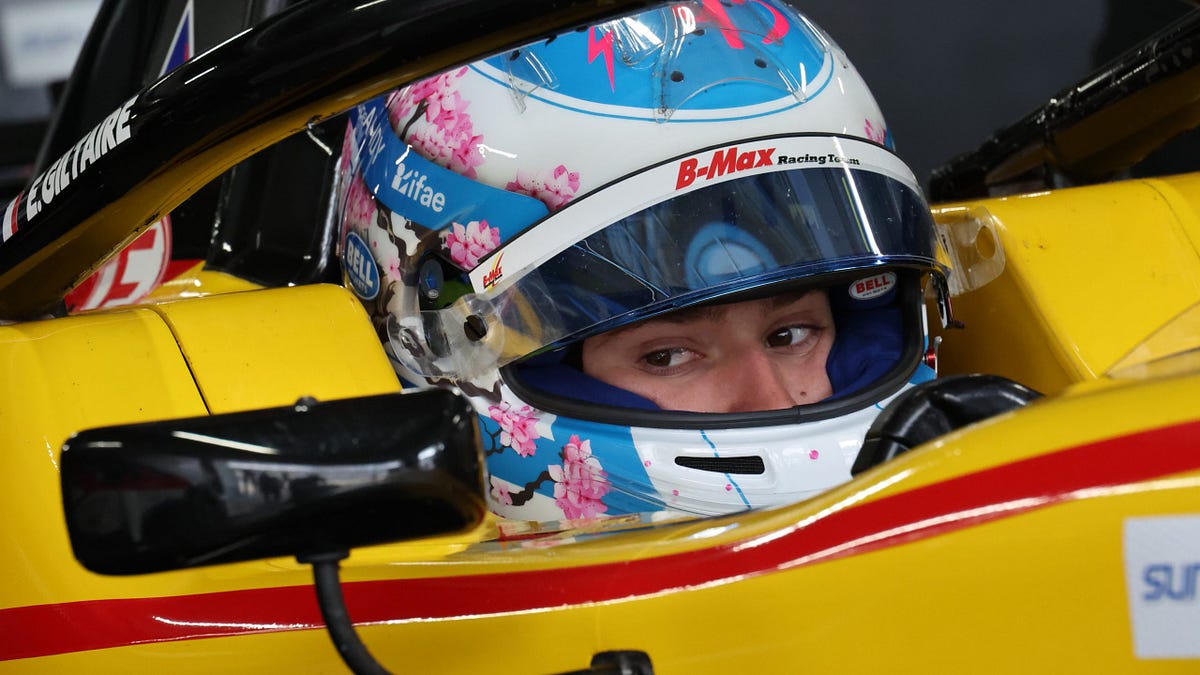

Honda-backed Japanese drivers moving to Europe and making a big impression is nothing new. But there haven’t been any concrete examples of the auto giant backing international talent and bringing them back to Japan — until now.
Evan Giltaire, 19, has just begun his first Super Formula Lights season with B-Max Racing, the Honda-affiliated team, supported by ART Grand Prix. Giltaire makes the switch after two years in Formula Regional European Championship, where he finished fifth overall in his latter season, as well as a title-winning Formula Regional Middle East season, accolades that marked him out as a talent worth watching.
Normally, such results would have resulted in a step up the ladder to FIA Formula 3, but in the absence of the funds to do so, Honda spotted an opportunity. Having already agreed with ART to place its Japanese protégé Taito Kato in FIA F3 for 2026, it was subsequently decided that Giltaire was worth investing in for a switch Japan, creating an impromptu “exchange programme” between the two drivers.
Honda’s choice to support Giltaire is especially interesting as the marque has not historically looked beyond its own Honda Racing School as candidates for its Super Formula and SUPER GT programmes. And its relationship with ART means there is likely to be a steady flow of promising candidates from the European ladder.
For Giltaire himself, the Super Formula Lights season started promisingly last month at Fuji Speedway with a third-place finish on debut, a victory and another podium to wrap up the weekend. An impressive qualifying performance, as he bagged a spot on the front row, and a daring move at the inside of Turn 1 were the keys to a win that the French driver will hope will provide the foundations for a title assault.

Japan Racing Insider sat down with Giltaire ahead of the first Fuji race to understand his reasons for making the move, the role that Honda and ART have played, his adjustments to Japanese racing, and what he hopes to make of the season.
SS: What made you come to Japan instead of progressing to FIA F3?
EG: The [required] budget for FIA F3 was quite massive after FRECA. For myself and my sponsors it was too much to go to FIA F3. The budgets are getting even worse year by year, so it’s getting difficult for drivers like me that don’t have a lot of money to race. So I decided to go to Japan, because for sure it’s quite cheap, but also for the experience as a driver. I think Japan can develop a driver a lot, because there are a lot of tools of racing and a lot of good stuff that a driver can learn from it.
Maybe later I will go back to Europe with better stuff that I discovered in Japan. For sure the budget is way easier to find to go to Super Formula Lights than F3, but there is also the fact that racing in Japan is quite a nice experience for a driver to discover.
SS: Would you say your medium-term plan to stay in Japan, and try to step up to Super Formula, or to go back to Europe?
EG: For the moment I just focus on my season in Super Formula Lights. You don’t have to think about your future in March, which is a bit early, but for sure as a driver you always think about your future. There are some options, Super Formula, or going back to Europe. We’ll see what happens, but first of all we need to focus on Super Formula Lights in 2026 and do our best to bring the title home. If I’m able to go to Super Formula or go back to Europe with the budget, we don’t know yet.
What is the best option is will be key [to the decision]. If the best option for my future is to stay 10 years in Japan, I will stay 10 years in Japan. And if the opportunity comes back to go back to Europe, and it’s better to approach F1 or bigger stuff, why not going back to Europe. I will take the best opportunity to be a racing driver.

SS: You first joined B-Max Racing for last year’s post-season Super Formula Lights. Were you surprised to be as immediately fast as you were?
EG: Difficult to say. I know that I had the potential to go fast for sure, but I didn’t expect to be as close as I was to the Japanese drivers, because we know as European drivers that it’s difficult to adapt to the Japanese world and Japanese culture. As a European guy I’ve seen a lot of drivers that struggle a lot to discover this racing culture I would say. But I was surprised to be that fast and it was a good surprise.
SS: The entry name for your car this year is ‘ART Grand Prix with B-Max’. Can you explain what the partnership between B-Max and ART entails?
EG: I’ve always been an ART driver since I started in, single-seaters. I was first of all French F4. I had a lot of help from the simulator during my French F4 with ART. And then I stepped up with them in FRECA for two years. I have a really good relationship with the boss Sébastien Philippe. He is helping me a lot for Japan because he has been a racing driver in Japan back in the 2000s. He has spent a lot of time with Honda and all the people in Japan. So he has helped a lot me to discover Japan and that’s where the ART and B-Max collaboration has been made by Sébastien Philippe.
SS: On social media you also mentioned that you have Honda’s support to race in Japan. Can you explain what kind of support Honda is offering?
EG: Honda has quite a good relationship with ART in France because French Honda is supporting the ART team. And there is also the fact that Taito Kato is racing with ART under the name of Honda. So I think all of this made a good relationship between ART and Honda. And at the end, I was a bit in trouble with the budget to go to FIA F3. So I had a lot of help from Honda and ART to come to Japan to switch a bit the categories to continue my progress in single-seaters. And at the end, Honda and ART did an amazing job to bring me here to B-Max to fight for this season.
SS: How important was Honda’s support to land the seat in the end?
EG: For sure it was quite important. They have been a big part of the negotiation and they are helping me a lot on the racing aspect, on the Japanese aspect. So I’m really happy to have Honda and HRC on my side.

SS: How are you finding communication with the team and the cultural differences of racing in Japan so far?
EG: It was my biggest worry, I would say. I was worried about the communication because the Japanese language is completely different to European languages. I knew that the Japanese people were so kind and also the racing part was perfect. I was just scared about the communication with my engineer, my mechanics and all the team. In the end they are doing a lot of efforts to speak as much English as possible.
On my side, I also try to discover the Japanese language and the Japanese culture. So both of those things make the relationship really nice. And at the end I was scared about it before going to Japan, but after one day [of testing] only I was really comfortable with the team and everything so it went perfectly.
To be honest I was really scared about it the communication. Not the rest, but only the communication. I thought that it would be more harder than this to communicate with all the people. And at the end it was so easy to find my ways on the racing side and also on the lifestyle in Japan. So yeah, it went perfectly.
SS: How about your adaptation to the car itself?
EG: I think the pure learning phase is finished. Now we are just trying to improve the car as much day by day and session by session. Also I’m trying to improve my driving style, and for sure I still have many things to improve on my side. But the discovery phase I think is over and now we are just trying to find the best stuff on each point to be the fastest on track. We have run plans before each session and the goal is to improve the car and improve my driving to be the fastest at the end.

SS: What would you say your current strong point is?
EG: I would say team relationship between driver and team. That makes things easier for a European driver. If the European driver is not making efforts to come to the Japanese people and to work with them, or at the same time also the Japanese people don’t come that much to the European guy, if that happens I think you cannot improve yourself or the car. If everybody is staying on their side you cannot improve. You have to work with the team with everybody and to work as best as possible.
AloJapan.com