
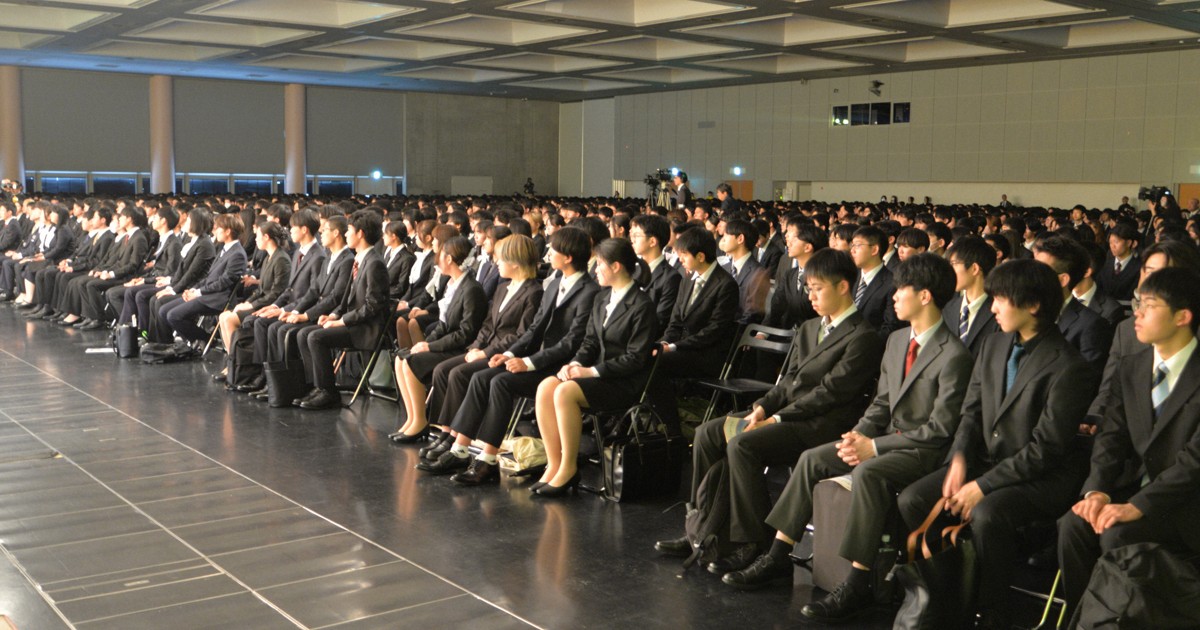
New students attending Kyoto University’s entrance ceremony are seen in Kyoto’s Sakyo Ward on April 7, 2026. (Mainichi/Hiroyuki Ota)
KYOTO — Kyoto University held its entrance ceremony on April 7, welcoming 2,942 new students across 10 faculties. President Nagahiro Minato emphasized the importance of writing skills and international experiences, and offered a word of encouragement: “I hope you will experience as many encounters as possible, discover new aspects of yourselves, and find your goals in life.”
At the ceremony held at the Miyako Messe convention center in Kyoto’s Sakyo Ward, Minato pointed out concerns that the spread of generative AI and social media could impoverish human vocabulary and expression, and emphasized the importance of writing in one’s own words. He also referred to George Orwell’s dystopian novel “1984,” which depicts an authoritarian ruler seeking to diminish people’s capacity for thought by simplifying language and eradicating freedom of thought and expression. “Writing is a process of expressing one’s feelings and thoughts, and for that, careful thinking is essential,” he said.
Recalling his own experience studying in the United States after graduation, where he competed and collaborated with researchers from around the world, Minato encouraged students to travel abroad while at university.
Alumnus Yasuhiro Tsujimoto, who graduated from the Faculty of Agriculture in 2005 and earned his Ph.D. at the Graduate School of Agriculture in 2010 and now serves a project leader in the Crop, Livestock and Environment Division at the Japan International Research Center for Agricultural Sciences, delivered a congratulatory address.
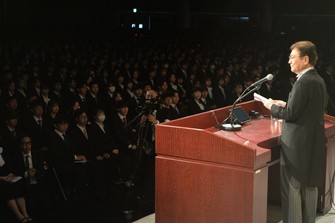
Kyoto University President Nagahiro Minato addresses new students at the entrance ceremony in Kyoto’s Sakyo Ward on April 7, 2026. (Mainichi/Hiroyuki Ota)
“The greatest value of university life lies in challenging oneself in unknown worlds and confronting questions with no answers as well as engaging with different perspectives,” he said, urging students to attend any lecture that sparks their curiosity even if it is outside their own faculty or department.
“At Kyoto University, there are many exceptional professors who have won Nobel Prizes, as well as unique professors who are doing things that you may not fully understand but that seem fun and exciting. They really broaden your perspective. And thankfully, no matter how many classes you take, the tuition doesn’t change,” he added.
Tsujimoto also described spending 3 1/2 years in rural Madagascar during graduate school, in an area without electricity, gas or cellphone signals. Before his departure, his mentor at the time handed him a worn-out spring scale and ruler, telling him that his research mission was simply to “come back alive.” Looking back, he described this as “a true reflection of Kyoto University’s proud tradition of academic freedom and the spirit of independent, self-directed learning.”
Upon arrival in Madagascar, he asked a monastery to house him in an attic, and he recounted learning the local language from scratch. Enduring bouts of diarrhea and malaria, he developed the resilience needed to survive under harsh conditions.
“Stepping outside the environment you grew up in lets you reexamine your own strengths and weaknesses. Living as a minority cultivates tolerance toward others who are different,” he said. “Above all, experiences in unknown worlds gained during your student years, when your sensitivity is at its peak, become a powerful driving force that drives you forward.”
(Japanese original by Hiroyuki Ota, Kyoto Bureau)
AloJapan.com