
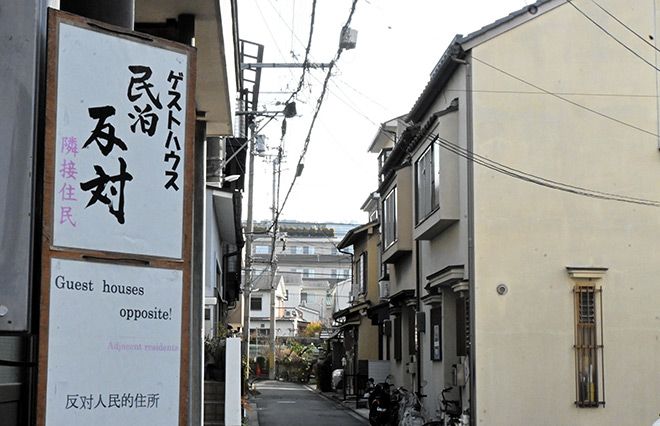
KYOTO—Despite billing itself as the city with the strictest rules on short-term rental lodgings in the nation, the ancient capital is considering tacking on additional regulations to combat overtourism.
Under the “minpaku” system under Japanese law, owners renting out private homes and rooms can offer lodging up to 180 days a year.
But under Kyoto regulations, private lodging in zones designated exclusively for residences can operate only from Jan. 15 to March 16 until noon.
In addition, managers of minpaku facilities are required to be based within a 10-minute access to be able to quickly respond to problems.
The municipal government established these restrictions in 2018 when the central government enacted the Private Lodging Business Law, which introduced the 180-day rule.
Kyoto, one of the most popular destinations for international tourists in Japan, is set to incorporate additional rules through ordinance revision in fiscal 2026. Officials have set their sights on possibly establishing zones where short-term rentals are prohibited.
Some city assembly members are calling for expanding areas where operating private lodging is restricted or further reducing the number of business days for minpaku facilities.
Others have floated the idea that private accommodations whose managers are slow to respond to complaints should be banned throughout the city.
Driving the move toward stricter rules is the growing numbers of grievances from residents.
As of the end of 2025, there were more than 1,000 units operating under the Private Lodging Business Law in Kyoto, compared with 490 in 2018, due to a sharp rebound in tourist numbers as the COVID-19 pandemic wound down.
But the 2025 figure for private lodging is believed to be undercounted because some units, placed in the same category as guest houses, dormitories and capsule hotels under the Hotel Business Law, effectively serve as minpaku rooms.
City authorities have difficulty keeping track of how many are actually offered as vacation rentals among the accommodations classified in this category.
It is becoming clear, however, that the more low-cost accommodations become available, the more complaints pour into the Kyoto municipal government.
There were 264 grievances filed from April to December in fiscal 2025, surpassing 244 for all of fiscal 2024. The figure for fiscal 2023 was 199.
Most of the complaints concerned noise made by guests talking and partying late into the night and checking in and out during late night and early morning hours. Improper trash disposal despite instructions on detailed local rules on display in multiple languages has also been a major source of complaints.
Kyoto Mayor Koji Matsui acknowledged residents’ frustration in that the existing ordinance is not keeping pace with the problems that are arising.
“Residents are concerned that their communities could be falling apart,” he said at a news conference in January. “We have strengthened the oversight of operators, but that is not enough. We need to go further.”
Matsui said the city would not rule out the possibility that some districts would be effectively banned from offering private lodging services, with a rule capping the maximum number of business days at zero.
A municipal official voiced concern over applying tougher rules on private lodging alone.
The measures could end up sending tourists to similar facilities operating under the Hotel Business Law, the official noted. The facilities, which are required to have a license to operate, can basically be open year-round in the designated zones.
As a possible solution, the city government is considering applying the regulation to private lodging under the Private Lodging Business Law and minpaku-like facilities under the Hotel Business Law in a designated zone in an integrated manner.
The quasi-industrial district, such as one where potters craft Kyoto’s traditional porcelain and earthenware at their studios that also double as their homes, is a candidate for this type of management.
Currently, both private lodgings and low-cost accommodations are allowed to operate in a quasi-industrial district, up to 180 days for the former and no limit for the latter.
Experts believe that imposing tougher regulations only on private lodging in this district would be unable to achieve the desired outcome if budget facilities were left intact.
Furthermore, residents in the quasi-industrial district already are calling for more regulations, saying their neighborhood, as it stands, is very similar to the residential zone classification.
City officials said that a likely solution would be to reclassify the quasi-industrial area as an area exclusively for residences under the City Planning Law to regulate minpaku and minpaku-like facilities together.
While Matsui noted the need for toughened rules, he added that the action is aimed at preventing further disruptions to the lives of local residents; not regulating every aspect of private lodging services.
“I am hoping that minpaku facilities will be operated in a way acceptable to nearby residents,” he said.
AloJapan.com