
I know Japan is widely known for its idiosyncratic food and drink culture, but I never thought I’d find a city, anywhere in the world, so loudly passionate about orange juice.
Ehime, one of the four regions on the southwestern island of Shikoku, is one of Japan’s smaller and lesser-known prefectures.
And as with all prefectures, it has its own official mascot: Mican, a cutesy blend of a mandarin orange and a dog, with a bright orange body and two green leaves on its head.
READ MORE: ‘This could be the best holiday for Aussies right now
 Ehime is considered the “Citrus Kingdom” of Japan. (Getty Images/iStockphoto)
This is my ninth time in Japan, so I’ve seen mascots for just about everything, from a moustachioed milk carton to a crying bird who can’t fly because his head is a brick.
I’ve even been to festivals where sumos compete to make babies cry (for good health and to chase away evil spirits). Yet I’ve never seen such a deep reverence for OJ and all types of citrus juices.
READ MORE: ‘Irritating’ plane etiquette mistakes passengers need to stop making

The best places to see cherry blossoms outside of Japan
Mikan is special because it symbolises Japan’s most beloved citrus fruit, which grows in abundance across Ehime due to the prefecture’s mild climate, sunny disposition, salty sea air, and sloping coastal terrain.
Locals say that Mikan in Ehime is unique because these citrus fruits grow under “three suns”. That is, direct sunlight from the sky, sun reflected off the Seto Inland Sea, and sun reflected off the mountains.
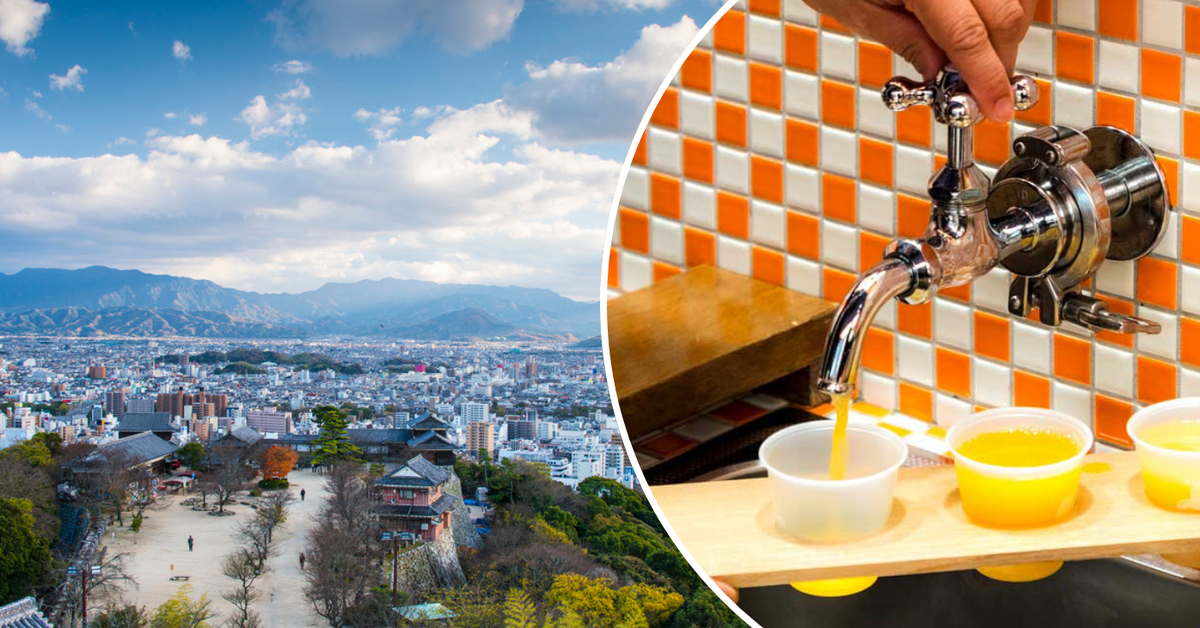
 This was my first time visiting Matsuyama. (Getty)The Citrus Kingdom of Japan
This combination of sun exposure and perfect drainage has made Ehime the “Citrus Kingdom” of Japan.
It’s such a source of pride that its biggest city, Matsuyama, hosts numerous “orange juice bars,” some packed with over 40 different nuances of citrus, from the high-end, jelly-like Beni Madonna to the rich, fragrant Setoka, which blends several varieties.
Before I’m told any of this, I stop and watch – half amused, half confused – as a long queue of locals files into Ehime no Shokutaku 1970 in the L-shaped Dogo Haikara-dori arcade, a covered shopping street leading up to the oldest onsen in Japan, Dogo Onsen.
 Matsuyama hosts numerous “orange juice bars”. (Supplied)
Inside are dozens of taps, each signposted with a different variety of Mikan with clear indicators for sweetness, acidity and bitterness. The concept is simple. You take a brewery-like tasting paddle around to the various self-serve taps and choose as many types of orange juice as you’d like to try.
My three-slot paddle is filled with Blood Orange, Beni Madonna and Setoka before I sit down for a self-guided taste test. The blood orange juice is sweet with low acids, but I’m familiar with the taste as I knock the pleasant juice back. Less familiar is the Beni Madonna, which, true to its description, has this gorgeous jelly texture that slips down with the rich, bright orange flavour.
It reminds me of a drink that I used to find vending machines all over Tokyo: Cola Up, which was cola with jelly in it. I haven’t been able to find it since 2010.
 My paddle of juices to try. (Supplied/Chris Singh)
Setoka is to mandarin oranges what otoro (fatty tuna belly) is to sushi. It’s exceedingly rich and juicy, making it one of the most highly prized and expensive varieties to try.
The aftertaste is very pleasant, leaving a long, lingering richness. And given it’s a relatively new variety, made from blending three types of citrus, Ehime still accounts for around 80 per cent of Setoka production in Japan.
I’m told the taps are dynamic and there are new varieties being cultivated around Ehime all the time with increasingly sophisticated breeding techniques.
The Beni Madonna, for example, has been blended with the fleshy Kanpei to make the Beni Princess – a variety that’s only now emerging in popularity.
 There are new varieties of oranges being cultivated around Ehime all the time. (Supplied/Chris Singh)Is this the world’s first towel & orange juice store?
After searching the covered arcade for some interesting gifts, I stumble upon Iori Honten, a premium flagship outlet for Imabari towels.
Japan’s top towel brand is another unique export from Ehime, with shelves of gorgeously designed towels fetching a high price for their exceptional softness and absorbency.
It’s a highly polished collection of towels for all types of occasions – even handkerchiefs – and there’s a printing press at the back for custom towels.
I smile when I look towards the very back of the store, though. Behind the printing press is a small sit-down bar with even more taps for orange juice.
This may be the world’s only towel-and-orange-juice store. You can even rent towels to take up to the 3,000-year-old Dogen Onsen or its newer Annex Asuka-no-Yu building – each at opposite ends of the arcade.
If you’re feeling some post-soak dehydration, an orange juice tasting will set you straight after you return your towel.
 Inside the town store is a small sit-down bar with even more taps for orange juice. (Supplied)Citrus as a necessity
Ehime is primarily known for its nature, with cyclists from around the world scrambling to bike the Shimanami Kaidō, an 80km expressway that hops across six islands between Imabari, where the eponymous towel factory is, and Onomichi in Hiroshima Prefecture.
The journey mostly takes outdoor enthusiasts across the world’s first triple suspension bridge, the Kurushima Kaikyo Bridge, which is like a greyish version of the Golden Gate Bridge in San Francisco.
And so it makes sense that such a refreshing drink is in high demand. Locals grow up with soft adventure and the great outdoors.
Ehime also has a portion of the famous Shikoku Henro Buddhist pilgrimage, which is a 1200km loop around Shikoku, visiting 88 temples along the way.
After a few days exploring Matsuyama, drinking orange juice and eating seabream over rice – another local delicacy – I rush to the airport to fly to Tokyo.
I shouldn’t be surprised, but I’m still amused to see a big self-serve orange juice tap just opposite the check-in counters.
As visitors to this unique country are used to saying multiple times per day: only in Japan.
The writer travelled as a guest of Visit Ehime.

All the places we saw vending machines in Japan
AloJapan.com